
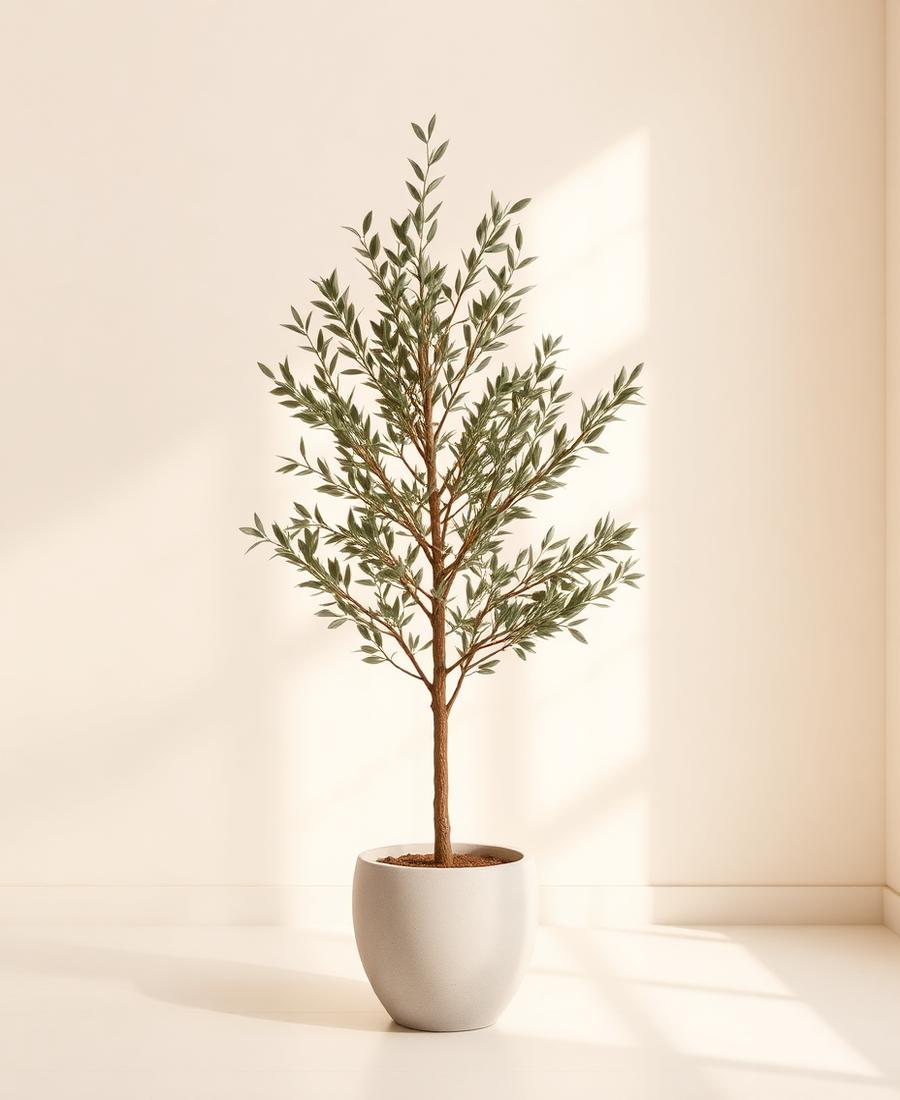

Artificial Olive Tree — 5.25 to 7 ft, Natural Wood Trunk
5.25 ft – 7 ft
From $249 CAD — request a quote
Questions before you order? Email support@eververda.com
A faux tree for a living room has to be tall enough to matter and narrow enough to live with. This page filters the range down to the heights that actually work in a domestic room, roughly five to eight feet, across olive, ficus and fiddle leaf, areca and fan palm, maple, bamboo and dracaena.
Showing 24 of 131 products
5.25 ft – 7 ft
From $249 CAD — request a quote


5 ft – 7 ft (60–84 in)
From $319 CAD — request a quote

52 in (about 132 cm)
From $739 CAD — request a quote

130 cm – 150 cm (4.3 ft – 5 ft)
From $139 CAD — request a quote

6.5 ft
From $999 CAD — request a quote

From $459 CAD — request a quote

24 in
From $349 CAD — request a quote

35 in (about 89 cm)
From $419 CAD — request a quote

5.2 ft
From $419 CAD — request a quote


5 ft (1524 mm)
From $439 CAD — request a quote

4 ft
From $419 CAD — request a quote

60 in
From $289 CAD — request a quote


5 ft
From $319 CAD — request a quote

5.2 ft (63 in)
From $419 CAD — request a quote

6 ft
From $409 CAD — request a quote

6 ft, single size
From $529 CAD — request a quote


5 ft – 7 ft (152–213 cm)
From $509 CAD — request a quote

120 cm – 210 cm (4–7 ft)
From $339 CAD — request a quote

4–7 ft
From $229 CAD — request a quote
A faux tree for a living room has to be tall enough to matter and narrow enough to live with. This page filters the range down to the heights that actually work in a domestic room, roughly five to eight feet, across olive, ficus and fiddle leaf, areca and fan palm, maple, bamboo and dracaena.
With a standard eight-foot Canadian ceiling, a six to seven foot tree is right for a corner and a five to six foot tree is right beside a sofa or behind a chair. Leave roughly a foot of clear air between the top of the canopy and the ceiling, or the tree looks wedged in rather than placed. Then measure the spread as well as the height: an olive or a fan palm is nearly as wide as it is tall, and a canopy that crosses a walkway gets knocked every day for a decade. Where a listing offers several heights the photographed size is not always the smallest, so read the option before ordering. There is more on this in How to Choose the Right Size Artificial Tree.
Olive for a neutral scheme, because the grey-green adds height without adding colour. Fiddle leaf or ficus where you want broad glossy leaves and one strong form. Areca or fan palm where the room is bright and the ceiling is high enough to carry the arch of the fronds. Bamboo or dracaena for a narrow gap beside a window, since both grow upward rather than outward. Flowering trees are better kept for a hallway or an event than a room you sit in daily. For the taller upright shapes, see artificial trees for a room corner.
Usually not, and that is worth knowing before it arrives. Most trees here come in a plain black plastic nursery pot, which is the standard trade finish and is meant to be set inside a planter you choose. Plan for that planter as part of the cost and the look. The trees that do include a pot say so in the title or the variant options, and they are collected in Potted Artificial Trees with Planters.
Yes, any indoor tree collects dust over time, and it shows more on a piece you sit near daily than one tucked in a hallway. A soft cloth or feather duster on broad leaves like fiddle leaf or ficus, and compressed air or a light shake for finer foliage like palm fronds or bamboo, handles most build-up in a few minutes every few weeks. Avoid glass cleaners and heavy soaking, particularly on real-touch leaves and any fabric-wrapped trunk.
Sustained direct sun fades any dyed foliage over months and years, and a south- or west-facing living room window is often the brightest, most exposed spot in the house. A room that is bright but does not get hours of direct afternoon sun is fine for most of this range. If your spot gets strong all-day sun, rotating the tree occasionally evens out the fading, and sheer curtains between the window and the tree slow it further.
Most floor trees ship with the trunk built and the branches compressed flat for the box, so the main task is separating and bending the branches outward into a natural, open silhouette once it is unpacked. This takes a few minutes on a single-trunk piece and longer on a dense, multi-stem palm or bamboo. No tools are required. Our unboxing and shaping guide walks through the branch-shaping technique step by step.
A live olive will not survive a Canadian winter outdoors and needs bright, fairly direct light indoors that many living rooms do not get; a live fiddle leaf is notoriously fussy about draughts, watering and being moved once it settles. A faux version holds the exact silhouette and colour that drew you to the species, in whatever light and however far from a radiator the room actually has, without a watering schedule or a risk of losing the plant.
Yes, the height given is the finished, potted height as the tree will stand in the room, measured to the top of the foliage, unless a listing states trunk-only. That is the figure to check against your ceiling clearance and the one-foot gap worth leaving above the canopy, not the box dimensions. Natural branch variation means two units of the same nominal height can differ by an inch or two either way.