

Artificial Fiddle Leaf Fig Tree — 160 to 180 cm, Nested Grower Pot, Textured Trunk
160 cm – 180 cm (5.2–5.9 ft)
From $429 CAD — request a quote
Questions before you order? Email support@eververda.com
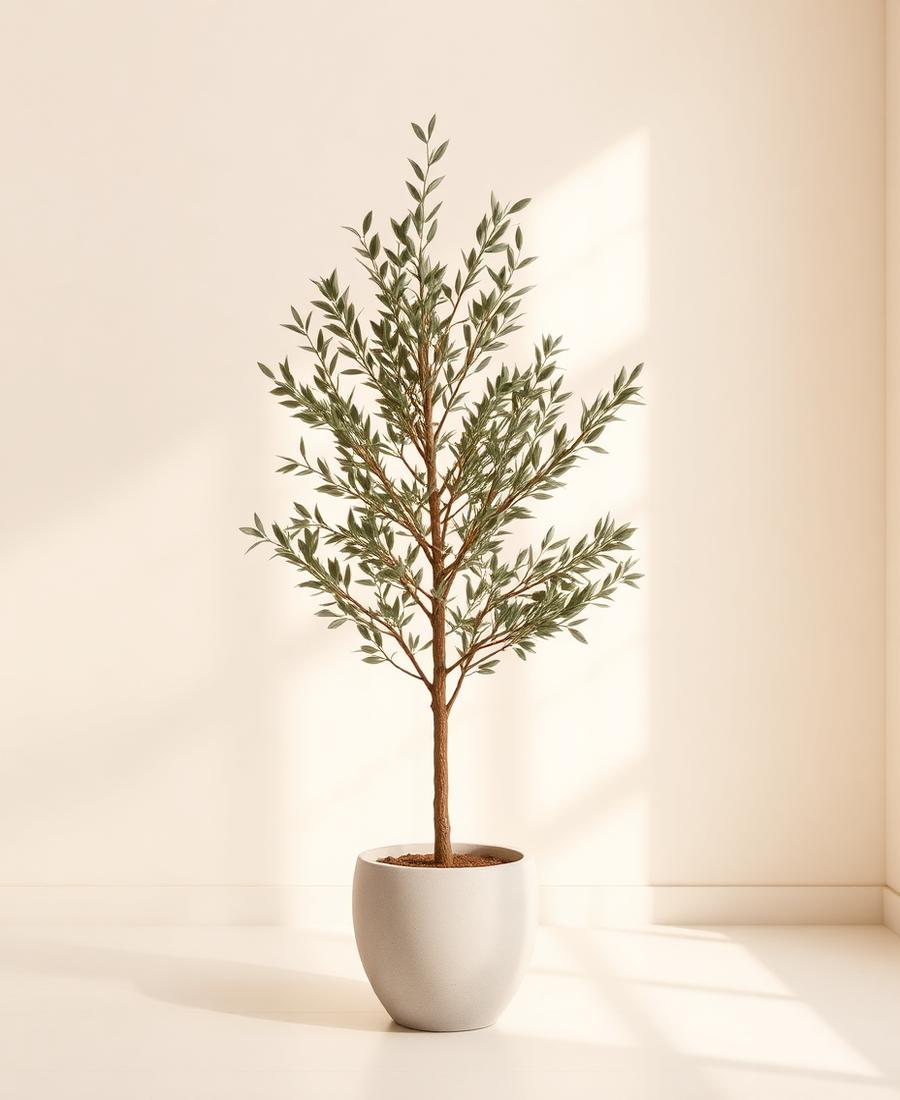
 Illustrative room scene
$319 CAD — Canadian delivery quoted
An artificial fiddle leaf fig tree in a white planter over a weighted cement base, offered in four heights from 4 ft to 7 ft (122-213 cm). The leaves are PVC over PE with moulded 3D veining and a matte finish, on a moulded, hand-painted trunk, built for indoor placement.
Color
Canadian Delivery by Request
This piece ships from a US warehouse. For delivery in Canada, send a request and we will confirm the delivered price and timing before you pay.
Request Canadian DeliveryA faux Ficus lyrata in a white planter, available in four heights from 4 ft to 7 ft. The leaves are PVC over PE with moulded 3D veining and a matte finish; the trunk is moulded composite, hand-painted in a grey-brown wood grain. It is a room-scale piece, at its best viewed from two or three metres — the distance most trees actually live at.
The fiddle leaf fig is the most-photographed houseplant of the last decade and one of the hardest to keep alive — it drops leaves over a draught, a move, or a watering can half a litre too full. A real ficus has large, matte, individually-angled leaves, and that is exactly what this version is built to reproduce.
Two details do the work. The leaves carry moulded vein channels rather than printed lines, with a matte rather than wet-look surface — the specific finish that avoids the plastic sheen people notice first on an artificial tree. And every branch has a steel wire running through it, so the silhouette is yours to set rather than the shape it was moulded in.
The planter is a weighted cement base inside a plain white pot, with a bag of decorative pebbles to cover the soil disc. That weighted base matters more than it sounds: a tree this tall needs real ballast to stand steady in daily life.
| Heights available | 4 ft (122 cm) · 5 ft (152 cm) · 6 ft (183 cm) · 7 ft (213 cm) |
|---|---|
| Foliage material | PVC over PE, moulded 3D veining, matte finish |
| Trunk | Moulded composite, hand-painted grey-brown wood-grain |
| Branch armature | Steel wire through every branch — shapeable and re-shapeable |
| Pot | White planter over a weighted cement base; decorative pebbles included |
| Leaf count | Not specified |
| Canopy width | Not specified |
| UV rating | Not specified — best suited to indoor use |
| Placement | Indoor |
| Assembly | Branches slot into pre-marked sockets in a few minutes; opening the canopy out by hand takes considerably longer |
| Height | Ceiling it suits | What it does in the room |
|---|---|---|
| 4 ft (122 cm) | Any | Corner filler beside furniture. Not a focal point. |
| 5 ft (152 cm) | 8 ft | The safe choice for a standard living room. |
| 6 ft (183 cm) | 8–9 ft | Reads as a real tree. The height most buyers should choose. |
| 7 ft (213 cm) | 9 ft and over | Statement scale. It looks crammed under an 8 ft ceiling. |
Leave roughly two feet of air between the top of the canopy and the ceiling. A tree that touches the ceiling reads as too big for the room, not as impressive.
| This tree | Live Ficus lyrata | |
|---|---|---|
| Light required | None | Bright indirect light, six hours or more. Most Canadian rooms cannot supply that from November to March. |
| Leaf drop | None | Drops leaves after a move, a draught, or one heavy watering. |
| Cost, year five | Nothing further | Frequently replaced once or twice |
| Lifespan indoors | Indefinite. Colour shifts under direct sun. | One to three years for most first-time owners |
| Maintenance | A damp cloth every two months | Watering, feeding, repotting, pest control, rotation |
The honest argument for a live one is that it changes. If watching a plant push out a new leaf is the point of owning it, buy the live one and accept the failure rate.
The tree ships compressed. The branches are folded in against the trunk so the box survives transit, and it will come out of that box looking flatter and thinner than the photographs. Opening it out by hand is not an optional finishing touch — it is the difference between a tree that reads as real and one that reads as a prop. Work from the lowest branches upward, pull each stem away from its neighbour, and give the leaves individual angles rather than a uniform fan.
On the 7 ft version, budget around half an hour to get the canopy right. It is tedious and it is the whole job. A tree fluffed for five minutes looks like a five-minute tree.
When your delivery arrives, check the pot and the trunk before unpacking further, and photograph any transit damage straight away — it makes a replacement quick to arrange.
From across a room, yes — convincingly so, provided you open the branches out properly. Up close the giveaway is almost never the leaves. It is the trunk, which is moulded rather than grown, and the soil, which is a moulded disc. Both are fixable: a handful of real bark chips or the pebbles included in the box cover the soil line, and placing the tree so the trunk is partly behind furniture removes the other tell. Choose a spot people admire from a few steps away rather than stand right beside.
For a standard 8 ft ceiling, the 5 ft or 6 ft is right — you want roughly two feet of air above the canopy or the tree reads as crammed. The 7 ft belongs in a room with 9 ft ceilings or higher, or a stairwell. The 4 ft is a corner filler and a side-table companion rather than a statement piece; if you are buying this to be the thing people notice, do not buy the 4 ft.
The usual failure point on any artificial tree is the joint where the leaf stem meets the branch. On this tree the stems are reinforced and wired rather than pushed into a friction socket, which is the construction that holds. The one habit that shortens any wired stem's life is repeatedly re-bending the same spot — shape it once, properly, then leave it alone.
Yes, and this is the strongest argument for an artificial ficus over a live one. A real fiddle leaf fig needs bright indirect light and will drop its lower leaves within weeks in a hallway. This one is indifferent to light. Bathrooms are fine too — the materials do not mind humidity. The only environment to avoid is direct sun through glass over long periods, for the same fading reason as outdoors.
A damp microfibre cloth, leaf by leaf, roughly every two months in a normal room and monthly in a kitchen where cooking grease settles. Do not use furniture polish or anything silicone-based — it puts back the exact glossy sheen the matte finish was designed to avoid. For the upper canopy, a hairdryer on cool at arm's length lifts dust without touching the leaves.
160 cm – 180 cm (5.2–5.9 ft)
From $429 CAD — request a quote

4 ft – 6 ft (122–183 cm)
From $319 CAD — request a quote


5.2 ft
From $389 CAD — request a quote

7 ft (210 cm)
From $459 CAD — request a quote

From across a room, yes — convincingly so, provided you open the branches out properly. Up close it does not, and the giveaway is almost never the leaves. It is the trunk, which is moulded rather than grown, and the soil, which is a moulded disc. Both are fixable: a handful of real bark chips or the pebbles included in the box cover the soil line, and placing the tree so the trunk is partly behind furniture removes the other tell. The buyers who are disappointed are usually the ones who put it somewhere people stand next to.
For a standard 8 ft ceiling, the 5 ft or 6 ft is right — you want roughly two feet of air above the canopy or the tree reads as crammed. The 7 ft belongs in a room with 9 ft ceilings or higher, or a stairwell. The 4 ft is a corner filler and a side-table companion rather than a statement piece; if you are buying this to be the thing people notice, do not buy the 4 ft.
Detaching leaves are the third most common complaint in this category, and the failure point is the joint where the leaf stem meets the branch. On this tree the stems are reinforced and wired rather than pushed into a friction socket, which is the construction that holds. We have not run this tree through a year of handling ourselves, so we will not promise you a number. What we will say is that repeatedly re-bending the same stem is what breaks it — shape it once, properly, then leave it alone.
Yes, and this is the strongest argument for an artificial ficus over a live one. A real fiddle leaf fig needs bright indirect light and will drop its lower leaves within weeks in a hallway. This one is indifferent to light. Bathrooms are fine too — the materials do not mind humidity. The only environment to avoid is direct sun through glass over long periods, for the same fading reason as outdoors.
A damp microfibre cloth, leaf by leaf, roughly every two months in a normal room and monthly in a kitchen where cooking grease settles. Do not use furniture polish or anything silicone-based — it puts back the exact glossy sheen the matte finish was designed to avoid, and it is the fastest way to make a good artificial tree look cheap. For the upper canopy, a hairdryer on cool at arm's length lifts dust without touching the leaves.
Delivery
Quoted to your Canadian address
Returns
Terms confirmed with your quote
Questions?
Email support@eververda.com