
Artificial Trees for High Ceilings, Stairwells and Double-Height Rooms
29 August 2026
A double-height room does not need a taller version of what works in a normal living room; it needs a different sizing rule. Newer Canadian builds increasingly put a two-storey great room, a vaulted living room or a stairwell void at the centre of the plan, and a tree sized for an 8 to 9 ft ceiling — the case our guide to choosing artificial tree size covers — disappears under 16 to 20 feet of open air. Short version: measure the visible wall height behind the tree, not the roof peak, aim for a canopy that fills roughly 55 to 65 percent of it, and check how the piece reads from the floor and from any landing above it before you buy. This covers the residential range, roughly up to 14 ft; for true 15 ft-plus commercial specification and installation, see our guide to giant artificial trees, which this article does not repeat.
Why does a normal-size tree disappear in a high-ceilinged room?
The eye judges a tree against the room, not against a tape measure. A 6 to 7 ft olive that reads as generous beside an 8 ft ceiling reads as a houseplant beside a 20 ft ceiling and a two-storey window wall, because the ratio between tree and room has collapsed. The same tree that fills a third of the wall behind it in a standard room fills a tenth of the wall in a great room, and a tenth reads as small no matter the actual height.
What's the sizing rule of thumb for a two-storey great room?
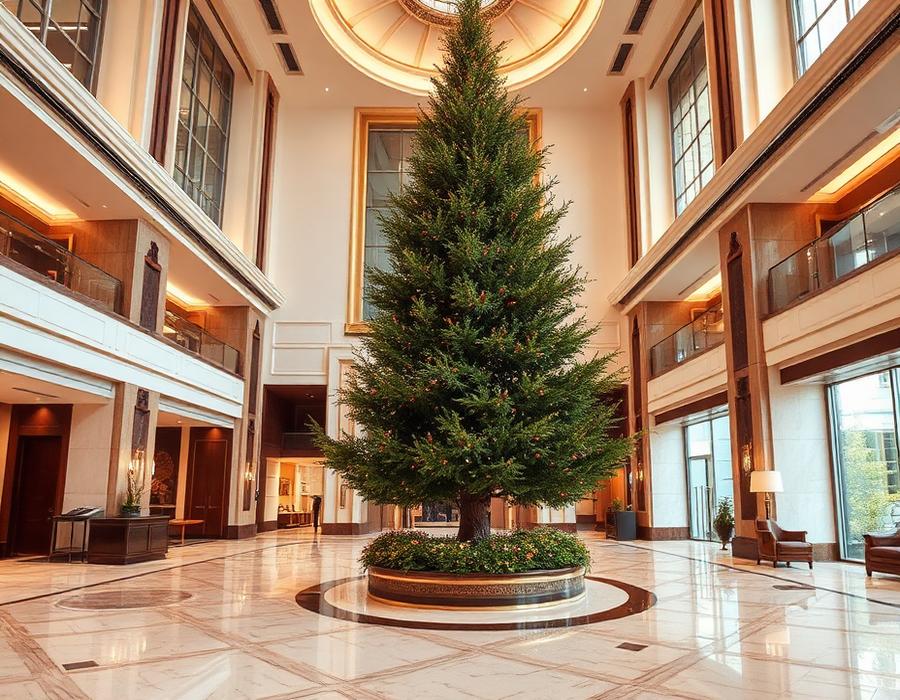
Measure the wall behind where the tree will stand up to the point the ceiling actually stops — the top of a knee wall, the underside of a mezzanine rail, or the eave line of a vault, not the ridge peak, which reads as architecture rather than backdrop. Aim for the canopy to reach roughly 55 to 65 percent of that figure. An 18 ft great room wall points to a 10 to 12 ft tree; a 20 to 22 ft stairwell void points to 12 to 14 ft. Below about 45 percent the tree reads as a floor accessory; above about 75 percent it starts competing with real architecture. One tall tree also does more for the proportion than two medium ones spaced apart — height reads as intent, width alone reads as clutter.
How do you judge the size from a landing or mezzanine, not just the floor?
Standard sizing advice assumes everyone views the tree from the same floor it stands on. In a double-height room, someone is often looking down into the canopy from a stair landing or a loft railing, which shows a different part of the tree than street-level product photography ever does. Many trees are built to look full from below and thin out toward the crown, since that section was never meant to be seen. From a landing, the top third of the canopy is on display — check it carries real foliage density, not just overall height, and favour a rounded, filled-out crown over a narrow, pointed top built for a floor-level silhouette. A stated leaf count is easier to judge this on than a size figure alone.
Does a tall tree solve the wasted space beside a staircase?
The vertical run beside a staircase, or the void a switchback stair leaves in an open plan, is usually the most wasted volume in a house — too narrow for furniture, too visible to leave empty, too tall for a normal plant to register. A single tall, narrow-footprint tree resolves that shape and reads at both the ground floor and the stairs above it. Two things matter here that a living-room placement doesn't: nothing in the canopy should be within reach of anyone on the stairs, and cleaning reach matters from the start, since a 12 to 13 ft canopy is past what a floor duster reaches. Our guide to cleaning artificial trees and plants covers method by material; here, the practical answer is usually cleaning from the landing with an extendable duster rather than a stepladder on the stairs.
Which species carry height well, and which look stretched?
Species with a naturally tall, narrow habit hold their proportions as they scale up; species built around a compact canopy on a short trunk start to look like a small tree on stilts once stretched.
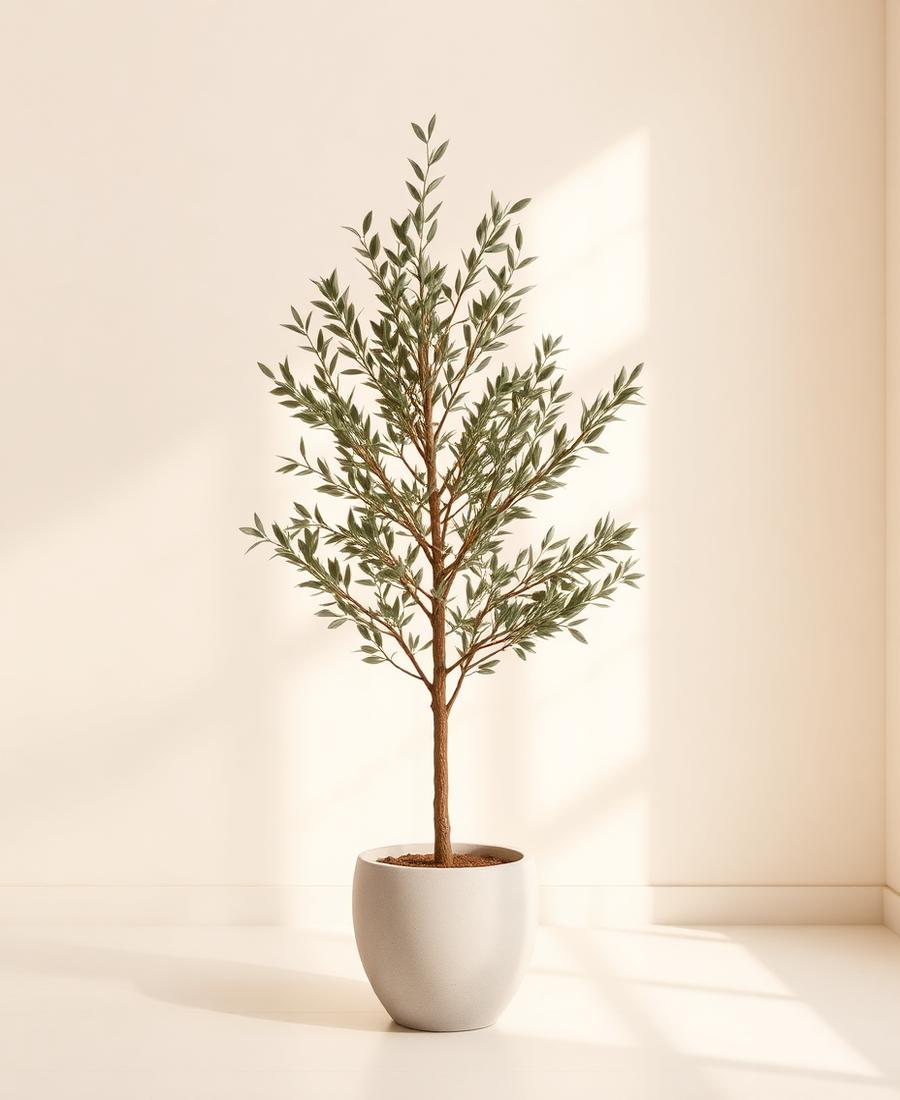
Carries height well. Palms are the most reliable choice, since height is their natural form: a golden cane palm, single or paired, 4.5 to 9 ft, runs $289 to $869 CAD, and the commercial line has a 9 ft palm from $827.99 CAD. Banyans and ficus stay substantial at height on a broad, layered canopy: a 7 ft banyan on a natural wood trunk is $739 CAD, and a commercial 9 ft willow-leaf ficus starts from $2,787.99 CAD. Cherry blossom carries height particularly well beside a stairwell, since the branching widens as it climbs; a 6 ft pink cherry blossom with a textured trunk is $879 CAD, and a commercial 10 to 15 ft cherry blossom starts from $2,787.99 CAD. Olive holds up at the top of its range — a 5.25 to 8 ft olive with silk foliage and counted leaves and fruit is $249 to $449 CAD — and extends further with a commercial 10 ft olive on a natural wood trunk from $2,648.99 CAD. Bamboo solves a narrower problem, a tight void where even a slim palm trunk is too wide: a 5.9 ft bamboo, 924 leaves, is $669 CAD, and a grouped set of two bamboo trees is $459 CAD for the pair.
Looks stretched. Fiddle leaf figs and other single-stem, lollipop-form trees are built around a compact top on a bare trunk, so stretching one to 10 or 12 ft usually means a long run of exposed trunk under a canopy that hasn't grown to match. A broad-canopy species carries real height better than a taller version of a naturally compact one.
What's the honest logistics of getting a 10 to 14 ft tree into a house?
Anything past about 7 to 8 ft typically won't travel fully assembled through a standard interior doorway, so expect the trunk, base and upper foliage as separate sections assembled on site — check a listing's stated assembly before buying if stairs or a tight hallway are on the route. Above roughly 10 ft, you're usually shopping the same commercial-grade catalogue that stocks lobby and atrium trees: crated freight, a longer lead time than a courier box, and, on the largest pieces, quote pricing instead of a fixed number because cost depends on height, trunk construction and freight to the address. A 13 ft banyan built for hotel use is quote-priced for that reason. It's not impractical for a home; it needs the same lead time and doorway planning as a large piece of furniture, not a last-minute order.
How do you stop a tall tree from tipping near stairs and kids?
A tall, narrow-footprint tree beside a stairwell carries more risk than the same tree on an open floor, because a knock that would just nudge it in open space can send it toward a stair edge. The core fix is the same as for any tall faux tree — a genuinely weighted or cement-filled base, ballast added if the pot didn't come weighted, and a trunk anchor to the wall for anything tall or narrow — covered fully in our guide to stopping an artificial tree from tipping over. Near a staircase, treat wall anchoring as the default rather than the last resort, and keep the base set back from the top of any stair run.
How do you light a tree seen from two floor levels?
An uplight at the base carves the trunk and lower canopy out of the room from the floor, but from a landing above, an uplit tree can read as a dark silhouette with a bright base and a dim crown — the opposite of where the eye is looking from up there. A modest light source higher up the trunk, aimed into the mid and upper canopy, balances both views; integrated string lighting woven through the upper foliage, where a listing offers it, does the same job with less visible hardware.
Residential vs. commercial-range trees for a double-height home
| Height | Typical source | Pricing | Delivery |
|---|---|---|---|
| Up to 8 ft | Standard residential line | Listed CAD price, e.g. olive from $249 CAD | Courier box, near-assembled |
| 8 to 10 ft | Top of residential / entry commercial | Listed CAD price, e.g. palm from $827.99 CAD | Sectional, assembled on site |
| 10 to 14 ft | Commercial catalogue | Listed from-price where available, quote above roughly $3,000 | Crated freight, longer lead time |
| 15 ft and up | Commercial specification | Quote-priced, project-based | Engineered anchoring, often lift-assisted — see our giant tree guide |
Frequently asked questions
How tall should an artificial tree be for a two-storey great room?
Measure the wall height behind the tree up to where the ceiling levels off or a mezzanine rail begins, not the roof peak, and aim for the canopy to fill roughly 55 to 65 percent of that figure. An 18 ft wall points to a 10 to 12 ft tree; a 20 to 22 ft stairwell void points to 12 to 14 ft.
Can I use a standard 7 to 8 ft artificial tree in a vaulted living room?
Only if the vaulted section is modest, roughly 10 to 12 ft to the ridge. Past that, a 7 to 8 ft tree reads proportionally small the same way an 8 ft ceiling makes it read generous. A tree at the top of the residential range, such as an 8 to 9 ft palm or olive, or a commercial-line piece, closes the gap.
Do tall artificial trees for double-height rooms ship fully assembled?
Rarely past about 7 to 8 ft. Expect the trunk, base and upper foliage as separate sections assembled on site, since a fully built 10 to 14 ft tree won't pass through a standard interior doorway. Confirm a listing's stated assembly and lead time before ordering if stairs or a narrow hallway are on the delivery route.
Is it safe to put a tall artificial tree next to a staircase with kids or pets around?
It can be, with the same fixes as any tall faux tree: a weighted or cement-filled base, added ballast if the pot didn't come weighted, and a trunk anchor to the wall, which matters more in a stairwell than open floor space, since a knock near a stair edge has less margin for error.
How do you clean an artificial tree that's 10 to 12 feet tall?
The same material rules apply as any artificial tree — PE tolerates a damp cloth or hose, silk is dry-clean only — but reach is the real constraint. Cleaning from an adjoining landing with an extendable duster usually reaches the upper canopy without a ladder on the stairs; above roughly 15 ft, cleaning starts to need the same lift access as installation.
Which species look best from a stairwell landing looking down into the canopy?
Species with a full, rounded crown read best from above, since that's the part of the tree a landing view actually shows. Palms, banyans and cherry blossom carry a filled-out top; a single-stem, lollipop-form tree such as a fiddle leaf fig, built around a compact canopy on a bare trunk, shows more bare stem than foliage from that angle.
Eververda prices are CAD and current as of 29 August 2026.