
Giant Artificial Trees Over 15 Feet: What They Cost and How to Specify One in Canada
29 August 2026
A giant artificial tree — anything from roughly 15 feet to 20 metres — is a different purchase from the 7 ft olive you put in a living room. It is closer to buying a piece of architectural millwork: it arrives in sections, it needs an engineered anchor, it may need a lift to install, and in most cases the price is quoted against your site rather than listed on a page. Here is the short version. Eververda carries 85 products in the 15-foot-plus commercial range: palms, cherry blossoms, banyans, olives, cedars, willows, ginkgos and giant commercial Christmas trees. Entry pricing for the smaller commercial pieces is published: a 13 ft date palm on a natural wood trunk built for hotel use starts from $2,368.99 CAD, a 20 ft curved-trunk palm from $2,787.99 CAD, and a custom-shape indoor banyan from $3,209.99 CAD. Above that, most giant trees are quote-priced, because the final number depends on height, trunk construction, foliage density, freight to your site and whether you need installation. Everything over $3,000 runs through our quote service, which is also where site measurements, drawings and fire documentation get handled. This article covers the rest: where these trees go, what changes structurally at this scale, what the specification process looks like, and what honest pricing means when almost nobody publishes numbers.
Where do giant artificial trees actually get installed?
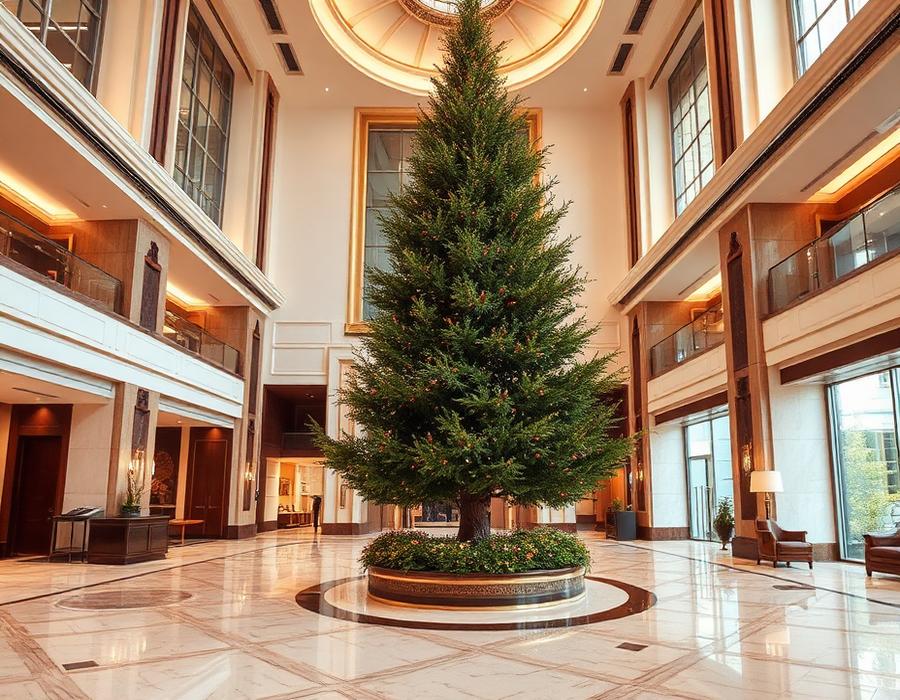
The buyers are almost never homeowners. Trees over 15 feet go into shopping centre atriums, hotel lobbies, casino floors, museum exhibits, waterparks, airport concourses, restaurant fit-outs with double-height ceilings, office headquarters and outdoor commercial landscapes in climates where a real palm will not survive. The logic is the same everywhere: the space has vertical volume that furniture cannot fill, live trees at that height need arborist-grade care and enormous planters of soil, and a fabricated tree holds its shape for years with cleaning as the only maintenance.
The scale ceiling is higher than most specifiers assume. Singapore's Gardens by the Bay operates 18 fabricated Supertrees rising up to 50 metres, the tallest about the height of a 16-storey building (site figures checked 29 August 2026). The Tree of Life at Disney's Animal Kingdom stands 145 feet tall and 165 feet wide with about 102,000 artificial leaves (checked 29 August 2026). Nobody is putting a 50-metre tree in a hotel lobby, but those projects are useful reference points: fabricated trees are an established structural discipline, not oversized decor. If your project is a lobby specifically, our hotel lobby guide covers that vertical in detail; for dining rooms, see specifying artificial trees for a restaurant fit-out.
What changes when a tree passes 15 feet?
Almost everything except the foliage chemistry. A 7 ft residential tree is a bendable wire-and-plastic assembly one person carries in a box. At 15 feet and beyond, the product category shifts:
Structure. Giant trees are built on welded steel armatures, typically clad in fiberglass or reclaimed natural wood trunk sections. Several trees in our range state this construction on the listing — the 15 ft UV-protected fiberglass olive and the 16 ft natural-trunk cherry blossom are both quote-priced examples. The armature is what lets a 6-metre canopy hold its geometry without sagging, and it is why these trees weigh hundreds of kilograms rather than twenty.
Shipping. Nothing at this scale ships assembled. Trunks arrive in flanged sections, branches ship separately in crates, and foliage heads are boxed by position. That means palletized LTL or container freight, a receiving dock or curbside liftgate, and a staging area near the final position. It also means the tree fits through normal doors on the way in — a genuine advantage over craning a live specimen through a roof opening.
Anchoring. A 7 ft tree stands in a weighted pot. A 20 ft tree does not. Indoor giants are typically bolted to a steel base plate that is either ballasted, anchored to the slab, or concealed inside a built planter; outdoor installations in Canada also have to account for wind and snow loading, which is a structural engineering question for your site, not a product spec. This is one of the things the quote process exists to resolve before anything ships.
Access. Assembly above roughly 12 feet needs scaffolding, a scissor lift or a boom lift. Before you fall in love with a tree, confirm the lift can reach the position: atrium floors have point-load limits, and some lobbies cannot take a machine at all, which pushes the install to scaffold and adds crew days.
Clearance math. Work from the finished floor, not the slab. Take your ceiling height, subtract any beams, lighting or sprinkler heads above the position — sprinkler clearance is a code matter your fire authority will care about — and leave visual breathing room above the canopy so the tree reads as placed rather than jammed. A 16 ft tree under an 18 ft ceiling is tight; under 22 ft it looks deliberate. Canopy spread matters as much as height: a banyan reads far wider than a palm of the same height, so check sightlines to signage and storefronts, not just the vertical number.
What do giant artificial trees cost in Canada?
Here is the honest answer almost no supplier publishes: most trees over 15 feet are quote-priced, ours included, because freight and configuration move the total too much for a flat list price to be truthful. What we can publish are the starting prices on the commercial pieces where configuration is standard enough to price openly. For context below the giant tier, an 8.2 ft olive tree in sculptural bonsai form is $1,807.99 CAD, and the 9 ft glass-fiber commercial coconut palm runs $2,787.99 to $6,291.99 CAD depending on configuration — that range is a fair proxy for what configuration alone does to a giant tree's price.
| Tree | Listed height | Pricing |
|---|---|---|
| Olive tree, bonsai form | 8.2 ft | $1,807.99 CAD |
| Commercial coconut palm, glass fiber | 9 ft | $2,787.99–$6,291.99 CAD |
| Date palm, natural wood trunk, hotel grade | 13 ft | from $2,368.99 CAD |
| Cherry blossom, wedding and event grade | 10–15 ft | from $2,787.99 CAD |
| Curved-trunk palm | 20 ft | from $2,787.99 CAD |
| Banyan, custom shape, indoor | custom | from $3,209.99 CAD |
| Fiberglass olive, UV-protected | 15 ft | quote-priced |
| Weeping willow, indoor | 16.5 ft | quote-priced |
| Giant commercial LED Christmas trees | varies | quote-priced |
The pattern to take from the table: entry to the giant category starts in the low $2,000s CAD, custom-shaped specimen trees such as the 16.5 ft ficus-leaf banyan or the 16.5 ft indoor weeping willow are quoted per project, and the top of the range — multi-storey banyans and 6-metre cherry blossoms — reaches five figures. A cherry blossom for a wedding or event space is one of the few giants with open pricing: the 10 to 15 ft wedding cherry blossom starts from $2,787.99 CAD. If a supplier hands you a single flat price for a 20 ft tree without asking about your site, treat that as a red flag rather than a convenience.
How do you specify a giant artificial tree?
The process is closer to ordering a fabricated staircase than buying furniture, and running it in order saves weeks:
1. Site measurements. Finished ceiling height at the position, canopy clearance to sprinklers and lighting, door and corridor dimensions on the delivery path, floor construction (slab on grade, suspended slab, raised floor) and any point-load limits. Photographs of the space help more than most buyers expect.
2. Drawings. For custom-shaped trees — banyans especially — the supplier produces or works from drawings covering overall height, canopy spread and diameter, trunk lean, and the anchor detail. This is where you confirm the tree against your interior elevations, and where a landlord or base-building engineer signs off on anchoring.
3. The quote. A real quote at this scale itemizes the tree, crating, freight to your city, and installation if you want it, and states the lead time. This is how our quote workflow runs for everything over $3,000: you send measurements and intent, we come back with configuration options and a landed number, and documentation requests get answered in writing before you commit.
4. Freight and receiving. Confirm who unloads. Palletized giant trees need a dock or a liftgate truck, plus clear interior transport to the staging area.
5. Install crew. Either the supplier's crew, your general contractor, or a display-install contractor working from the assembly drawings. Sectional trees go up trunk first, then branch framework, then foliage dressing — the dressing pass is where a giant tree ends up looking grown rather than assembled, so do not let it be rushed.
What about fire ratings at this scale?
At commercial scale, fire documentation stops being optional paperwork and becomes a condition of occupancy in many jurisdictions. The short version: in Canada the relevant flammability standard for decorative textiles and films is CAN/ULC-S109, applied through provincial fire codes; in the US it is NFPA 701. We do not claim any Eververda product is certified or compliant — what you should do is request test documentation for the specific product from every supplier, ours included, via the quote process, and put it in front of your local authority having jurisdiction (AHJ), because the AHJ makes the final call for your building. The full explanation of the standards, inherently flame-retardant versus coated foliage, and what documentation to ask for is in our guide to fire ratings for commercial artificial greenery.
Frequently asked questions
Do giant artificial trees arrive in one piece?
No. Trees over roughly 15 feet ship in sections — flanged trunk segments, separate branch crates and boxed foliage heads — on pallets or in containers. This is deliberate: sections pass through standard doors and corridors, and the tree is assembled at its final position, usually trunk first, then branches, then a foliage dressing pass.
Can a giant artificial tree stand outdoors through a Canadian winter?
Several trees in the 15-foot-plus range are built for outdoor use with UV-resistant foliage, including large date palms, coconut palms and cedars. Outdoor placement in Canada adds wind and snow loading to the anchoring question, which is a site-specific engineering matter — raise it in the quote process so the anchor detail is designed for your location rather than assumed.
What is the least expensive way to get a tree over 10 feet tall?
Published entry pricing in the commercial range starts at $2,368.99 CAD for a 13 ft date palm with a natural wood trunk, with 20 ft curved-trunk palms and 10 to 15 ft cherry blossoms from $2,787.99 CAD. Below the giant tier, an 8.2 ft sculptural olive at $1,807.99 CAD fills a double-height corner for less. Freight is extra at this scale, so compare landed quotes, not list prices.
Why are most trees over 15 feet quote-priced instead of listed?
Because the true cost moves with height, trunk construction, canopy spread, foliage density, crating, freight to your city and whether installation is included. A flat list price at this scale either hides those variables in padding or surprises you later. A quote against your site measurements is the honest version of the price.
Who installs a giant artificial tree?
Either the supplier's install crew, your general contractor, or a specialist display installer working from assembly drawings. Budget for lift access — scaffold, scissor lift or boom lift for work above about 12 feet — and confirm your floor can take the machine. The final foliage dressing pass matters most to how real the tree reads, so assign it time.
External installation facts checked 29 August 2026. Eververda prices are CAD and current as of 30 August 2026; quote-priced items are confirmed against your site through the quote process.