
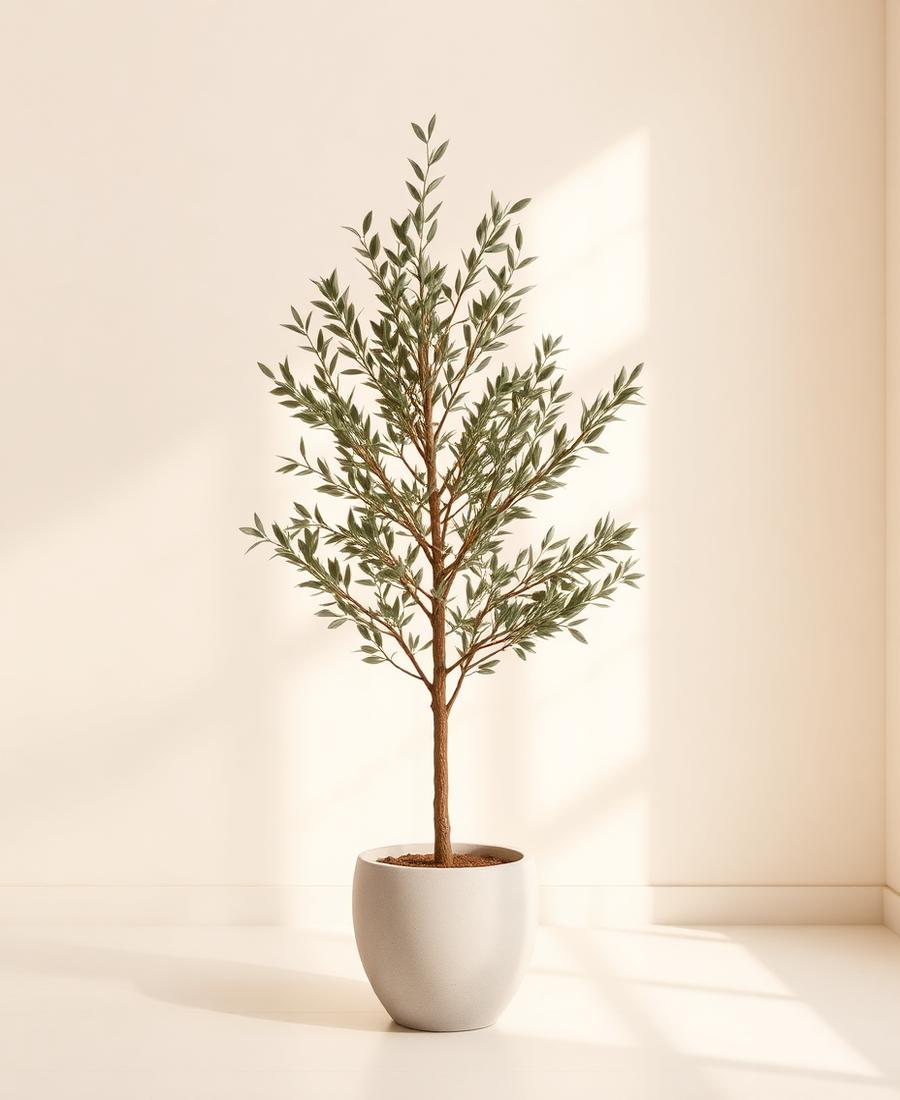

Artificial Fiddle Leaf Fig Tree — 5.2 ft, White Mossed Pot, Single Corner Size
5.2 ft
From $389 CAD — request a quote
Questions before you order? Email support@eververda.com
A corner is the one place in a room where a tree can be as wide as it likes, and it is usually the place that needs the most height. Nothing sits in front of it, so a tree that would overwhelm a sofa reads as architecture instead.
Showing 1 of 1 product
5.2 ft
From $389 CAD — request a quote
A corner is the one place in a room where a tree can be as wide as it likes, and it is usually the place that needs the most height. Nothing sits in front of it, so a tree that would overwhelm a sofa reads as architecture instead. This page filters to the floor trees that suit that job, roughly seven to nine feet, across olive, ficus and banyan, areca and date palm, dracaena, pine and maple.
Because a corner gives you two walls of vertical background and no furniture in front to set the scale. A five-foot tree beside a sofa looks substantial; the same tree alone in a corner looks stranded. The working rule is to add a foot or two to whatever you would choose for an open wall. In a room with a standard eight-foot ceiling that lands at seven to eight feet, leaving a hand's width of air above the canopy. In a stairwell, a landing or a double-height room, nine feet and over is comfortable, and those live in large artificial trees.
Broad ones. A corner rewards spread, so olive, banyan and ficus - wide open canopies carried on a visible trunk - do more there than a narrow upright will. Areca and date palm suit a high ceiling where the fronds can arch without brushing it. Dracaena and pine hold a tighter column where the corner is shallow or the traffic past it is heavy. Read the width in the size option as carefully as the height: several listings state height and canopy spread separately, and the spread is the number that decides whether the corner will actually take it. Start with artificial olive trees if the scheme is neutral.
Usually not. Most of these arrive in a plain black plastic nursery pot, the standard trade finish, meant to be dropped into a planter you choose. A corner tree is the piece most worth doing that for, because it is the one people see from across the room and the nursery pot is the detail that gives the whole thing away. Where a planter is included it is named in the title or the variant options, and those are collected in Potted Artificial Trees with Planters.
A corner tree gets seen from across the room, so dust shows more than it would tucked beside furniture — a soft brush, a microfibre duster on an extension pole, or a vacuum on low suction with a brush attachment handles it, worked top to bottom. A cool hairdryer on low airflow clears dust from clusters near the trunk a duster can't reach. Full method in our cleaning guide.
No. At seven to nine feet, these ship in sections — a trunk in two or more pieces and separate branch clusters that slot into marked points, then need fanning out by hand to remove creasing from transit. Because a corner tree is judged from across the room, take the time to space branches unevenly rather than symmetrically once it's assembled, since that reads as more natural. See our unboxing and shaping guide.
Unstabilised foliage can fade and turn brittle with sustained direct sun, which matters if the corner in question sits beside a bright south- or west-facing window rather than in the room's shadier reaches. UV-stabilised foliage resists that fade; the product page states whether it applies. Where it isn't mentioned, treat the tree as indoor-grade and, if the corner gets harsh afternoon sun, expect it to weather like any indoor material would in that light over time.
Yes — the height stated on the product page is what ships. Because a corner tree is chosen against a specific ceiling and a specific hand's-width of clearance, as this page describes, select the exact height option rather than assuming a pictured tree represents only one size; several products here list more than one height as a variant, and the wrong choice is the easiest mistake to make when ordering for a tight corner.
Measure canopy spread, not just height — a corner tree needs both walls' worth of clearance, and spread is listed separately from height on several products here, as noted above. Check whether a planter is included or needs sourcing separately. Confirm the trunk is visible rather than fully hidden by foliage if the corner is seen at an angle, since a bare or thin lower trunk looks unfinished from the side in a way it wouldn't head-on.