

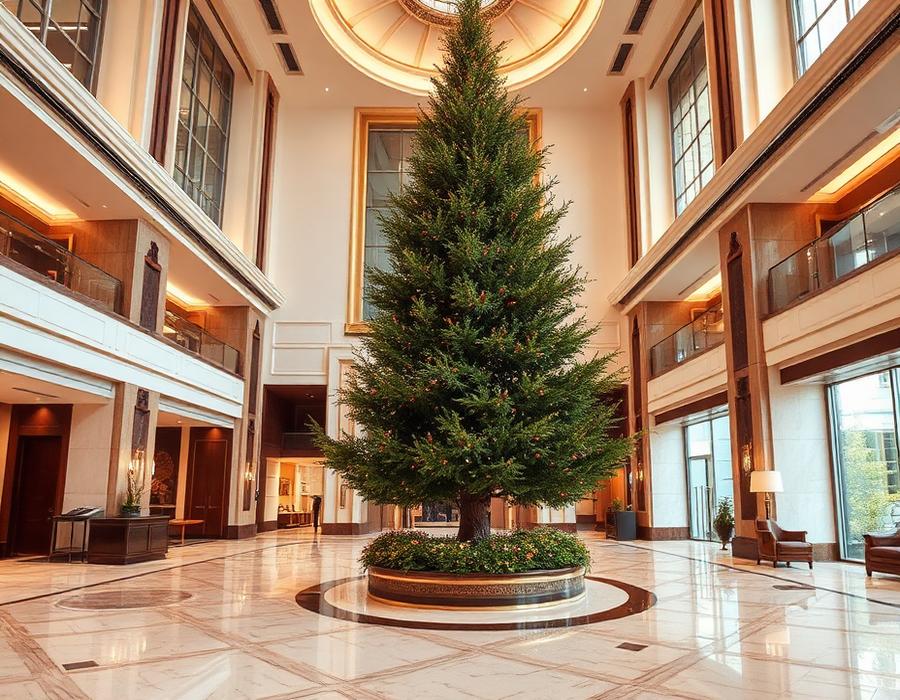

For Offices & Workspaces
Artificial plants for offices are low-maintenance greenery specified for workplaces — receptions, meeting rooms, breakout areas and desk clusters — where nobody's job description includes watering. Office interiors are the hardest environment in a building for living plants and the easiest case for faux ones: sealed windows, deep floor plates, weekend heating setbacks and no clear owner.
Showing 24 of 50 products


Artificial Areca Palm (Dypsis Lutescens) — 5.2 ft, UV-Resistant, Set of 2
5.2 ft (63 in)
US$305.99 USD


Artificial Pine Tree — 5 ft, Real-Touch Foliage, Set of 2 in Black Pot
5 ft (152 cm), each tree
US$451.99 USD


Artificial Cherry Blossom Tree — 5 to 6 ft, White or Pink Blossoms
150 cm (5 ft) – 180 cm (6 ft)
US$239.99 USD

Artificial Bamboo Tree — 5.9 ft, 924 Leaves in Black Nursery Pot
70.75 in; title rounds to 6 ft
US$487.99 USD


Artificial plants for offices are low-maintenance greenery specified for workplaces — receptions, meeting rooms, breakout areas and desk clusters — where nobody's job description includes watering. Office interiors are the hardest environment in a building for living plants and the easiest case for faux ones: sealed windows, deep floor plates, weekend heating setbacks and no clear owner.
Which artificial plants work in a windowless office?
All of them, which is the whole point — but some look more plausible than others under artificial light. Beneath fluorescent and LED panels, matte broad-leaf foliage reads best, because those sources are flat and directionless and any sheen turns into a hard highlight that gives a plant away instantly. Fiddle leaf fig, rubber plant, monstera and areca palm all work well. Very deep greens can look almost black in a poorly lit core, so lighter and variegated foliage usually holds up better in a basement or an internal meeting room.
Do plants actually improve an office?
The measurable air-quality claims come from living plants, and mostly from experiments at plant densities no real office would ever reach — so it is worth being straight about it: faux greenery does not clean air. What it does deliver is what most offices actually want from plants: broken sightlines, softened acoustics against hard surfaces, boundaries between zones without building walls, and a space that feels cared for. Plenty of workplaces sensibly do both — real planting where there is light and someone to look after it, faux everywhere else.
How to choose the right size
Standard office ceilings are 2.7 m, which caps a floor tree at about 7 ft before a room starts to feel crowded. Reception is the exception and can usually take more, so specify one 7 to 8 ft specimen there rather than a cluster of small pots. For screening between desk banks, height is set by sightline: 1.2 to 1.4 m screens a seated view, 1.7 m and above screens a standing one. Meeting rooms rarely need anything over 1.5 m. See Commercial Artificial Plants and Green Walls & Vertical Gardens.
Frequently asked questions
Do artificial plants for an office need to be fire-rated?
It depends on the building and your local requirements, which vary by province and occupancy type. In Canada, fire officials generally reference CAN/ULC-S109; in the US, NFPA 701 is the common benchmark, though testing and compliance rules differ by jurisdiction. If your office is in a building with specific fire code requirements for furnishings, ask for documentation from anyone you buy from, including us, and confirm the exact requirement with your building's authority having jurisdiction.
How much dusting do office plants need under constant HVAC airflow?
More than a home plant, since a sealed office runs air conditioning continuously and deep floor plates often have less natural settling of dust than a room with open windows. Matte broad-leaf species like fiddle leaf, rubber plant and monstera can be wiped down in one pass every few weeks; fine or dense foliage takes longer and shows dust sooner between cleans. Facilities staff can fold this into an existing cleaning round without special products or tools.
How much assembly is needed when an office plant arrives?
Most floor trees ship with the trunk built and the branches folded flat for the box, so the task on arrival is separating and shaping them into a natural silhouette, taking a few minutes per piece. Desk-height and screening plants are usually ready to place as-is. No tools are required either way, which matters for an office where nobody has a toolkit handy. Our unboxing and shaping guide covers the technique.
Does an office plant come with a base or planter, or can I use my own?
Some pieces ship with a stated planter or weighted base, particularly the taller screening and reception specimens where stability matters. Others arrive in a plain nursery pot meant to sit inside a container you choose. If you swap the base, especially on a tall screening piece near a walkway, make sure the replacement is heavy enough to keep it from tipping when brushed, since the base weight does that work, not the planter's finish.
Is the height listed the finished height once potted, so I can check it against a low ceiling?
Yes, the height stated is the finished, potted height as the piece will stand, measured to the top of the foliage, unless a listing says trunk-only. That is the number to check against a standard office ceiling or a screening sightline, not the box dimensions. Natural branch variation between units of the same nominal height can be an inch or two, so treat a tight clearance figure as a maximum rather than exact.