


Faux Plants for Entryways
An entryway is a hard place for a living plant and an easy one for a faux one. It is the coldest part of a Canadian house for four months of the year, the light is usually borrowed from another room, and nobody wants to water something on the way out the door.
Showing 24 of 91 products

Artificial Magnolia Tree — 5 to 7 ft, S-Curve Trunk, White Planter
5 ft – 7 ft (60–84 in)
US$232.99 USD


Artificial Areca Palm (Dypsis Lutescens) — 5.2 ft, UV-Resistant, Set of 2
5.2 ft (63 in)
US$305.99 USD


Artificial Fiddle Leaf Fig Tree — 6 ft, White Pot with Moss-Topped Soil
6 ft, single size
US$385.99 USD


Artificial Fiddle Leaf Fig Tree — 4 to 7 ft, Weighted Planter, 5-Minute Assembly
120 cm – 210 cm (4–7 ft)
US$247.99 USD


Artificial Fiddle Leaf Fig Tree — 5 to 7 ft, White Planter with Real Wood Trunk
5 ft – 7 ft (152–213 cm)
US$247.99 USD

Artificial Fiddle Leaf Fig Tree — 4 to 7 ft, 48 to 141 Leaves by Height
4 ft – 7 ft (122–213 cm)
US$269.99 USD


Artificial Pine Tree — 5 ft, Real-Touch Foliage, Set of 2 in Black Pot
5 ft (152 cm), each tree
US$451.99 USD
An entryway is a hard place for a living plant and an easy one for a faux one. It is the coldest part of a Canadian house for four months of the year, the light is usually borrowed from another room, and nobody wants to water something on the way out the door. This page collects the statement pieces that suit the job - welcome pines, olive and ficus floor trees, and the taller specimens that hold a hall or a landing.
How big should an entryway plant be?
Taller than you would think, and narrower. An entry is read while walking through it, so height registers and fine detail does not. Six to eight feet works in a standard hall; a double-height entry or an open stair takes nine or ten. Width is the real constraint. Keep the canopy clear of the door swing and clear of the line a person walks carrying a box, because a tree that has to be edged around every day will not survive the decade it was built for. Where a listing offers several heights, read the size option rather than the photograph.
What works in a Canadian entryway?
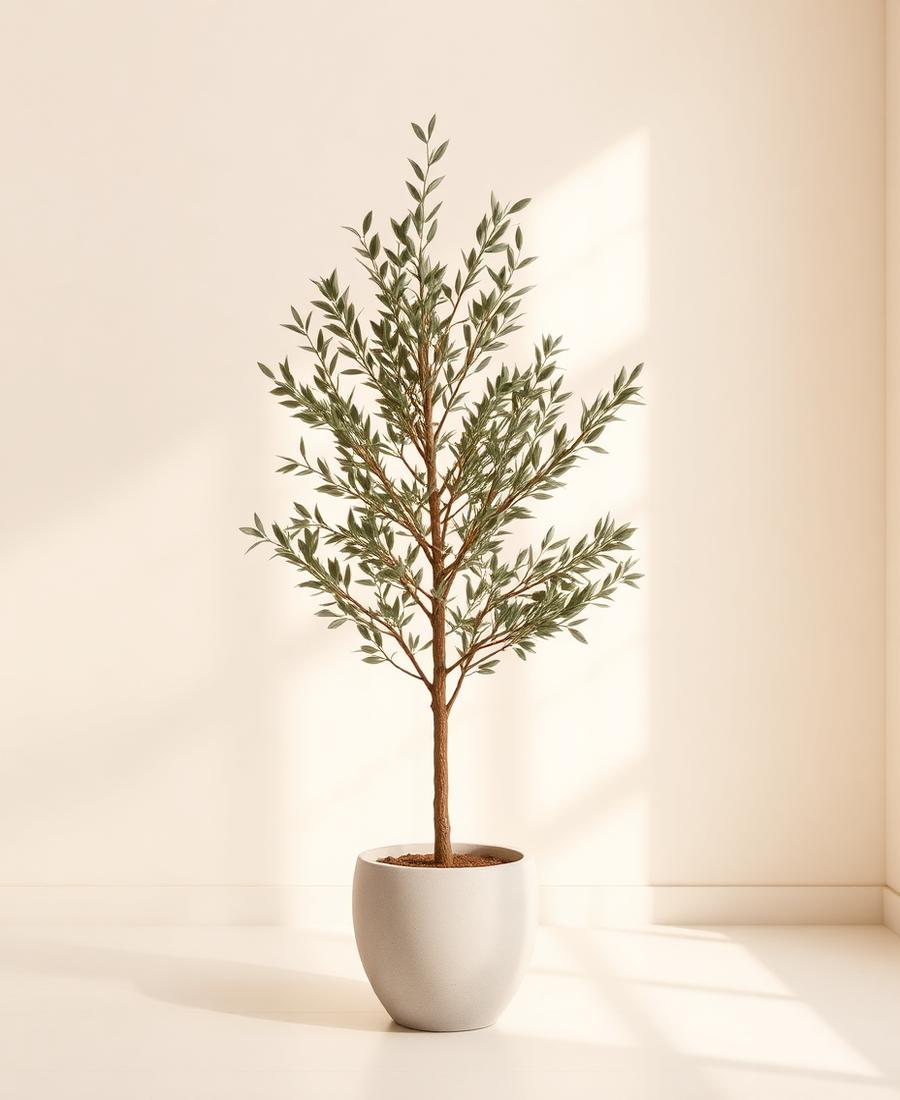
The welcome pine shapes are the traditional answer and there are a lot of them here: dense, upright, sculpted, and untroubled by a corner with almost no natural light, which is where a living conifer would start dropping needles within weeks. Beyond those, an olive gives a lighter and warmer silhouette against a pale wall, while a ficus or banyan reads well from the front and the side at once, which matters when a piece is seen from two directions. If the door is glazed and the plant will stand in direct sun, choose from UV resistant and outdoor safe, and see artificial pine trees for the wider conifer range.
Does it come with a planter?
Some of the welcome pine pieces are sold with a moulded basin or pot and name it in the variant options. Most of the floor trees are not, and arrive in a plain black plastic nursery pot. In an entryway the planter earns its keep more than anywhere else, because it sits at eye level for everyone taking their boots off. Budget for a heavy one in concrete or glazed ceramic, which also keeps a tall tree steady in a doorway. The pieces that already include a pot are collected in Potted Artificial Trees with Planters.
Frequently asked questions
Will cold air from the front door damage the plant over a Canadian winter?
A draft from a door opening and closing is not the same as sustained cold, and indoor-grade foliage and trunks handle brief cold air without lasting damage. What does cause problems is a genuinely unheated porch or vestibule that sits near freezing for months, or a spot in direct line of blowing snow and salt spray. If your entry is heated, even if it dips when the door opens, a standard indoor piece is fine there through the whole season.
Do entryway trees tip over easily, especially with kids, pets or boots flying past?
It depends on the base. A tree with a heavy weighted base or a substantial planter sits stable through normal traffic, including a bag dropped nearby or a door swinging past it, but nothing is immovable if it gets a direct hit. Placing the tree clear of the door swing and the path someone carrying groceries would take reduces the risk more than any base weight does. Check a product's base and planter details if tipping is a concern.
How do you clean dust off an entryway tree that people brush past daily?
Entryway pieces collect dust and, in winter, a bit of salt residue faster than plants elsewhere in the house, simply from the traffic. A weekly wipe with a soft cloth or duster on broad leaves, and an occasional shake or low-heat hairdryer for finer foliage, keeps it looking kept. If salt dust settles on lower leaves near the floor, a barely damp cloth lifts it off; avoid soaking the base if it sits on a wood floor.
How much assembly is involved, and does the tree arrive ready to stand up?
Most floor trees ship with the trunk built and the branches folded flat for the box, so on arrival you separate and shape the branches into an open, natural silhouette before the tree goes into its planter or base. This takes a few minutes for a single-trunk piece and longer for a dense, multi-trunk one. No tools are needed. See our unboxing and shaping guide for the branch-shaping technique.
Is the height listed the finished height once potted, so I can check it clears my doorway?
Yes, the height given is the finished, potted height as the tree will stand, measured to the top of the foliage, unless a listing states trunk-only. That is the number to check against a doorway, transom or stair landing, not the box dimensions. Natural branch variation means two units of the same nominal height can differ by an inch or two, so if your clearance is tight, allow a small margin rather than treating the figure as exact.