
Artificial Trees for Hotel Lobbies: What to Specify
29 August 2026
Prices mentioned in this article are Canadian dollar (CAD) list prices. Current US prices, in US dollars, are listed under Products in this article and on each product page.
A hotel lobby tree is the one piece of décor every guest walks past, and at lobby scale it stops being décor and becomes a small engineering project. A 14 ft tree is specified, anchored, cleaned on a schedule, and delivered on a truck. This guide covers what belongs in the specification, with figures from commercial fabricators and retailers cited by name.
Our position on fire documentation. Eververda publishes a fire figure only where documentation exists for that specific piece, and describes nothing as "fire rated". On a commercial quote we establish the occupancy, the adopted code edition and what your authority having jurisdiction (AHJ) will accept as documentation, in writing, before the order. Where no documented route exists for a piece, we say so and set out the alternatives. We do not claim a certificate for any product.
How tall should a hotel lobby tree be?
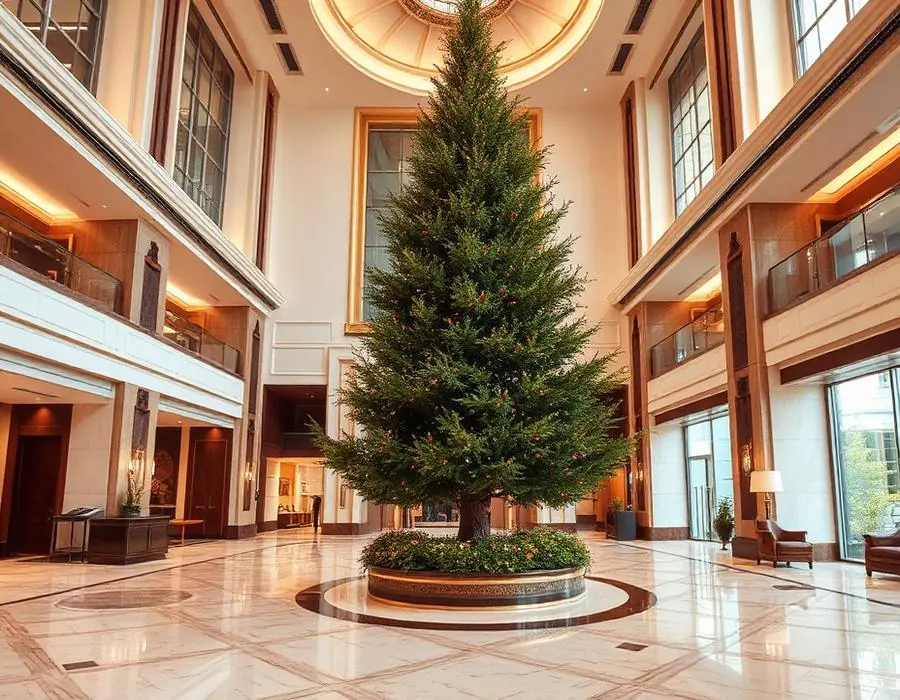
Work from the ceiling down, not the floor up. International Greenscapes, a US commercial fabricator, advises in guidance checked 29 August 2026 leaving 12 to 20 inches between the tree's highest point and the ceiling, and sizing a feature tree to fill roughly two-thirds to three-quarters of the floor-to-ceiling height. In standard 8 to 10 ft spaces their guidance is a tree at roughly 85 to 88% of ceiling height, with the ideal ratio decreasing as ceilings rise: a 20 ft atrium does not want an 18 ft tree pressed against the soffit.
The same source, checked 29 August 2026, puts planter proportions on paper: the planter width should run at least a third of the tree's height, stay wider than the overhanging branches, and stand at least 27 inches tall. For the fuller sizing method (measuring, pot height, and sightlines), see our guide to choosing artificial tree size.
What should the trunk be built from at this scale?
Residential trees get by with plastic-wrapped steel stems or a natural wood trunk. At commercial height the structure changes class. International Greenscapes, checked 29 August 2026, says that for a large atrium tree “only an internal steel armature can support it and meet seismic and wind-load requirements”, and describes certified welders building the armature with hand-carved bark finishes applied over it. The common commercial pattern is a moulded trunk shell, typically fibreglass, over internal steel. Our own 9 ft commercial coconut palm ($2,787.99 to $6,291.99 CAD depending on configuration) is built with a glass-fibre trunk for exactly this reason. For how construction tiers separate the price bands more generally, see why faux trees cost $80 or $900.
How is a large tree anchored?
Anchoring is decided by weight and geometry, not appearance. International Greenscapes' published trigger, checked 29 August 2026: any component weighing more than 400 pounds, or whose centre of gravity sits more than 4 feet above the floor, requires formal seismic design analysis, with heavy-duty steel base plates and multiple anchor bolts into concrete for large trees. That is US guidance from a US fabricator (the structural requirements for your building are set by your own engineers and local officials), but the trigger is a useful screen. If your tree is anywhere near that class, the specification needs an engineering conversation, and the supplier should be able to support it with drawings and anchoring documentation. Mid-size lobby trees are handled with weighted, ballasted planters instead; the point is to know which class you are in before the order is placed.
What maintenance access does the spec need?
Artificial trees need no watering, pruning, or pest control, but they do collect dust, and at height that has logistics. International Greenscapes' cadence, checked 29 August 2026: monthly dusting for trees under 15 feet, using compressed air, microfibre cloths, or specialty spray cleaners, and quarterly deep cleaning for 15 to 25 ft trees requiring scissor lifts. A general cleaning guide from ArtificialPlantsSupplier.com puts hotels and retail stores at a routine pass every one to two weeks, with anything near entrances needing more frequent attention. So the spec should name three things: a clear lift path to the tree, a staging plan, and a line on the housekeeping schedule. It is dusting, not horticulture, but at 18 feet, dusting involves a machine.
What fire documentation should you request?
Ask every supplier, in writing, what fire documentation exists for the actual product being quoted; for our listings, ask through the quote process and we will tell you what, if anything, the manufacturer can provide. A hotel lobby is a listed location under Article 2.3.2.1 of Ontario's Fire Code (O. Reg. 213/07), which requires decorative materials, including textiles and films, to meet CAN/ULC-S109 there. The Code does not mention artificial trees by name, so applying it to a tree rests on a broad reading of “other similar or decorative materials”. Acceptance in your building is decided by your code consultants and the local authority having jurisdiction, not by any supplier's marketing page. For a US lobby, the International Fire Code accepts either NFPA 701 (Test Method 1 or 2) or NFPA 289 (20 kW ignition source, 100 kW maximum heat release rate) for artificial vegetation, at Section 807.4.1 from the 2018 edition onward; it was Section 806.2 in the 2015 edition, which some jurisdictions still run. The full picture (what the standards test, treated foliage, and the paperwork to keep on file) is in our guide to fire documentation for commercial artificial greenery.
Why are lobby trees quoted rather than added to a cart?
Because the price of the tree is only part of the price of the tree. A 12 ft piece ships crated on a freight truck, may need a lift and a crew at the receiving end, and often needs site measurements before fabrication. International Greenscapes published no price list at all when checked on 29 August 2026 (“Every project is custom-quoted”) and cites a minimum three-month lead time for custom fabrication from design approval. Our commercial catalogue works on the same logic: architectural and commercial-scale pieces, and anything priced $3,000 CAD and above, go through a quote so freight class, crating, and installation are planned per order. That is the feature, not the obstacle. It is how a lobby tree arrives intact, on a date the front desk knows about. Start at our commercial page or go straight to a quote request.
What does the market charge for lobby-scale trees?
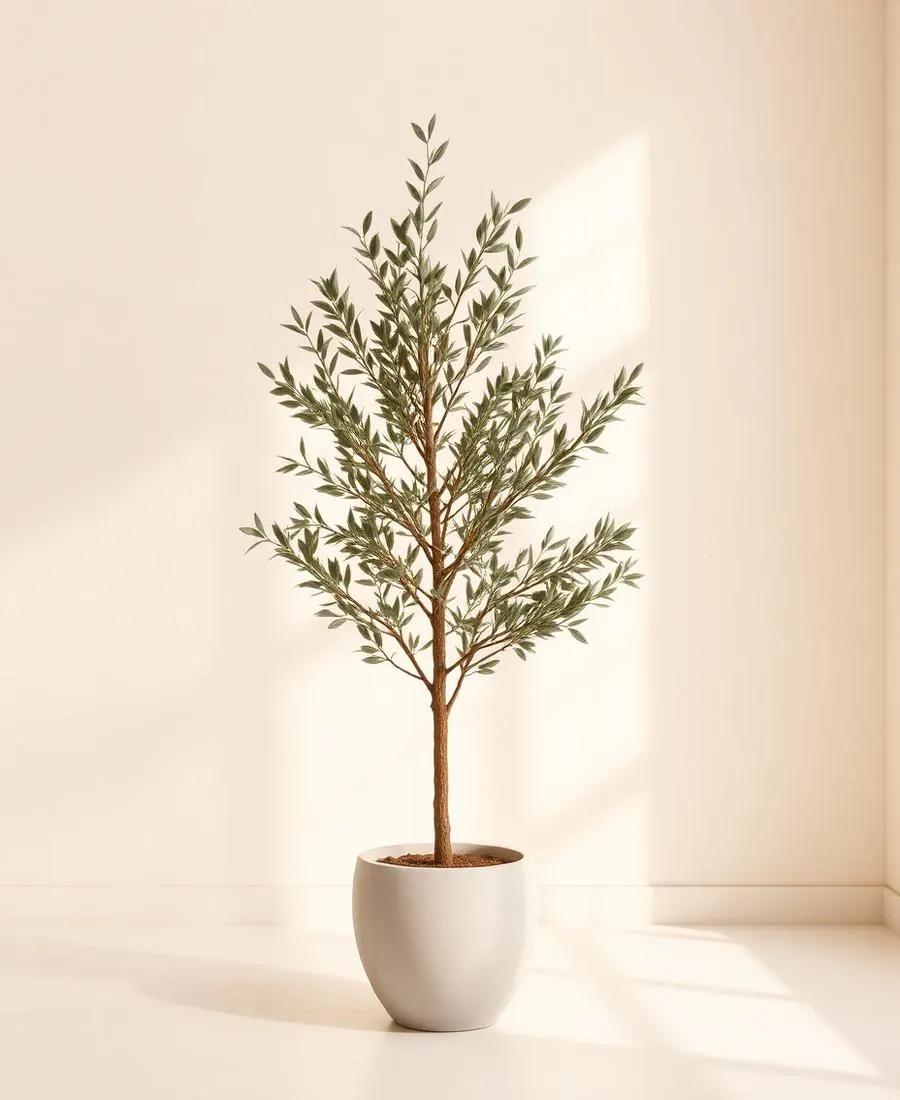
Décors Véronneau, a Canadian retailer, listed the upper band of the Canadian market when checked on 29 August 2026: a large Mediterranean olive at $9,899.99 CAD and a banyan at $11,499.99 to $13,899.99 CAD. Most commercial work sits below that band. From our own catalogue: the 9 ft commercial coconut palm runs $2,787.99 to $6,291.99 CAD, an 8.2 ft olive in bonsai form is $1,807.99 CAD, and silk pine bonsai in landscape feature sizes run $547.99 to $4,889.99 CAD. Every listing publishes its specifications and prices in plain CAD, and delivery in Canada is quoted individually.
What should the spec say for your lobby?
| Lobby scenario | What to specify, on supplier guidance checked 29 August 2026 |
|---|---|
| Boutique lobby, 8 to 10 ft ceilings | Tree at roughly 85 to 88% of ceiling height (per International Greenscapes), weighted planter, monthly dusting on the housekeeping schedule |
| Double-height lobby, 12 to 20 ft ceilings | 12 to 20 in of ceiling clearance, internal steel armature, engineered base, quarterly deep cleaning with lift access (per International Greenscapes) |
| Open atrium feature | Formal structural review: International Greenscapes cites a 400 lb / 4 ft centre-of-gravity trigger for seismic analysis, with steel base plates anchor-bolted to concrete, confirmed by your project engineers |
| Lobby zones serving assembly space | Fire-performance documentation requested from the supplier up front; acceptance confirmed with your code consultant and the local authority having jurisdiction |
Frequently asked questions
How much clearance should there be between a lobby tree and the ceiling?
Leave 12 to 20 inches between the tree's highest foliage and the ceiling, per International Greenscapes' commercial guidance checked 29 August 2026. The same source suggests a feature tree fill roughly two-thirds to three-quarters of the floor-to-ceiling height, and notes the ideal tree-to-ceiling ratio shrinks as ceilings get taller, so an atrium tree should sit proportionally lower than an office tree.
How much does a hotel-grade artificial tree cost in Canada?
Concrete points on the scale: our 8.2 ft olive in bonsai form is $1,807.99 CAD, our 9 ft commercial coconut palm runs $2,787.99 to $6,291.99 CAD, and Décors Véronneau listed large trees at $9,899.99 to $13,899.99 CAD at the top of the Canadian market when checked on 29 August 2026. Larger custom work is quoted per project rather than listed.
How often does a large artificial tree need cleaning?
Monthly dusting for trees under 15 feet and quarterly deep cleaning with scissor lifts for 15 to 25 ft trees, per International Greenscapes, checked 29 August 2026. A separate trade cleaning guide puts hotels and retail on a routine pass every one to two weeks. Build the cadence and the lift access into the spec, not into an after-the-fact conversation with housekeeping.
Does a lobby tree need engineering documents?
It depends on its class. International Greenscapes, checked 29 August 2026, cites a formal seismic analysis trigger at components over 400 pounds or with a centre of gravity above 4 feet: US guidance, but a sound screen anywhere. Your own engineers and local officials set what applies to your building, so ask the supplier during quoting what anchoring drawings and documentation they can provide.
How far ahead should a lobby tree be ordered?
Early. International Greenscapes, checked 29 August 2026, cites a minimum three-month lead time for custom fabrication from design approval, and any quoted order needs time for freight and installation planning. Our quote process confirms timelines per order, so the delivery date is agreed before anything is built or shipped rather than discovered after.
Specifying a restaurant instead? The food-service version of this checklist is in specifying artificial trees for a restaurant fit-out. Browse commercial artificial plants, see the commercial page, or request a quote for anything architectural, commercial-scale or priced $3,000 CAD and above.
Sourced figures and supplier claims were checked on 29 August 2026 and are quoted as displayed at the source. Eververda prices are CAD and current as of 30 August 2026. Fire code text was verified against the publishers' own published text on 24 October 2026.
Products in this article
- Army Green Artificial Coconut Palm Tree 9.8 ft Glass Fiber$1,995 USD to $4,129 USD
- 8.2 ft Faux Olive Tree Indoor$1,659 USD
- Silk Pine Bonsai Tree for Landscape Feature Displays$393 USD to $3,499 USD