
Specifying Artificial Trees for a Restaurant Fit-Out
29 August 2026
Prices mentioned in this article are Canadian dollar (CAD) list prices. Current US prices, in US dollars, are listed under Products in this article and on each product page.
Greenery earns its place in a restaurant. It softens acoustics-driven hard surfaces, divides rooms without walls, and makes a patio feel enclosed. But a dining room is a hostile environment for plants and a regulated one for materials, which is why fit-out specs treat greenery as a specified product, not a decorating afterthought. Here is the restaurant-specific version of the checklist.
Our position on fire documentation. Eververda publishes a fire figure only where documentation exists for that specific piece, and describes nothing as "fire rated". On a commercial quote we establish the occupancy, the adopted code edition and what your authority having jurisdiction (AHJ) will accept as documentation, in writing, before the order. Where no documented route exists for a piece, we say so and set out the alternatives. We do not claim a certificate for any product.
Why is artificial greenery the default near food service?
Three reasons, all practical. First, no soil: live planters near food prep and service mean growing medium, moisture, and everything that comes with them. Second, no pests: real plants and wet soil attract insects, and a restaurant has less tolerance for that than any other commercial space. Third, no watering regime: nobody on a closing shift should be responsible for keeping a ficus alive, and the plant will lose that arrangement within a quarter. The same logic drives offices, where we've set it out in more depth in artificial vs real plants for the office, restaurants just face a stricter version of it.
Where should greenery go, and where shouldn't it?
Placement decides most of the maintenance bill. Kitchen air carries grease, and grease-laden dust bonds to foliage: a trade cleaning guide from ArtificialPlantsSupplier.com, as published on 29 August 2026, puts restaurants and kitchens at the weekly end of its cleaning-frequency table, the most demanding environment it lists, and notes plants near entrances and kitchens need the most frequent attention. Practically: keep foliage away from the pass and cooking equipment, confirm clearances from any heat source or open flame with your fire consultant, and give whatever sits near the kitchen a weekly wipe-down line on the cleaning schedule rather than a hopeful monthly one.
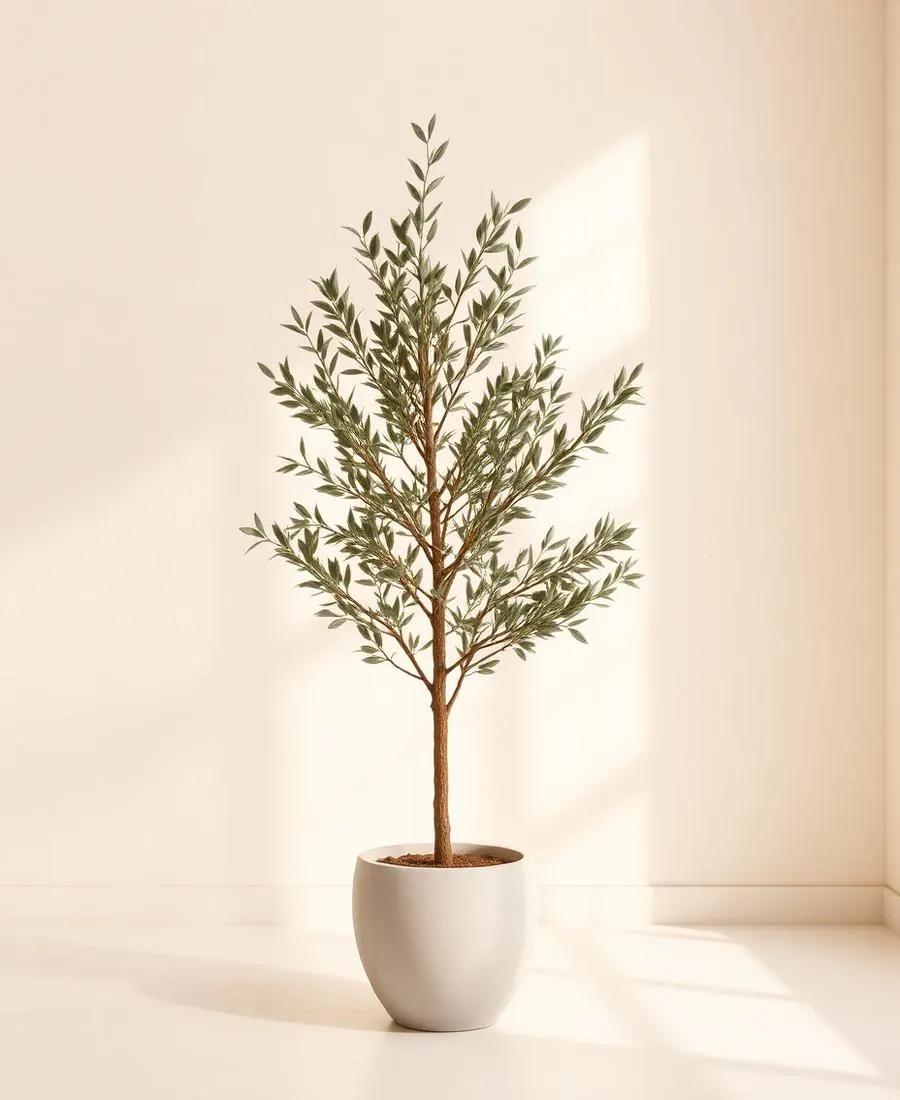
Traffic is the other force. Lower branches at chair-back and tray height get caught, bent, and shed; place floor trees in corners, behind banquettes, or in planters that hold the canopy above contact height. A clear-trunk form works with the room rather than against it: our 8.2 ft olive in bonsai form ($1,807.99 CAD) carries its foliage as a sculpted canopy above head height, which is exactly the geometry a busy dining room wants.
What works on the patio?
Outdoors splits into two cases. A covered patio shields foliage from the worst of sun and weather; an open patio exposes it to both, and UV is the variable that matters: a UV-resistant claim slows fading, it does not stop it, and it covers sunlight only, and we set out that distinction honestly in can you put artificial trees outside. For screening, which is the most common patio request (defining the perimeter, blocking a parking lot, giving tables a back), purpose-made panels are the right tool: our willow-trellis ivy privacy screen is a 3.3 ft panel at $225.99 CAD, and the anti-UV boxwood fence panel is $127.99 CAD. Whatever goes outside also needs to stand up to wind: fix screens to the railing or frame, and give freestanding pieces ballasted bases.
What about fire documentation?
A restaurant is assembly-type space, so ask every supplier, in writing, what fire documentation exists for the actual product being quoted; for our listings, we will tell you what, if anything, the manufacturer can provide. Ontario's Fire Code (O. Reg. 213/07, Division B, Article 2.3.2.1) requires decorative materials, including textiles and films, to meet CAN/ULC-S109 in listed locations, among them a lobby or exit, access to exit in assembly occupancies, and assembly occupancies with an occupant load of more than 100 persons. The Code does not mention artificial trees by name, so applying it to a tree rests on a broad reading of “other similar or decorative materials”. Acceptance in your building is decided by your code consultants and the local authority having jurisdiction, not by a product label. The full explainer, including treated foliage and the exact questions to ask, is in fire documentation for commercial artificial greenery.
How do you actually buy it?
Two routes, by scale. Smaller pieces are simpler: dining-room trees like a 5.25 to 8 ft silk-foliage olive list at $249 to $449 CAD, and screening panels are a few hundred dollars each, with delivery in Canada quoted individually, stating delivered cost, timing and any duties before you pay. Larger pieces work differently, and should: architectural and commercial-scale pieces, and anything priced $3,000 CAD and above, go through a quote, because a large tree ships crated on a freight truck and often needs installation planned at the receiving end. The quote is where freight class, crating, delivery dates, and install are settled per order, and where the documentation questions above get answered in writing. A covered-patio feature like the 6.5 ft indoor/outdoor cedar bonsai pine ($2,787.99 to $3,489.99 CAD) sits at that threshold. Start at the commercial page or go straight to a quote request; the sizing method for each room is in how to choose artificial tree size.
What belongs where in the fit-out?
| Fit-out zone | What works | What to check |
|---|---|---|
| Dining room | Floor trees with clear trunks and canopies above contact height | Clearance from chair backs and service paths; a named cleaning cadence |
| Near the kitchen or pass | Little or nothing: grease-laden dust bonds to foliage | Weekly cleaning per trade guidance; heat-source clearances confirmed with your fire consultant |
| Entry and host stand | Wall panels or a trellis screen | High-touch traffic; secure fixing; frequent cleaning near the door |
| Covered patio | Trees that list indoor/outdoor placement; ivy or boxwood screening | A UV-resistant claim on the listing; wind: fixed or ballasted mounting |
| Open patio | UV-resistant screening panels | Honest fading expectations: UV resistance slows fading, it does not stop it; drainage and ballast |
Frequently asked questions
Do artificial plants attract pests in a restaurant?
No, that is a large part of why they are the food-service default. There is no soil, no moisture, and nothing for insects to feed on, which removes the pest pressure that live planters bring into a dining room. What artificial foliage does collect is dust and airborne grease, which is a cleaning-schedule problem rather than a pest-control one.
How often should restaurant greenery be cleaned?
Weekly, for anything near the kitchen or entrance: restaurants and kitchens sit at the most demanding end of ArtificialPlantsSupplier.com's published cleaning-frequency guidance, when checked 29 August 2026. Foliage deeper in the dining room can run on a longer cadence, but put every piece on the cleaning schedule by name; grease-laden dust that sits becomes much harder to remove.
Can screening panels stay on an open patio year-round?
Yes, if they publish a UV-resistant claim and are fixed against wind. Our willow-trellis ivy screen ($225.99 CAD) and anti-UV boxwood panel ($127.99 CAD) are listed for outdoor use. Be honest about the sun: UV resistance slows fading rather than stopping it, so an open south-facing patio will age panels faster than a covered one.
Do restaurant trees need fire documentation?
Request fire documentation from any supplier for the actual product, because a restaurant is assembly-type space, but no certificate is self-executing. Ontario's Fire Code cites CAN/ULC-S109 for decorative materials in listed locations and does not mention artificial trees by name. Outside Ontario, confirm the code in force with your AHJ. Acceptance is decided by your code consultants and the local authority having jurisdiction.
What does greenery for a restaurant fit-out cost?
Screening panels run $127.99 to $225.99 CAD each, dining-room olives $249 to $449 CAD, and statement pieces climb from there: an 8.2 ft olive in bonsai form is $1,807.99 CAD and a 6.5 ft indoor/outdoor cedar bonsai pine runs $2,787.99 to $3,489.99 CAD. Some pieces are quoted at any price depending on how they are supplied, and everything priced $3,000 CAD and above is quoted, so freight, crating, and installation are planned per order; the product page is the authority.
Fitting out a hotel instead? The lobby-scale version of this checklist is in artificial trees for hotel lobbies, and wall greenery is costed in artificial green walls vs living walls. Browse commercial artificial plants or request a quote.
Sourced figures and supplier claims were checked on 29 August 2026 and are quoted as displayed at the source. Eververda prices are CAD and current as of 30 August 2026. Fire code text was verified against the publishers' own published text on 24 October 2026.
Products in this article
- 8.2 ft Faux Olive Tree Indoor$1,659 USD
- Willow Trellis Artificial Ivy Privacy Screen 3.3 ft$162 USD, quoted
- Boxwood Fence Artificial Plant Panel Anti UV$92 USD, quoted
- Artificial Cedar Bonsai Pine Tree, 6.5 ft (2 m) and 8.25 ft (2.5 m), Indoor or Outdoor$1,995 USD to $2,497 USD