
How to Choose the Right Size Artificial Tree
22 August 2026
Size is the thing people get wrong most often when buying an artificial tree, and it is also the hardest thing to fix afterwards, because a tree that is the wrong size is not slightly disappointing - it is visibly wrong every time you walk into the room. Here is how to get it right the first time.
What size fake tree do I need for my room?
As a starting rule, the tree should be about 75 to 80 percent of your ceiling height, and its canopy should spread about half its own height. In a standard 8 ft room that puts you at a 6 ft tree; in a 9 ft room, 7 ft; in a 10 ft room, 8 ft.
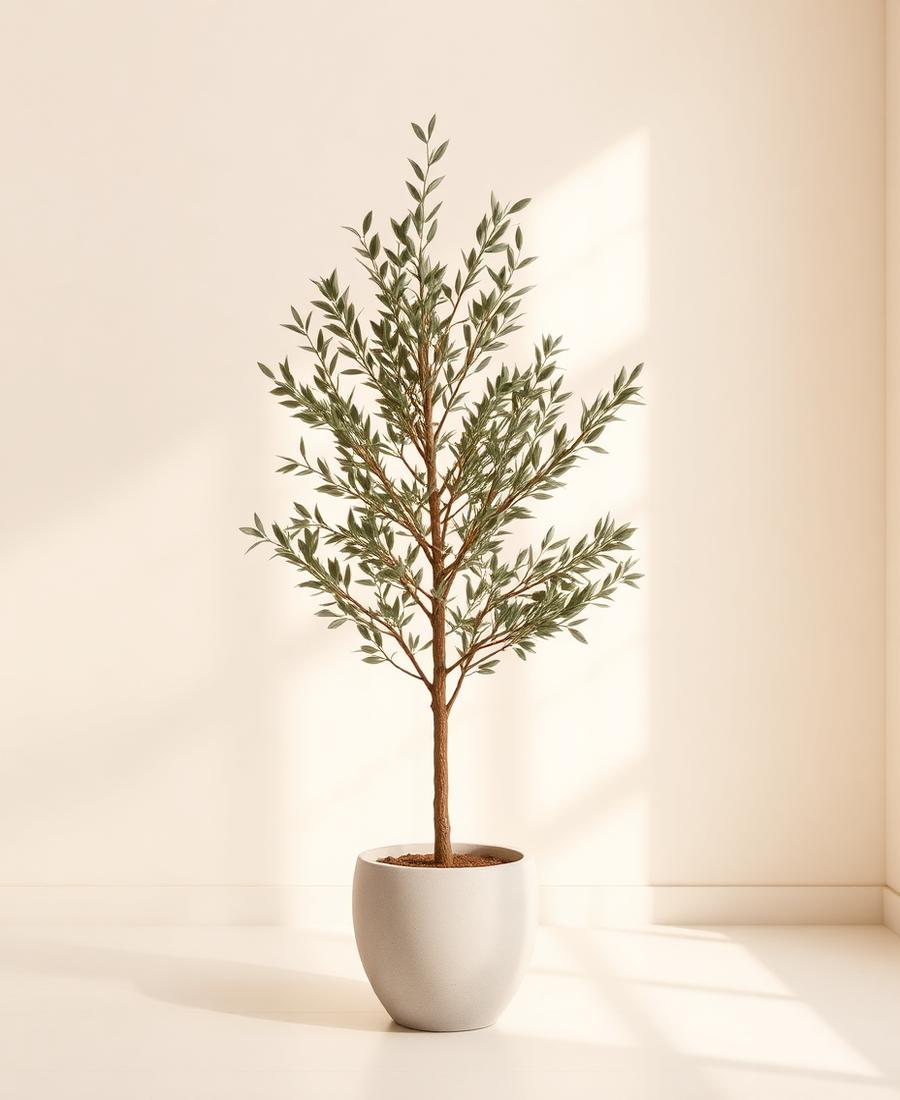
Most of that range is covered by one product family: the 5.25 to 8 ft olive with counted leaves runs $249 to $449 CAD across its heights, so standard 8 ft ceilings and 10 ft ones are both in reach.
Everything below is either a refinement of that rule or a warning about where it breaks.
How much clearance do you need above an artificial tree?
The reason to leave 20 to 25 percent of the ceiling height clear is that a tree needs visible air above it to read as a tree rather than as furniture wedged under a ceiling. Real trees are seen against sky. Indoors you are faking that with headroom, and the gap does the work.
Measure your actual ceiling, not the one in the floor plan. Then subtract for anything that intrudes: a ceiling fan, a pendant light, a bulkhead, a sprinkler head, crown moulding. The clearance you care about is the clearance at the exact spot the tree will stand.
One correction to the rule: it assumes the tree is standing in its pot on the floor. If you are putting the tree in a decorative planter, the planter adds its own height, sometimes a foot or more. A 7 ft tree in a 14 inch planter is a 8 ft object. This catches people constantly.
Does canopy width matter more than height?
Canopy width is the specification buyers ignore and the one that decides whether the tree looks right. It is also, and this is the part nobody explains, the main thing driving the price.
A wider canopy needs more primary branches, more sub-branches, and dramatically more leaves. Leaves are the expensive component. So when you compare two 10 ft olive trees and one is half the price, the difference is very often not height, quality of trunk, or even leaf material - it is that the cheap one is narrow. It is still 10 ft. It is also a stick.
The working ratio for most broadleaf species is a canopy spread of roughly half the tree's height. A 10 ft tree wants about a 5 ft spread. Below about 40 percent, a broadleaf tree starts to look wrong, and no amount of shaping recovers it, because the branches to spread simply are not on the tree.
Columnar species are the legitimate exception. Cypress, some pines and certain bamboos are genuinely narrow in real life and should be narrow here. If you want height in a tight space, choosing a naturally columnar species is the right answer rather than buying a narrow version of a broad species.
Practically: measure the floor space you have in width before you shop, and treat canopy spread as a hard constraint. A 5 ft spread needs 5 ft of clear floor plus walking room, and it will overhang furniture.
What size artificial tree does a double-height room need?
The single most common sizing error is undersizing in a tall room. Someone with an 18 ft atrium or a double-height living room buys an 8 ft tree because 8 ft sounds enormous when you are reading it on a screen, and the tree arrives and disappears.
Scale is relative to the space, not to you. In a room with a 20 ft ceiling, an 8 ft tree occupies the bottom 40 percent of the wall and reads as a houseplant. The room needs something in the 12 to 15 ft range to hold the volume, and possibly two of them.
If the budget will not carry a 15 ft tree, the better answer is not a smaller tree in the same spot. It is either to raise the tree - a substantial planter or a plinth adds real height and reads as intentional - or to group three trees of staggered heights, which fills volume far more convincingly than one undersized specimen. A cluster at 10 ft, 8 ft and 6 ft will do more for a double-height room than a single 10 ft tree standing alone.
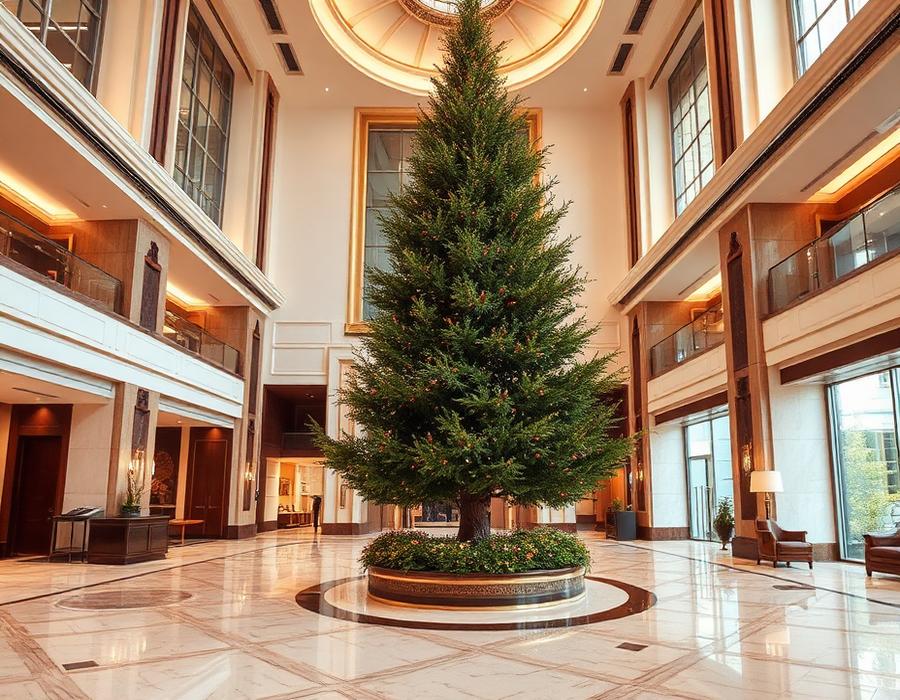
For the anchor tree in a group like that, our commercial line is where the candidates are: the 7.2 ft cedar pine bonsai is $1,246.99 CAD, and raised on a substantial planter or plinth it gains a foot or more of effective height.
What size tree fits each ceiling height?
Rough guidance, assuming the tree sits on the floor in a low pot. Adjust down if you are using a tall planter.
| Ceiling height | Tree height | Canopy spread to expect | Typical setting |
|---|---|---|---|
| 8 ft (2.4 m) | 5 to 6 ft | 2.5 to 3 ft | Standard apartment or bedroom corner |
| 9 ft (2.7 m) | 6 to 7 ft | 3 to 3.5 ft | Living room, office, larger bedroom |
| 10 ft (3.0 m) | 7 to 8 ft | 3.5 to 4 ft | Open-plan living, restaurant floor |
| 12 ft (3.7 m) | 9 to 10 ft | 4.5 to 5 ft | Reception, showroom, larger hospitality |
| 14 to 16 ft (4.3 to 4.9 m) | 11 to 12 ft | 5.5 to 6 ft | Hotel lobby, mezzanine, retail atrium |
| 18 ft and above (5.5 m+) | 15 ft or a staggered group | 7 ft plus | Double-height atrium, mall, event space |
A tabletop tree, meaning anything under about 2 ft, is a different object entirely and is sized to the surface rather than the room: allow the tree to be roughly a third of the width of the table or console it sits on.
Between tabletop and full height there is a useful middle size: the 4 ft fiddle leaf fig in a white planter is $219 CAD and suits a wide shelf, a console, or a small room where a floor tree would crowd the space.
Will a large artificial tree fit through the door?
Large trees ship compressed with branches folded in, so the box is narrower than the finished canopy - but the box is long. Before ordering anything over about 8 ft, check three things: the width of your building entrance and any turns in the corridor, whether the box will fit in the lift or up the stairwell, and whether there is a landing tight enough to make a long box impossible to turn.
Also check the weight. Trees over about 10 ft are routinely a two-person unboxing, and a large fibreglass-trunk tree with a weighted base can be seriously heavy. This is worth knowing before delivery day rather than during it.
What size planter does an artificial tree need?
Match the planter opening to the tree's shipping pot diameter, not to the trunk. If the planter opening is narrower than the nursery pot, the tree will not drop in, and cutting the nursery pot away often means losing the tree's ballast. Check the published pot diameter before buying a planter.
Visually, the planter should be roughly a fifth to a quarter of the total height of the finished object. Too small and the tree looks top-heavy; too large and it looks like a plant in a barrel.
Frequently asked questions
Can an artificial tree be too tall for a room?
Yes. A tree needs 20 to 25 percent of the ceiling height clear above it to read as a tree rather than as furniture wedged under the ceiling - indoors, that gap of air is doing the work the sky does outside. Measure the actual ceiling at the exact spot the tree will stand, and subtract for fans, pendant lights, bulkheads and crown moulding.
Does the planter count toward the tree's height?
Yes, and it catches people constantly. A decorative planter can add a foot or more, so a 7 ft tree in a 14 inch planter is an 8 ft object, and your ceiling clearance has to absorb that. As a proportion, the planter should be roughly a fifth to a quarter of the total height of the finished object.
Is a 6 ft artificial tree big enough for a living room?
For a standard 8 ft ceiling, yes - 5 to 6 ft is the right range, and 6 to 7 ft suits a 9 ft ceiling. Where 6 ft fails is tall rooms: in a double-height space it reads as a houseplant, because scale is relative to the room, not to you. Match the tree to the ceiling, not to how big the number sounds on a screen.
How much does a living-room-sized artificial tree cost?
Our residential olive line covers the standard-ceiling range at $249 to $449 CAD for 5.25 to 8 ft trees, and a 4 ft fiddle leaf fig for smaller spots is $219 CAD. When comparing prices elsewhere, check the canopy spread before anything else: width drives cost more than height, and the cheapest tree at a given height is usually the narrowest.
How heavy is a large artificial tree to move and set up?
Heavy enough to plan for. Trees over about 10 ft are routinely a two-person unboxing, and a large fibreglass-trunk tree with a weighted base can be seriously heavy. Before delivery day, check the weight, the width of your entrance and any corridor turns, and whether the long shipping box will fit in the lift or turn on a stairwell landing.
Browse by size
We group the catalogue by height so you can shop the number directly: medium trees from 2 to 7 ft for standard ceilings, 10 ft artificial trees for taller rooms, and 12 foot artificial trees and above for double-height spaces. Canopy spread and pot diameter are published on the product spec wherever we hold the measurement.
Eververda prices are CAD and current as of 29 August 2026.