
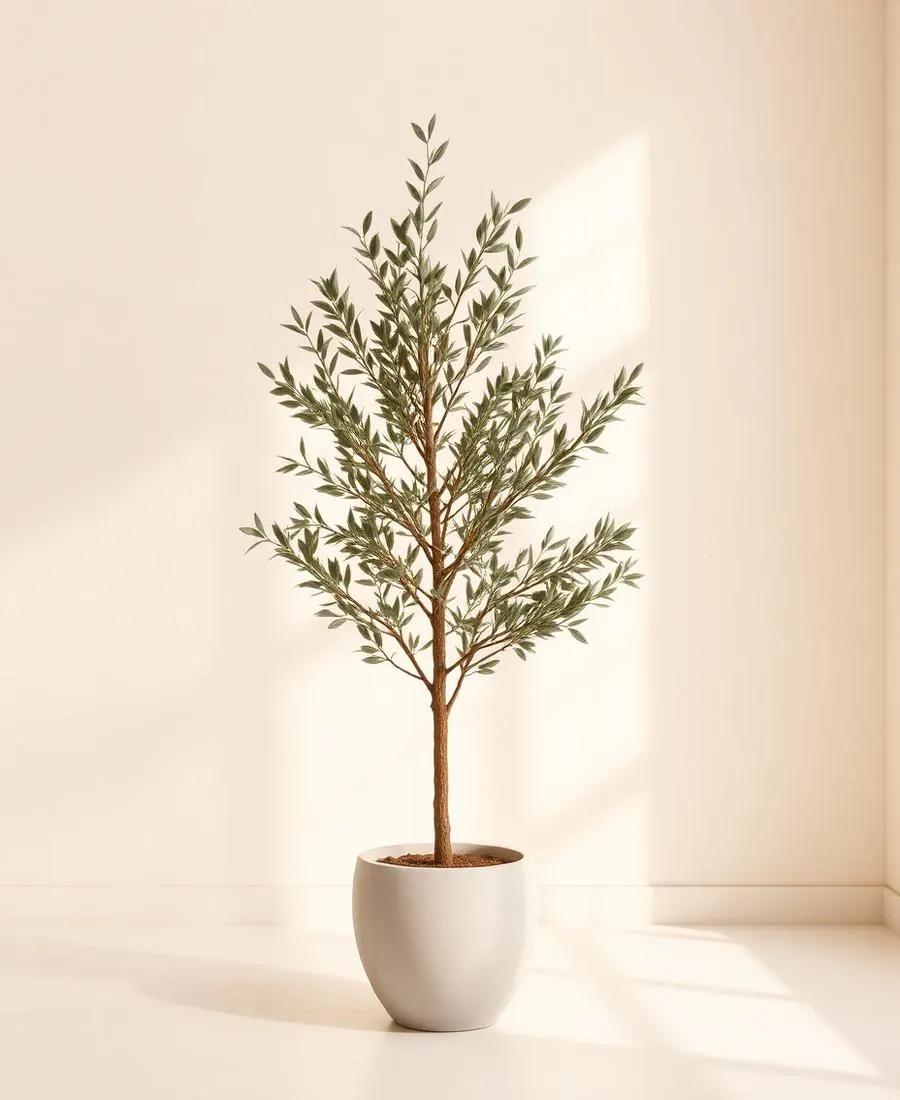
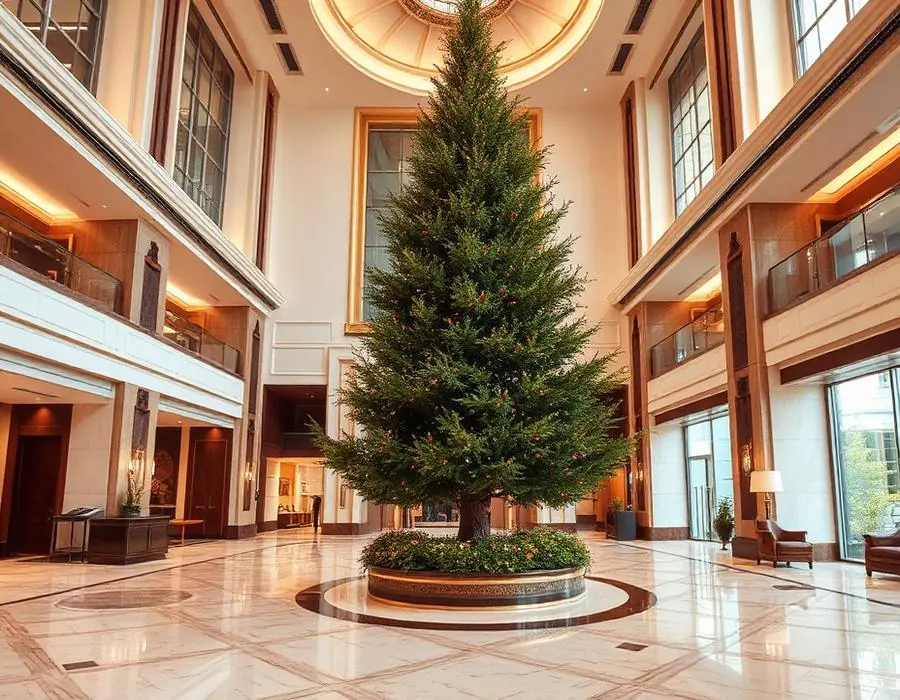
Why Faux Trees Cost $80 or $900, and What Changes In Between
22 August 2026
A faux olive tree can cost you $80 or it can cost you $900, and both trees will have plastic leaves. That fact confuses more shoppers than anything else in this category, so this article walks the whole ladder and says plainly what changes at each rung and what does not.
Prices are as published on each retailer's own page when checked in August 2026. Canadian and US pricing differ, so check your local site. If you arrived here hunting a specific brand, we keep separate deep dives on Pottery Barn's olive tree, McGee & Co and RH versus West Elm. This page is the ladder those three hang off.
Eververda lists its trees on the terms this article asks you to demand from any seller. Every Eververda product page carries a specification table holding what the manufacturer documented, and where a value was never documented it reads "Not specified" rather than being guessed. In October 2026, 375 such fields across 152 products were rewritten so an unknown reads as an unknown. Every third-party price Eververda publishes carries the date it was read at source, and a sample is re-read on a schedule: 556 figures carry a date, and the last re-check was 12 October 2026.
What does the price ladder actually look like?
Roughly like this, from the bottom up.
| Rung | Typical price, August 2026 | What you get |
|---|---|---|
| Amazon bestsellers | $50 to $130 | Narrow canopy, plastic trunk, basic pot. 600 to 2,600 reviews each, so plenty of real-world evidence |
| IKEA | Entry level | Simple shapes, consistent quality control, small sizes |
| Canadian Tire, Bouclair | Mid-market | Seasonal ranges, decent height for the money, variable canopy density |
| Artiplanto and specialist faux sellers | Mid to upper | Better canopy density, more size options, faux-specific expertise |
| Crate and Barrel | $249 for 5 ft | "Polyester, plastic, foam and wire", "Contains 8% recycled material", cement planter included, "Made in Thailand", 476 reviews on the faux olive line when checked 12 October 2026 |
| Pottery Barn | $249 to $549, 6 ft to 9 ft | "Made of polyester, plastic, and Styrofoam", "Includes Black plastic vessel" |
| West Elm | $299 to $648 | Catalogue styling, mid-tier construction |
| McGee & Co | $718 for 72 in, $888 for 96 in | "Plastic, Polyfoam, & Iron", ceramic or woven pot included |
| RH | "SAVE 40% Starting at $929 Member Sale /$1,565 Regular" | Top of the consumer catalogue tier |
| Eververda and commercial specialists | $199 CAD entry, four figures at commercial sizes | The manufacturer's documented trunk material, real height in feet and metres, listed placement and box contents published on every listing, with anything undocumented marked "Not specified". Sizes past the 9 ft ceiling of the catalogue tier |
What genuinely changes as the price goes up?
Four things, and they are real.
The trunk. At the bottom of the ladder a trunk is moulded plastic over a wire core. Higher up it becomes plastic over a proper metal support, then fibreglass over steel, then in some cases an actual timber trunk with the canopy built onto it. This is the single biggest driver of how a tree reads when you stand next to it, and it is also structural: a 13 ft tree needs a steel core to stand without guy wires. Real wood costs more and reads better at close range, which is why it is worth paying for in a lobby and often not worth it in a hallway. It is also not automatically a four-figure feature: our 5.25 to 7 ft olive built on a natural wood trunk runs $249 to $419 CAD.
Foliage density. More leaf costs more money. A sparse canopy with visible gaps is the fastest way to spot a cheap faux tree from across a room, and it is the specification that separates two trees of identical height and identical price. Fullness is also the axis on which McGee & Co's own most-upvoted reviewer, an interior designer, judged the brand's 72 in olive and concluded that fuller trees were available for less, as read in August 2026; we go through that review in detail in the McGee & Co breakdown. Density can be published rather than guessed at: our 5.25 to 8 ft silk-foliage olive lists counted leaves and fruit for every size and runs $249 to $449 CAD.
Canopy width. Width is what makes a tree fill a corner. It is also the number most often left off a listing, which is why two 8 ft trees can look completely different in a room. If a seller publishes canopy width, that is a small sign they expect you to compare properly.
The pot. A ceramic, cement or woven planter is heavy and genuinely expensive to ship. Its presence or absence can move the real cost of a tree by a hundred dollars or more. Crate and Barrel's $249 tree, as published in August 2026, includes a cement planter. Pottery Barn's tree at the same starting price ships with a plain black plastic vessel, while the concrete planter in its photography is sold separately, and to their credit they print that on the page. That disclosure, and how to read it, gets a full treatment in the Pottery Barn dupe guide.
Why are big fake plants so expensive?
Size drives cost faster than the height on the label suggests, for four reasons that compound on each other.
Material scales in three dimensions, not one. A tree twice as tall is not twice the plant. To look right it also has to be roughly twice as wide and twice as deep, so leaf count climbs far faster than height does. Doubling the height of a convincing tree can quadruple the foliage on it, and foliage is the component priced by volume.
Past about 10 ft the structure changes. A wire core holds a 5 ft tree. It will not hold a 12 ft one. Beyond that point the trunk needs a steel or fibreglass core, which is a different manufacturing process with different tooling rather than a thicker version of the same part. That is a step change in cost, not a gradual climb, and it is why prices tend to jump somewhere around the 10 ft mark instead of rising smoothly.
The base has to get heavier. A tall tree has the sail area of a real one and almost none of the weight, so it needs ballast to stand up, especially outdoors. Heavy planters and weighted bases cost money to make and considerably more to ship.
Freight is charged on space, not weight. Carriers price a large tree on the volume it occupies, and a 12 ft tree in a box is mostly air. That is why big trees often move by freight rather than parcel, and why delivery can be a meaningful fraction of what you pay.
The one input that does not scale is the leaf. A 12 ft tree and a 4 ft tree from the same range usually carry identical foliage. You are paying for a great deal more of it, held up by much more engineering, and moved by a more expensive method.
What does not change no matter how much you spend?
The leaf material. Read the published materials lists down the ladder, as checked in August 2026, and they converge. Crate and Barrel at $249: "Polyester, plastic, foam and wire". Pottery Barn at $249 to $549: "Made of polyester, plastic, and Styrofoam". McGee & Co at $718 to $888: "Plastic, Polyfoam, & Iron". Iron rather than wire is a genuine build upgrade in the armature. Polyester, plastic and foam are constant.
Much of this category is sourced from a shared manufacturing base, and that is not a secret anyone is hiding. It is simply visible in the specifications the retailers publish themselves. A shopper on r/interiordecorating, in a thread that ranks on these very searches and was read in August 2026, described ordering from one retailer and receiving a tree shipped from a known faux-plant manufacturer. One customer's experience is not a rule about a whole industry, but it does explain why so many trees at very different prices photograph so similarly.
So how much is brand markup?
Some of it, and less than the internet tends to claim. Art direction, photography, showrooms, returns handling and customer service are real costs, and a brand that styles a room well is selling you a genuinely useful service: a decision you do not have to make. That has value.
The problem is only that price does not reliably predict construction. Review depth is the clearest illustration. Crate and Barrel's 5 ft olive was $249 in August 2026, on a page that carried 476 reviews when checked 12 October 2026, a count pooled across every size in the faux olive line rather than the 5 ft tree alone. The McGee & Co 72 in at $718 carried five. That is not a quality verdict, but it tells you how much real-world evidence exists behind each purchase.
How should I decide what to spend?
Work backwards from the room, not from a budget.
- Will anyone stand within arm's reach? If yes, pay for the trunk. If no, put the money into canopy density instead.
- How tall is the space? Above about 10 ft you are in structural territory and a steel or fibreglass core stops being optional.
- Is it near direct sun? Ask for UV-protected foliage. It slows fading in bright positions; it does not stop it, and any seller who tells you otherwise is overselling.
- Do you already own a planter? If so, buy the tree alone and save the shipping weight.
At the across-the-room end of that decision, you do not need the top rungs at all: a 4 to 6 ft olive with PE foliage on stainless-steel branches covers most hallway and corner placements at $199 to $329 CAD.
How Eververda's range compares
Part of what separates the rungs is what the listing tells you before you buy. Every Eververda listing publishes the manufacturer's documented specification: trunk material, real height in feet and metres, listed placement and what is in the box, with anything undocumented marked "Not specified" rather than filled in with a guess. That is exactly the information this article says you should be comparing. Artificial trees and plants are the whole of our catalogue rather than one category inside a general home range, and we sell past the 9 ft ceiling of the catalogue tier, where the construction questions above stop being cosmetic.
Our artificial olive trees start at $199 CAD for a 4 to 6 ft tree with PE foliage and run into four figures for fibreglass-over-steel and real-timber trunk builds. Commercial-scale pieces are quoted with freight, crating, lead time and site access planned per order.
Browse the full range in artificial trees Canada, or go straight to large artificial trees if you are working above 7 ft.
Eververda sells the products described in this section.
The short version: $80 buys you plastic leaves on a wire trunk in a plain pot. $900 buys you plastic leaves on a much better trunk, in a much fuller canopy, in a real planter. The leaves are the same. Everything holding them up is not.
Frequently asked questions
Why are large artificial trees so expensive?
Because material scales in three dimensions while the label only shows one, because past about 10 ft the trunk needs a steel or fibreglass core rather than a wire one, because the base has to get heavy enough to hold the tree up, and because freight is charged on the space a box occupies rather than its weight. The leaves themselves are usually identical to the ones on the 4 ft version of the same tree.
What is a reasonable amount to spend on a fake tree?
Work backwards from the room rather than forwards from a budget. If nobody will stand within arm's reach, a dense canopy on a plastic trunk does the job, and that exists from $199 CAD in our own olive range. If people will stand beside the tree, spend on trunk material instead. Above about 10 ft, a steel or fibreglass core stops being optional whatever you had planned to pay.
Do cheap and expensive faux trees use the same leaves?
Essentially, yes. The materials lists that retailers published when checked in August 2026 converge on polyester, plastic and foam from $249 through $888, in the retailers' own words on their own product pages. What extra money buys is a better trunk, a fuller and wider canopy and a heavier pot. The leaf material itself does not improve as the price climbs.
Why do two faux trees of the same height look so different?
Canopy width and foliage density, neither of which is captured by the height on the label. Width is the specification most often missing from listings, and two 8 ft trees can differ enough in spread to suit completely different rooms. Density is what separates a tree that reads well across a room from one with visible gaps in the canopy.
Does UV-protected foliage stop a faux tree from fading?
No. UV protection slows fading in bright positions; it does not stop it, and a seller who claims otherwise is overselling. It is still worth asking for on any tree that will sit near direct sun, because slower fading is a real benefit. Away from windows it matters far less, and you can put the money into density instead.
Is it worth buying a faux tree without a decorative planter?
Often, yes. A ceramic, cement or woven planter is heavy and genuinely expensive to ship, and its presence or absence can move the real cost of a tree by a hundred dollars or more. If you already own a planter you like, buying the tree alone in its plain nursery pot saves that entire cost and the shipping weight with it.
Competitor prices are USD list prices as published when checked in August 2026. Eververda prices are CAD and current as of 28 August 2026.
Products in this article
- Artificial Olive Tree, 5.25 to 7 ft, Natural Wood Trunk$181.99 USD to $305.99 USD
- Artificial Olive Tree, 5.25 to 8 ft, Silk Leaves with Fruit, Black Pot$181.99 USD to $327.99 USD
- Artificial Olive Tree, 4 to 6 ft, PE Foliage, Stainless Steel Branches$167.99 USD to $210.99 USD