
McGee & Co Dupes: An Honest Look at What You're Paying For
22 August 2026
Searching for McGee & Co dupes usually means one specific thing: you have seen a Studio McGee room, you have found the faux tree that anchors it, you have seen the price, and you want to know whether the price is buying you something real. That is a fair question and it has a factual answer, because McGee & Co publish their own specifications and their own customer reviews.
This is not a hit piece. Studio McGee's styling is genuinely good, and taste is a real product. But you should know precisely which part of the bill is taste and which part is materials. This page confines itself to McGee & Co's two olive listings; the wider market, from $50 Amazon trees to RH's four-figure regular price, is charted tier by tier in why faux trees cost $80 or $900.
Why are McGee and Co so expensive?
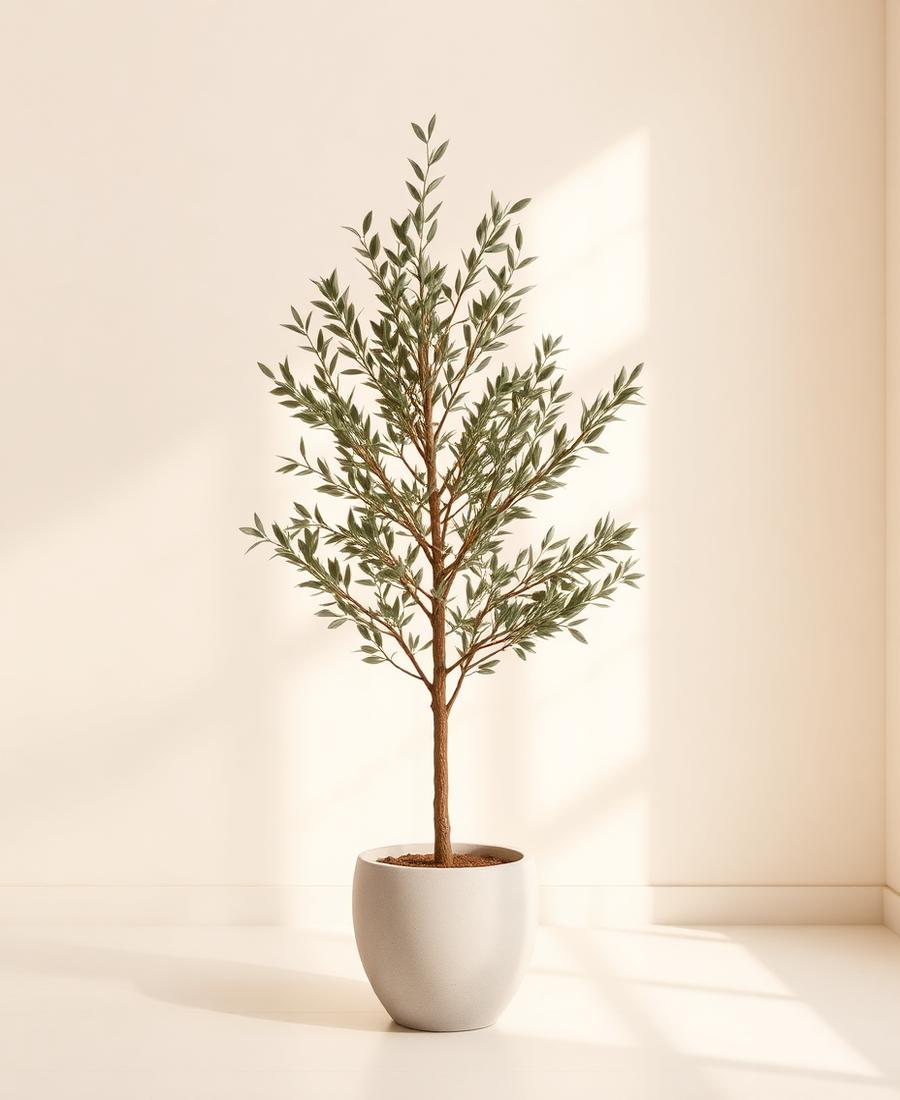
Because you are paying for a curated, art-directed assortment rather than for unusual materials. The McGee & Co Faux 72" Olive Tree with Ceramic Pot lists at $718, and the 96" version with a woven pot lists at $888. For both, the materials the brand publishes are "Plastic, Polyfoam, & Iron".
Iron is the interesting word in that list. An iron armature rather than a wire one is a real build upgrade: heavier, stiffer, better at holding branch positions. It is worth something. Plastic and polyfoam, on the other hand, are what the tiers below use as well; one rung down, Crate and Barrel sell a 5 ft faux olive at $249 with wire-framed polyester-and-plastic foliage and a cement planter in the box. So whatever separates $249 from $718, it is the armature, the fullness, the pot and the brand, and the brand does not claim otherwise.
What do McGee and Co's own reviewers say?
This is the part most comparison articles skip, and it is the most useful evidence available. The 72" olive tree carries five reviews. The most-upvoted of those is a four-star review from an interior designer which reads: "it wasn't really worth $500 when I saw it. Crate & Barrel and Pottery Barn have fuller looking ones for cheaper."
Note that this is a four-star review. The customer did not hate the tree. A design professional simply looked at it in person and concluded that fullness, the thing that actually makes a faux tree convincing, was available for less money elsewhere. That is the whole argument of this article, made by someone on McGee & Co's own website.
Here are the two McGee listings side by side, with the Crate and Barrel tree their own reviewer invoked as the reference row.
| Listing | Price as listed | Published materials | Pot included | Reviews |
|---|---|---|---|---|
| McGee & Co Faux 72" Olive Tree | $718 | Plastic, Polyfoam & Iron | Ceramic pot | 5 |
| McGee & Co Faux 96" Olive Tree | $888 | Plastic, Polyfoam & Iron | Woven pot | 5 |
| Crate and Barrel Faux Olive Tree in Pot, 5 ft (reference) | $249 | Polyester, plastic, foam and wire | Cement planter | 474 |
Neither review number grades the tree itself. But if you want to know how a faux olive holds up after a year in a real living room, one of these products has 474 field reports and the other has five.
What does the $718 actually include?
A pot, for one thing, and that deserves real credit. The 72" ships with a ceramic pot and the 96" with a woven one, and a decorative planter of that kind is heavy, costly to freight, and often a three-figure purchase on its own. McGee & Co are among the brands where the photograph and the packing list agree. Pottery Barn, by contrast, photographs its olive in a planter it sells separately, a habit worth understanding before you shop anywhere; we take it apart in the Pottery Barn olive tree guide.
The step from $718 to $888 buys two feet of height, from 72 in to 96 in, and swaps the ceramic pot for a woven one. The materials line does not change between the two listings. Taller means more foliage and a bigger armature, so the step is not empty, but it is the same recipe at a larger size.
How should you shop this tier instead?
With a method rather than a destination, because no single site owns the look. Four questions do the work:
- What is the armature? Wire, iron or steel. Iron is McGee's genuine upgrade over the wire tiers; make any alternative declare its own.
- How full is the canopy, counted rather than felt? Fullness is exactly what the designer-reviewer above was measuring, and it is visible in photographs if you count leaf clusters instead of admiring the styling.
- How wide is the canopy? Spread is what occupies a corner, and it is routinely absent from listings at every price. Ask for it.
- What pot arrives? McGee includes a real one. Many alternatives do not, and a missing planter quietly adds a three-figure line to the true cost of the room in the photo.
Put those four answers next to each other and the logo stops carrying information. The materials lists across this market converge on the same plastic-and-foam family, which is why a method beats a brand.
Where does Eververda sit in this?
Honestly, not where you might expect from an article like this, and we would rather tell you than let you find out at checkout. We are not a budget dupe shop. Our artificial olive trees reach well past McGee's prices at the top: an 8.2 ft olive in sculpted bonsai form lists at $1,807.99 CAD, more than the 96" McGee. Several commercial builds go higher still.
Where we do overlap with the McGee question is on fullness, and our answer is to publish the numbers: our silk olive in 5.25 to 8 ft sizes carries a stated leaf and fruit count at every height, $249 to $449 CAD, and a 4.9 to 6.9 ft olive on a natural wood trunk with a black pot runs $259 to $439 CAD. Counted foliage is our way of making the designer-reviewer's question answerable before the box arrives.
Our own fine print, since we asked for everyone else's: our foliage is plastic, the same as every product named above. Plenty of our range arrives in a plain nursery pot with no decorative planter, where both McGee listings include one. What every one of our listings does state is trunk material, real height in feet and metres, and what is in the box — the same checks this article says to run on anyone's tree, ours included. Browse indoor trees for the room-first view, or ficus and fiddle leaf trees if olive is not the silhouette you need.
The takeaway on McGee & Co dupes: the styling is real, the pot is real, the iron armature is real, and the leaf is ordinary. Their own most-upvoted reviewer will tell you fuller trees exist for less. Shop the armature, the counts, the width and the pot.
Frequently asked questions
Is the McGee and Co faux olive tree worth the money?
It depends what you are buying it for. The $718 and $888 prices include a genuine ceramic or woven pot and an iron armature, both real upgrades, plus Studio McGee's curation. The leaf materials, plastic and polyfoam, match cheaper tiers, and the brand's own most-upvoted reviewer, an interior designer, found fuller-looking trees for less. Pay for it as taste, not as material science.
What are McGee and Co faux trees made of?
The published materials for both the 72" and 96" faux olive trees are plastic, polyfoam and iron. The iron armature is the notable part, since cheaper trees typically use wire. The plastic-and-foam foliage is the same material family the rest of the market publishes, from $249 trees upward, so the leaf itself is not where the price difference lives.
Do McGee and Co faux olive trees come with a pot?
Yes. The 72" olive includes a ceramic pot and the 96" includes a woven one. That is worth noting when comparing prices, because a decorative planter is heavy, expensive to ship, and can add a hundred dollars or more when bought separately. Some competitors photograph their trees in planters that are sold separately, so always check what actually ships.
What is the difference between the 72-inch and 96-inch McGee olive trees?
$170, two feet of height, and the pot. The 72" lists at $718 with a ceramic pot; the 96" lists at $888 with a woven pot. The published materials are identical, so the larger tree is the same construction scaled up with more foliage. Choose on ceiling height and how much corner you need filled, not on any specification difference.
Can I get a fuller faux olive tree for less than $718?
According to McGee & Co's own most-upvoted reviewer, yes: she named Crate and Barrel and Pottery Barn as having fuller-looking trees for cheaper, and the Crate and Barrel 5 ft lists at $249 with 474 reviews. In Canadian dollars, our silk olive comes with a published per-size leaf and fruit count at $249 to $449 CAD.
Competitor prices are USD list prices as published when checked in August 2026. Eververda prices are CAD and current as of 28 August 2026.