
NFPA 701 and Artificial Greenery: What US Commercial Buyers Should Ask For
29 August 2026
Prices mentioned in this article are Canadian dollar (CAD) list prices. Current US prices, in US dollars, are listed under Products in this article and on each product page.
If you are specifying artificial greenery for a US commercial project, there are two routes to compliance, not one, and the second is the one that usually goes unmentioned. The International Fire Code requires artificial decorative vegetation to meet the flame propagation criteria of Test Method 1 or Test Method 2 of NFPA 701, documented and certified by the manufacturer in an approved manner. Alternatively, it may be tested to NFPA 289 using the 20 kW ignition source, with a maximum heat release rate of 100 kW. Either route satisfies the code. Knowing both is the difference between being told a product cannot be used and finding the route that fits it.
Eververda publishes a fire figure only where documentation exists for that specific piece, and describes nothing as "fire rated", because a tree is not a building assembly and no tree carries a fire-resistance rating. On a commercial quote we establish the occupancy, the code edition your jurisdiction has adopted and what your authority having jurisdiction will accept as documentation, in writing, before you order. Where no documented test route exists for a piece, we say so and set out the alternatives rather than answering with the words "flame retardant". This page is general information and not code advice: your code consultant and your AHJ decide what is acceptable in your building.
Which code section actually applies, and why the number depends on the edition
This trips up buyers and sellers alike. In the 2015 International Fire Code, artificial vegetation sat at Section 806.2. From the 2018 edition onward it was renumbered: artificial decorative vegetation is now Section 807.4, with the flammability requirement at 807.4.1, and Section 806 covers natural decorative vegetation only. The 2021 and 2024 texts of 807.4 are identical.
Both numbers are live, because jurisdictions adopt editions on their own schedule. Several states, including Virginia, Indiana and North Carolina, still run codes based on the 2015 IFC, which is why you will see 806.2 cited in current local guidance and why a certificate prepared against one numbering is not wrong simply because it cites the other. Ask your AHJ which edition is in force before you argue about a section number. The 2024 IFC is the current edition, and its Chapter 80 references NFPA 289-23 and NFPA 701-23.
What does NFPA 701 actually test, and does it cover a whole tree?
NFPA 701, "Standard Methods of Fire Tests for Flame Propagation of Textiles and Films", current edition 2023, is a flame propagation test. It measures how far flame spreads beyond the area exposed to the ignition source on the specimens tested, and whether they self-extinguish. The standard's own purpose clause is explicit that passing it "shall not be deemed to indicate whether the material tested resists the propagation of flame under more severe fire exposure conditions or when the material is used in a manner that differs from the test conditions".
Despite the title, its scope is not limited to fabrics. The 2023 scope lists combustible artificial decorative vegetation by name: Test Method 1 for an areal density at or under 700 g/m2 (about 21 oz per square yard), Test Method 2 above that. So artificial foliage is squarely within the standard.
What it does not do is certify an assembly. A finished commercial piece is foliage, dye, adhesive, trim and usually a trunk and armature, and a flame propagation result belongs to the specimens that were tested. NFPA 701's own non-mandatory annex is direct about where a whole item belongs: freestanding decorative materials should be tested to NFPA 289. That is the single most useful sentence in this subject, and it is why the NFPA 289 route exists in the code at all.
The practical consequence: a 701 certificate covering foliage material is real evidence, but it is evidence about the foliage. It does not demonstrate that the trunk, base or complete tree behaves the same way. Whether your AHJ accepts a foliage certificate for a complete piece is a judgement they make, which is what "in an approved manner" means in the code text. Ask what was tested before you assume what is covered.
The NFPA 289 route, and why it suits a large tree
NFPA 289, "Standard Method of Fire Test for Individual Fuel Packages", current edition 2023, determines the fire test response of an individual fuel package exposed to an ignition source. Applied through IFC 807.4.1, the item is tested with a 20 kW ignition source and must not exceed a 100 kW maximum heat release rate. The logic is straightforward: cap how much heat the object can add to a room fire, and you have bounded its contribution to the hazard, whatever it is made of.
This is the route that matches a large specimen tree, because it tests the thing you are actually installing rather than a swatch of its leaves. It is an alternative to NFPA 701, not an addition: meeting either satisfies 807.4.1.
Is there an exemption for a lobby tree?
Almost certainly not. IFC 807.4 carries an exception where testing is not required, but it is narrow on two axes at once. It reaches only Group I-1, Group I-2 Condition 1, Group R-2, Group R-3 and Group R-4 occupancies equipped throughout with an approved sprinkler system, and within those it applies only to small items: a free-standing piece must not exceed 3 ft in any dimension, a door item must not exceed 50% of the door surface, and a wall item must not exceed 30% of the wall area. It does not reach Group A, Group B or Group M at all, which is most of commercial life: assembly, offices and retail.
A lobby or atrium specimen is not covered by that exception in any occupancy. Separately, and regardless of testing, artificial vegetation must never obstruct a means of egress.
Lit trees: a second requirement people miss
IFC 807.4.2 prohibits unlisted electrical wiring and lighting on artificial decorative vegetation, and prohibits electrical wiring and lighting on artificial trees constructed entirely of metal. If your piece is lit, the lighting has to be listed, and that is a separate question from the foliage's flame test. Ask about both.
Which code sections cite what
| Provision, verified 24 October 2026 | What it requires | Practical note |
|---|---|---|
| IFC 807.4 (2018, 2021 and 2024 editions), Artificial decorative vegetation | Must comply with Section 807.4 and with Sections 806.2 and 806.3, which cover obstruction of egress and open flame | The 2021 and 2024 texts are identical |
| IFC 807.4.1, Flammability | Flame propagation criteria of Test Method 1 or Test Method 2 of NFPA 701, documented and certified by the manufacturer in an approved manner. Alternatively, tested to NFPA 289 with a 20 kW ignition source and a maximum heat release rate of 100 kW | No occupancy list. It applies in all occupancies except those in the 807.4 exception |
| IFC 807.4 exception | No testing required in Group I-1, I-2 Condition 1, R-2, R-3 or R-4 where sprinklered throughout, and only for items under 3 ft free-standing, 50% of a door, or 30% of a wall | Does not reach Group A, B or M. It cannot cover a lobby or atrium piece |
| IFC 807.4.2 | Unlisted electrical wiring and lighting prohibited; wiring and lighting prohibited on artificial trees constructed entirely of metal | Applies to any lit commercial tree, independent of the foliage test |
| IFC 2015 Section 806.2 | The same NFPA 701 and NFPA 289 requirement, under the former numbering | Still the live citation wherever a code based on the 2015 IFC is adopted, including Virginia, Indiana and North Carolina |
| California Fire Code 2025, Sections 807.4 and 807.4.1 | The same two routes as the IFC. The CFC exception list omits Group I-1 | Separate from the State Fire Marshal system below |
| California 19 CCR Section 3.08, Decorative Materials | In Groups A, E, I, R-1, R-2, R-2.1, R-3.1 and R-4, decorative material must be nonflammable or treated and maintained flame-retardant by a process approved by the State Fire Marshal | Groups B and M are not on that list, though CFC 807.4.1 can still apply there. SFM approval means registered chemicals, fabrics and applicators with labels and certificates, which is a different thing from a 701 report |
| New York City Fire Code 2022, Section 804.4 | Artificial decorative vegetation, including artificial trees, must be flame-resistant in the occupancies set out in FC 805.1, or tested to NFPA 289 at a maximum 100 kW using a 20 kW ignition source | FDNY accepts certification by a testing laboratory or by the manufacturer in an approved manner, and requires FDNY-approved chemicals applied by a Certificate of Fitness holder for field treatment |
| Ontario Fire Code, O. Reg. 213/07, Article 2.3.2.1(1) | Drapes, curtains, netting and other similar or decorative materials, including textiles and films, must meet CAN/ULC-S109-14 in care and treatment and detention occupancies, a lobby or exit, access to exit in assembly occupancies and assemblies over 100 persons, and open floor areas over 1500 m2 in business, mercantile or industrial occupancies | A hotel lobby is a listed location. The Ontario Fire Code does not cite NFPA 701, and does not address artificial vegetation by name, so applying this Article to a tree rests on reading "other similar or decorative materials" broadly. Confirm with your fire prevention officer |
| Ontario Fire Code, Article 2.3.2.2 | Flame retardant treatments must be renewed as often as required to pass the match flame test in NFPA 705 | This is the Ontario hook for field-applied treatment, and it is a maintenance obligation, not a one-off |
| Ontario Fire Code, Article 1.2.1.1 | Unless otherwise specified, the owner is responsible for carrying out the provisions of the Code | The obligation sits with the building owner or whoever controls the space, not with the seller |
Claims to refuse, and why
This market overstates fire performance routinely. These are the specific claims worth pushing back on.
"Fire rated." In the IFC, a fire-resistance rating is the period for which a building element, component or assembly confines a fire or keeps performing structurally, determined by the tests in the building code. A tree is not a building element. The standards that apply to trees produce a pass or a fail, not a rating, so "fire rated" applied to a tree is not a weaker claim than it sounds, it is a category error.
"Fire retardant" or "flame retardant" with nothing after it. The code asks for specific criteria: Test Method 1 or 2 of NFPA 701, or NFPA 289 at 20 kW with a 100 kW maximum, certified in an approved manner. A claim with no standard, edition, lab or date named is not evidence of anything.
"NFPA 701 compliant", meaning the whole tree passed. See above: the standard's purpose clause and its own annex both point whole freestanding items at NFPA 289. Ask what was tested.
ASTM E84 or a Class A flame spread index offered as satisfying the vegetation rule. E84 is the surface burning test for wall and ceiling interior finish. Neither route in IFC 807.4.1 uses it. It does not satisfy 807.4.1 on its own.
A US NFPA 701 report presented as Canadian compliance. The Ontario Fire Code cites CAN/ULC-S109, and NFPA 705 for field testing. It does not cite NFPA 701. A 701 report is not automatically an S109 report.
"CAN/ULC-S109 is required for artificial trees in Canada", stated flatly. In Ontario it applies in the Article 2.3.2.1 locations, and the Code is silent on artificial vegetation specifically. The honest version is that Article 2.3.2.1 names S109 for decorative materials in its listed locations, a lobby among them, and that the Code does not say whether an artificial tree is such a material. It is not a rule that every artificial tree in Canada must carry an S109 certificate, and the answer outside Ontario is for the local authority having jurisdiction to give.
"Fireproof" or "flameproof." Neither NFPA 701 nor NFPA 289 produces such a result. Both are pass or fail tests against stated limits, and a pass does not mean the item cannot burn.
What to ask for, in writing, before you order
Put all of this in the submittal request rather than discovering it at final inspection.
First, which jurisdiction and occupancy the installation sits in, and which code edition is adopted there, since that decides whether you are citing 807.4.1 or 806.2. Second, whether a manufacturer certificate or lab report exists naming a specific standard: NFPA 701 with the test method, NFPA 289 with the ignition source and peak heat release rate, or CAN/ULC-S109 in Ontario. Third, the edition and date of the test, the laboratory's name and accreditation, and the report number. Fourth, exactly what was tested: foliage material alone, a sample, or the complete item as sold, and whether trunk, branches and base are covered. Fifth, whether the certificate covers the exact model and construction being supplied, matched to the SKU on your purchase order rather than a related line from the same factory. Sixth, for anything treated rather than inherently resistant: which chemical, which applicator, what date, and how often renewal is required. Seventh, whether the lighting is listed, and whether the trunk is entirely metal. Eighth, whether the documentation can be delivered in time for plan review or final inspection, and whether the item will arrive tagged.
What if the piece was never tested?
You have four real options, and it is worth knowing their limits before you pick one.
Field-applied flame retardant. Permitted in some places, and where it is, it has to be kept up: Ontario Article 2.3.2.2 requires treatments to be renewed as often as needed to pass the NFPA 705 match flame test. Whether a given plastic foliage will take a treatment at all is a question for the applicator and the AHJ before you rely on this route. California treats the matter through a State Fire Marshal approved process under 19 CCR Section 3.08, and New York City requires an FDNY-approved chemical applied by a Certificate of Fitness holder.
Test the item. The NFPA 289 route is available and is the one designed for a complete freestanding object. Lab cost and lead time vary and are worth establishing early.
Specify a different piece that already has a documented 701, 289 or S109 route.
Site it where the requirement does not reach. This is narrower than it sounds. The IFC exception needs both a listed sprinklered occupancy and an item under 3 ft. Ontario Article 2.3.2.1 applies in its listed locations. California Section 3.08 does not list Groups B or M, though CFC 807.4.1 may still apply there. For a large lobby piece, this option is usually not available.
Who has to satisfy the fire official
The building owner, or whoever controls the space, not the seller. Ontario states it directly in Article 1.2.1.1: unless otherwise specified, the owner is responsible for carrying out the provisions of the Code. US practice is the same in substance, with the fire code official entitled to ask for test results and deciding what counts as certification in an approved manner.
What an AHJ typically wants to see is one of: a manufacturer certificate or laboratory report naming the standard and the route, a tag or label affixed to the item, or, for a field-treated piece, the applicator's treatment record plus proof the chemical is on the local approved list. There is no single universal document, and the answer is local. Call the AHJ before you order, not after the tree is standing in the lobby.
Where Eververda fits
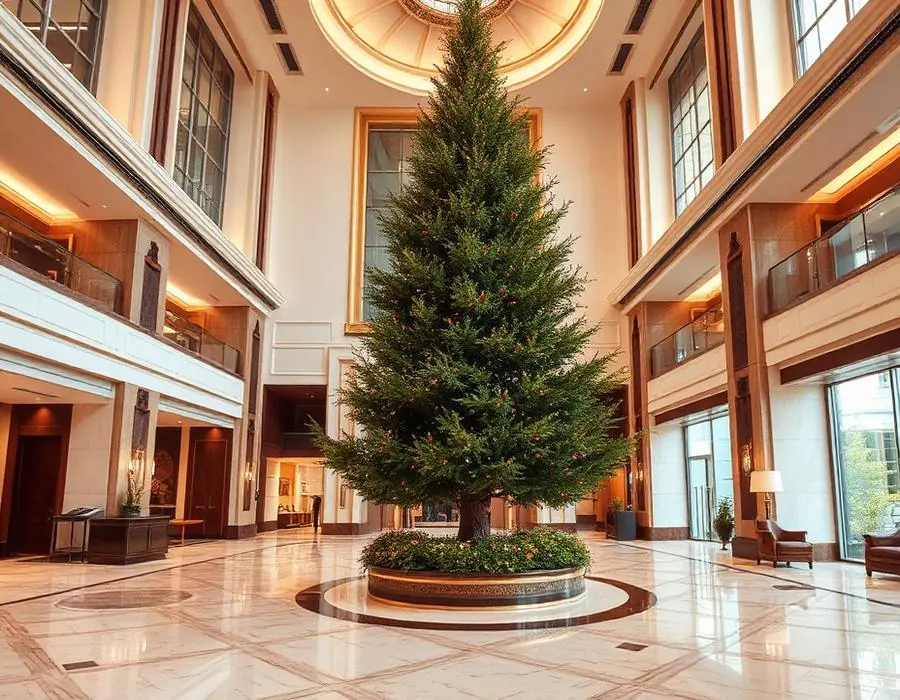
Eververda is a specialist retailer of artificial trees and plants, selling into Canada and the United States. Our commercial catalogue includes pieces such as a grass wall panel from our commercial line at $266.99 CAD, an anti-UV boxwood fence panel at $127.99 CAD, and a 9 ft commercial coconut palm at $2,787.99 to $6,291.99 CAD. No Eververda listing claims a fire rating, because no tree carries one. For a quote-priced piece such as our large-scale pine landscape display, the documentation question is answered inside the same conversation as the quote, in writing, product by product: what documentation exists, what it covers, and if none exists, which of the four options above actually applies to that piece. Anything priced $3,000 CAD and above, and any architectural or commercial-scale piece, goes through that process. Our answer is not a test report and we do not claim any product is NFPA 701 certified. Your code consultant and your AHJ decide.
Specifying at public scale, or somewhere the fire conversation gets more specific? See artificial trees for airports, malls and atriums, artificial plants for medical and dental clinics, and giant artificial trees over 15 feet for what changes at that scale. Buying for a Canadian site instead? Our companion guide on fire documentation for commercial artificial greenery covers CAN/ULC-S109 and the Ontario Fire Code.
Frequently asked questions
Is NFPA 701 the only way to comply for an artificial tree?
No, and this is the most useful thing to know. IFC 807.4.1 gives two routes: the flame propagation criteria of Test Method 1 or Test Method 2 of NFPA 701, or an alternative test to NFPA 289 using a 20 kW ignition source with a maximum heat release rate of 100 kW. Meeting either satisfies the section, and NFPA 289 is the one designed for a complete freestanding item.
Is the section number 806.2 or 807.4.1?
Both, depending on the edition your jurisdiction adopted. It was Section 806.2 in the 2015 IFC and became Section 807.4 with flammability at 807.4.1 from the 2018 edition onward. Several states still run 2015-based codes, so current local guidance legitimately cites 806.2. Ask your AHJ which edition is in force.
Does an NFPA 701 certificate mean an artificial tree is fireproof?
No. NFPA 701 measures flame propagation on tested specimens under lab conditions, and its own purpose clause says a pass does not indicate performance under more severe exposure or different use. Nothing in this category is fireproof. A pass is evidence for your code consultant and AHJ to weigh, not a safety guarantee.
Does a certificate for the foliage cover the finished tree?
Not on its face. A flame propagation result belongs to the specimens tested, and a finished piece is an assembly of foliage, adhesive, trim, trunk and armature. NFPA 701's own annex says freestanding decorative materials should be tested to NFPA 289. Ask what was tested and whether the certificate names the SKU you are buying.
Is a US NFPA 701 report enough for a project in Ontario?
Not automatically. The Ontario Fire Code cites CAN/ULC-S109-14, and NFPA 705 for field testing, in Article 2.3.2.1(1). It does not cite NFPA 701. The Article applies in listed locations, a lobby among them, and the Code does not address artificial vegetation by name, so confirm the requirement with your fire prevention officer rather than assuming either way.
Can a lit artificial tree be used in a commercial lobby?
Yes, subject to two separate requirements. The foliage needs its 701 or 289 route under 807.4.1, and under 807.4.2 the electrical wiring and lighting must be listed. Wiring and lighting are prohibited outright on artificial trees constructed entirely of metal.
Who is responsible for satisfying the fire marshal?
The building owner or whoever controls the space, together with the project's code consultants. Ontario states it in Article 1.2.1.1. A test report is evidence the authority having jurisdiction reviews, and no supplier, Eververda included, can make that decision for your building.
Code text and standards references on this page were verified against the publishers' own published text on 24 October 2026: IFC 2015, 2018, 2021 and 2024 Chapter 8 and Chapter 80, California Fire Code 2025 Chapter 8, 19 CCR Section 3.08, New York City Fire Code 2022 Chapter 8, and Ontario Regulation 213/07 Division B Articles 1.2.1.1, 2.3.2.1 and 2.3.2.2. NFPA 701 and NFPA 289 are both cited in their 2023 editions, as referenced by the 2024 IFC Chapter 80. Eververda prices shown here are Canadian-dollar list prices checked 29 August 2026; the US storefront carries its own pricing in US dollars. Code editions and local amendments change, so confirm the edition in force with your authority having jurisdiction.
Products in this article
- Large Format Artificial Grass Wall Panel 3.3 x 3.3 ft$191 USD, quoted
- Boxwood Fence Artificial Plant Panel Anti UV$92 USD, quoted
- Army Green Artificial Coconut Palm Tree 9.8 ft Glass Fiber$1,995 USD to $4,129 USD
- Natural Touch Pine Bonsai Tree 16.5 ft Indoor$7,008 USD, quoted