
Large Artificial Olive Trees: Heights, Trunks, Outdoor Use and What They Cost
21 October 2026
A large artificial olive tree costs $398 to $7,113 USD, from a 3.9 ft potted piece to a 16.5 ft fiberglass specimen. Those are the figures US buyers see on our own listings as of 21 October 2026.
Our position on fire documentation. Eververda publishes a fire figure only where documentation exists for that specific piece, and describes nothing as "fire rated". On a commercial quote we establish the occupancy, the adopted code edition and what your authority having jurisdiction (AHJ) will accept as documentation, in writing, before the order. Where no documented route exists for a piece, we say so and set out the alternatives. We do not claim a certificate for any product.
Olive is the most requested large tree we quote, and for a reason worth stating up front: it is the most forgiving species in this whole category, indoors and out. The leaf is small, matte and silver-green rather than large and glossy, so it does not show the moulding and uniform colour that give away a big shiny leaf. The branch structure is open, so the canopy does not read as a solid block and does not behave like a sail in wind. And fading, when it eventually happens, reads as natural variation rather than damage, because a real olive is already two-toned.
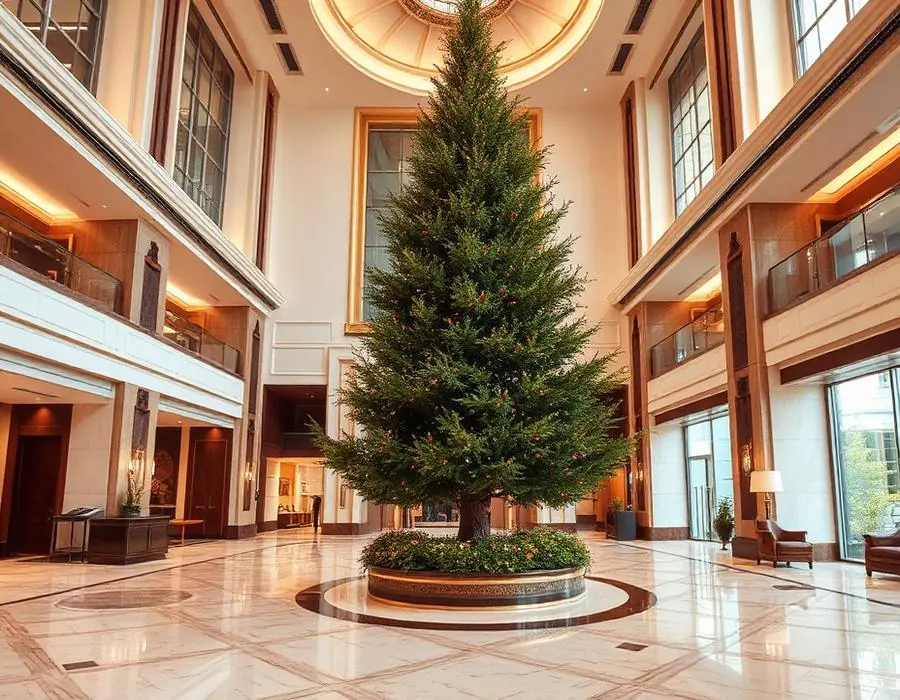
That is why olive works at 14 ft in a lobby where a fiddle leaf fig of the same height would look obviously fake, and why it survives a courtyard where a banyan would need an engineered base.
What does a large artificial olive tree cost?
| Height | Price, USD | What you get at this tier |
|---|---|---|
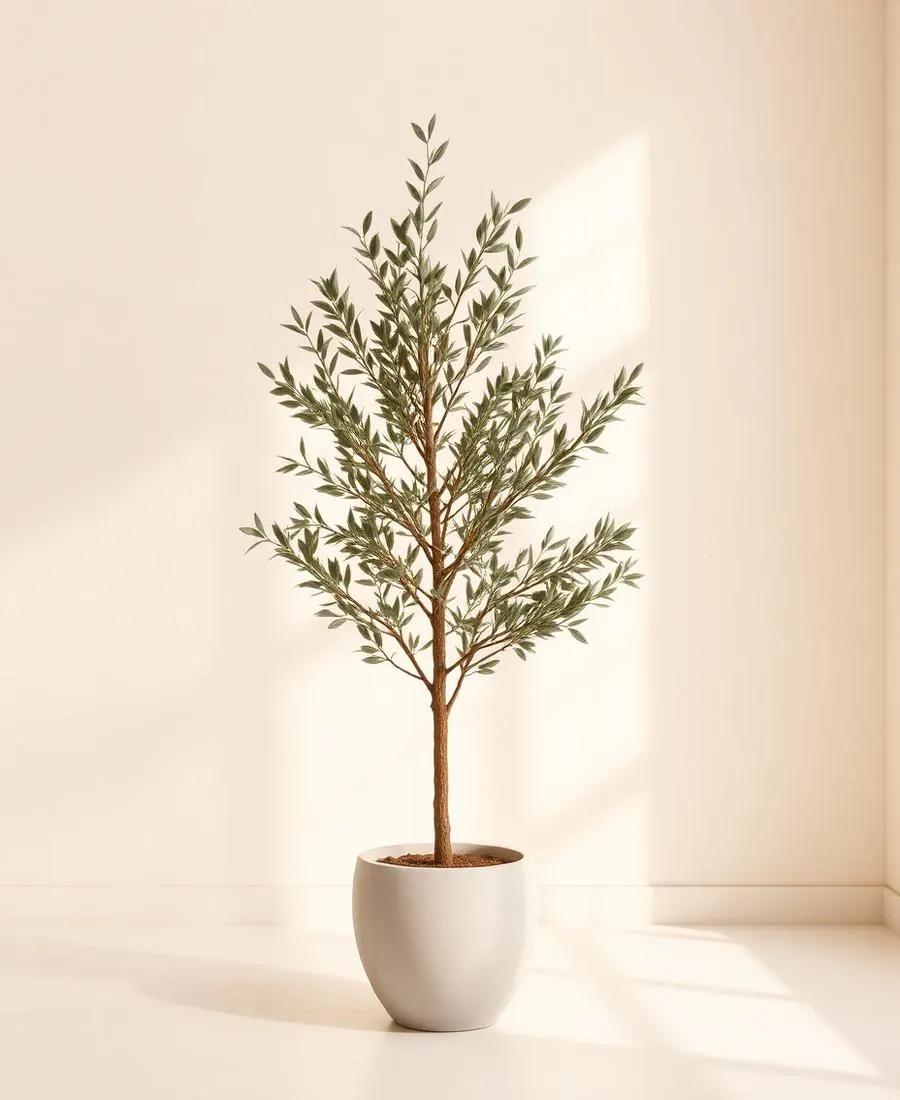
| 3.9 to 6.5 ft | $398 to $1,416 | Potted Nordic-style and wood-branch builds. Offices, cafés, reception |
| 7 to 9 ft | $1,212 to $2,331 | Natural wood trunk, Y-shaped and forked-trunk forms. Hotel and mall scale |
| 10 to 13 ft | $2,025 to $5,077 | Steel and fiberglass trunks, indoor and outdoor builds, lighted versions |
| 14 to 16.5 ft | $4,670 to $7,113 | Architectural fiberglass specimens for atriums and courtyards |
Freight is not in those figures. Above roughly 10 ft the tree is crated and palletised and needs a dock or a liftgate, so the delivered cost depends on where it is going and what the access is like. Everything at that scale is quoted rather than sold at checkout for that reason: we price the tree and its delivery together once we know the site.
Natural wood, fiberglass or steel trunk?
On an olive the trunk does more work than on almost any other species, because a real olive trunk is gnarled, twisted and deeply irregular. That is the signature of the tree, and it is the hardest part to fake.
- Moulded plastic trunk. Entry construction. Acceptable at smaller heights and at distance; the mould repeat and the seam show at close range, and on an olive that matters more than usual because the eye expects irregularity.
- Natural wood trunk. Real timber carrying applied foliage. The best close-range answer by a clear margin, because the grain and the twist are genuine. A mould repeats and a tree does not. This is what to specify if people will stand within arm's reach, at an entrance or beside seating.
- Steel trunk. Structural, used in the 10 to 13 ft band where the tree needs strength and the trunk finish is applied over it.
- Fiberglass over steel. The architectural tier. A trunk skin, usually moulded from a real olive, over a steel core. It is what makes 14 to 16.5 ft stand without guy wires, and it is why the top of the ladder sits where it does.
These builds are listed separately: a potted Nordic-style olive at 3.9 and 5.9 ft, an olive on a real wood trunk at 8.2 and 10 ft, a steel-trunk olive at 10 to 13 ft and a fiberglass-trunk olive at 14 ft.
Choose by viewing distance, not by budget. Across a 60 ft atrium, canopy density matters and trunk texture does not. At a restaurant entrance where people pass within two feet of it, the trunk is the whole impression.
Can an artificial olive tree go outside?
Olive is among the better species for it, and listed placement is still per product rather than per species. Three placements exist and each listing states which it carries: indoor, covered outdoor, or full outdoor.
Where olive has a real advantage is the foliage itself. A small matte silver-green leaf has less pigment to lose and a less uniform starting colour than a large glossy green one, so when fading does occur it reads as the natural two-tone of a real olive rather than as a faded plastic plant. The open branch structure also spills wind rather than trapping it, which puts olive closer to a palm than to a banyan on the wind question.
None of that makes it permanent. UV resistance slows fading rather than stopping it, on our trees and on everyone else's. A UV-treated olive in permanent southern-exposure sun will shift over a period of years. Partial shade, or a position that catches morning rather than afternoon sun, extends the life of the colour more than any product claim does. The wider version of this is in large outdoor artificial trees.
What holds a 14 ft olive up?
Not a pot. Above roughly 10 ft, and for anything outdoors, the base is one of three things: a ballasted base sized to the height and spread, a bolt-down base plate fixed into a concrete slab, or a below-grade sleeve where the trunk should look like it grows out of the ground.
If you are pouring a pad, get the base plate dimensions and bolt spacing in writing before the pour. This is the most common sequencing mistake on outdoor installations and the most expensive to correct. Ask at the same time for the finished footprint, the section count and the longest single section, which together decide whether the tree can physically reach the position through your doors, elevators and turns.
Eververda does not install. You arrange your own installer, and our job is to supply the correct parts and the information that installer needs: section weights, base type, bolt pattern where there is one, and the finished spread.
How full should the canopy be?
Fullness is what separates a convincing olive from a sparse one, and it is the spec most often left off a listing. A real olive is airy rather than dense, so an over-stuffed artificial olive looks wrong in a different way than a thin one does. What you want is layered depth: foliage at several distances from the trunk rather than a single outer shell.
Two things to ask for. First, canopy spread in inches or centimetres, because two 12 ft olives can differ by three feet of spread and spread is what fills a corner. Second, whether the foliage is set at varied depths or applied as an outer layer only, which is visible in a photograph taken from the side rather than the front.
Some of our smaller olive listings publish a leaf and fruit count per size, which is a harder number than any photograph. Where the manufacturer has not documented it, we mark it "Not specified" rather than estimating.
Where olive gets specified
Hotel lobbies and restaurant interiors are the two most common briefs we quote, with courtyards and covered terraces third. The reason is consistent: olive reads as Mediterranean and warm without reading as tropical, which suits a far wider range of interiors than a palm does. It also sits comfortably in modern, minimalist and Japandi schemes where a dense green tree would be too heavy.
For placement, anchoring and cleaning access at lobby scale, see artificial trees for hotel lobbies. For restaurant fit-outs specifically, see specifying artificial trees for a restaurant fit-out. Browse the range at artificial olive trees.
For a scheme built around that look rather than a single tree, see Mediterranean style.
What should you ask any supplier for?
- Trunk construction. Moulded plastic, natural wood, steel, or fiberglass over a steel core. On an olive this is the single biggest quality variable.
- Canopy spread, not just height, and whether foliage is layered or applied as an outer shell.
- Listed placement for that specific product: indoor, covered outdoor, or full outdoor.
- Base type, bolt pattern and finished footprint, before any concrete is poured.
- Section count and longest section, to confirm the delivery route.
- Whether a planter is included, or whether the tree arrives in a plain nursery pot. A decorative planter is heavy and expensive to freight and is often a separate line.
- Lead time and freight terms in writing before you commit. A made-to-order tree at this scale runs to weeks, not days.
- Fire documentation, if the space needs it. In the United States, the International Fire Code accepts either NFPA 701 (Test Method 1 or 2) or NFPA 289 (20 kW ignition source, 100 kW maximum heat release rate) for artificial vegetation, at Section 807.4.1 from the 2018 edition onward; it was Section 806.2 in the 2015 edition, which some jurisdictions still run. No product is automatically compliant for your building. Ask what test documentation exists, and confirm the requirement with your local fire marshal or authority having jurisdiction, which has the final say. See fire documentation for commercial artificial greenery.
Where Eververda fits, with the caveats
We ship to the United States and price in USD at checkout, which is where every figure on this page comes from. Each listing publishes the manufacturer's specification, including trunk construction and listed placement, and anything the manufacturer has not documented is marked "Not specified" rather than filled in with a guess.
The caveats, in the same spirit. Everything at feature scale here is quoted rather than sold at checkout, so you cannot add a 14 ft olive to a basket; send the height, the position, the exposure and the delivery access and we price the tree and its freight together. The specification table on each listing records what the manufacturer documented about the piece and writes "Not specified" rather than a guess, so a photograph can be checked against the numbers behind it. Returns are open for 30 days, shipping damage can be reported within 48 hours, and anything damaged, defective or incorrect is repaired, replaced or refunded at our cost, with no restocking fee. And we do not install.
The largest pieces across all species sit in trees over 15 ft, and the outdoor question across species is covered in large outdoor artificial trees.
Frequently asked questions
How much does a large artificial olive tree cost?
$398 to $7,113 USD on our own listings as of 21 October 2026. A 3.9 to 6.5 ft potted olive runs $398 to $1,416, a 7 to 9 ft tree $1,212 to $2,331, a 10 to 13 ft feature tree $2,025 to $5,077, and architectural specimens at 14 to 16.5 ft $4,670 to $7,113. Freight is quoted with the tree.
Why are artificial olive trees so popular for commercial spaces?
Because olive is the most forgiving species to fake. The leaf is small, matte and silver-green rather than large and glossy, so it does not show moulding or uniform colour the way a fiddle leaf fig does. The branch structure is open, which reads as natural and does not catch wind. And it suits Mediterranean, modern, minimalist and Japandi interiors equally, which a palm does not.
Is a natural wood trunk worth it on an artificial olive?
At close viewing distance, more than on any other species. A real olive trunk is gnarled and deeply irregular, and that irregularity is exactly what a mould cannot reproduce, because a mould repeats and a tree does not. If people pass within arm's reach, the trunk is the whole impression. Across a large atrium, canopy density matters more.
Can artificial olive trees be used outdoors?
Certain builds list outdoor placement, per product rather than per species. Olive does better outdoors than most: the small matte leaf has less pigment to lose, and fading reads as the natural two-tone of a real olive rather than as damage. The open canopy also spills wind rather than trapping it. UV resistance still only slows fading, so check the placement shown on the specific listing.
How do you anchor a large artificial olive tree?
Above roughly 10 ft: a ballasted base sized to the height and spread for sheltered positions, a bolt-down base plate fixed into concrete for permanent installations, or a below-grade sleeve where the trunk should appear to grow from the ground. Get the base plate dimensions and bolt spacing in writing before pouring any pad.
How long does a large artificial olive tree take to arrive?
Weeks rather than days at the larger sizes, because they are made to order and then crated and freighted. Production and transit both sit between the order and the delivery date. Ask for the lead time in writing with the quote, particularly if the tree has to be standing for a fixed opening or event date.
Prices are USD as shown to US visitors at checkout and were read from our own listings on 21 October 2026. Fire code text was verified against the publishers' own published text on 24 October 2026.
Products in this article
- Artificial Olive Tree, 3.9 ft and 5.9 ft, Potted Nordic Style$393 USD to $492 USD
- Artificial Olive Tree, 8.2 ft (2.5 m) and 10 ft (3 m), Real Wood Trunk$1,896 USD to $2,309 USD
- Steel Trunk Olive Tree 10 ft to 13 ft Lobby Decor$2,529 USD to $4,001 USD
- 14 ft Artificial Olive Tree with Fiberglass Trunk$4,309 USD