Large Outdoor Artificial Trees: What Actually Survives Outside, and What It Costs
21 October 2026
A large outdoor artificial tree costs $295 to $15,250 USD depending on species, height and how it is built. Those are the figures US buyers see on our own listings as of 21 October 2026. A 6 ft real-touch plant sits at the bottom. A 33 ft banyan specified into a restaurant atrium sits at the top.
Our position on fire documentation. Eververda publishes a fire figure only where documentation exists for that specific piece, and describes nothing as "fire rated". On a commercial quote we establish the occupancy, the adopted code edition and what your authority having jurisdiction (AHJ) will accept as documentation, in writing, before the order. Where no documented route exists for a piece, we say so and set out the alternatives. We do not claim a certificate for any product.
Before any of that, the three things that decide whether an outdoor tree is still worth looking at in year three, in order of how often they are got wrong:
- The listed placement of that specific product, which is not a property of the species.
- Wind loading, which is about canopy shape rather than height.
- The base, which above roughly 10 ft is never just a pot.
And the thing nobody in this category says plainly: UV resistance slows fading. It does not stop it. That is true of our trees and of everyone else's. A UV-stabilised leaf in permanent direct sun holds its colour markedly longer than an untreated one and will still shift over a period of years. Partial shade, or a position that gets morning rather than afternoon sun, is worth more to the lifespan than any claim on a listing.
What does a large outdoor artificial tree cost?
| What | Height | Price, USD |
|---|---|---|
| Outdoor shrubs, ferns and screening panels | panel and shrub scale | $73 to $295 |
| Potted outdoor trees, UV-resistant | 5 to 8.5 ft | $398 to $1,517 |
| Feature trees: acacia, birch, cedar pine, bonsai forms | 6.5 to 11.5 ft | $906 to $2,535 |
| Palms: coconut, date, Washingtonia | 8 to 18 ft | $1,721 to $7,113 |
| Olive, banyan, ficus and wisteria at feature scale | 11 to 16.5 ft | $2,025 to $5,077 |
| Architectural specimens | 16 ft and above | $5,077 to $15,250 |
Freight is not in those numbers. Anything above roughly 10 ft is crated and palletised and needs a dock or a liftgate, so the delivered cost depends on the destination and the site access. Trees at that scale are quoted rather than sold at checkout for exactly that reason: we price the tree and its delivery together once we know where it is going.
Indoor, covered outdoor, or full outdoor?
Three placements exist, and they are listed per product. The single most expensive mistake in this category is assuming a species is outdoor-safe because another tree of the same species is.
- Indoor. No outdoor placement listed. Sun and standing rain will take it apart quickly.
- Covered outdoor. An entrance, a loggia, a roofed terrace, a covered walkway. Outdoor air and temperature, but protected from standing rain and the worst of the midday sun. A large share of trees sold as "indoor outdoor" mean this.
- Full outdoor. Open sky, direct sun, wind, rain. At feature scale these are fiberglass-over-steel or steel-frame builds with UV-treated foliage.
Match the listed placement to where the tree will actually stand. Browse what lists outdoor exposure in UV resistant and outdoor safe and outdoor trees.
Which species hold up outside, and which do not
- Palms are the best outdoor choice, and not because of the foliage. A frond spills air; a dense broadleaf canopy traps it. That makes a palm the sensible pick for an exposed terrace, a rooftop or a waterfront position. Coconut, date and Washingtonia all come in full-outdoor builds. Detail in outdoor artificial palm trees.
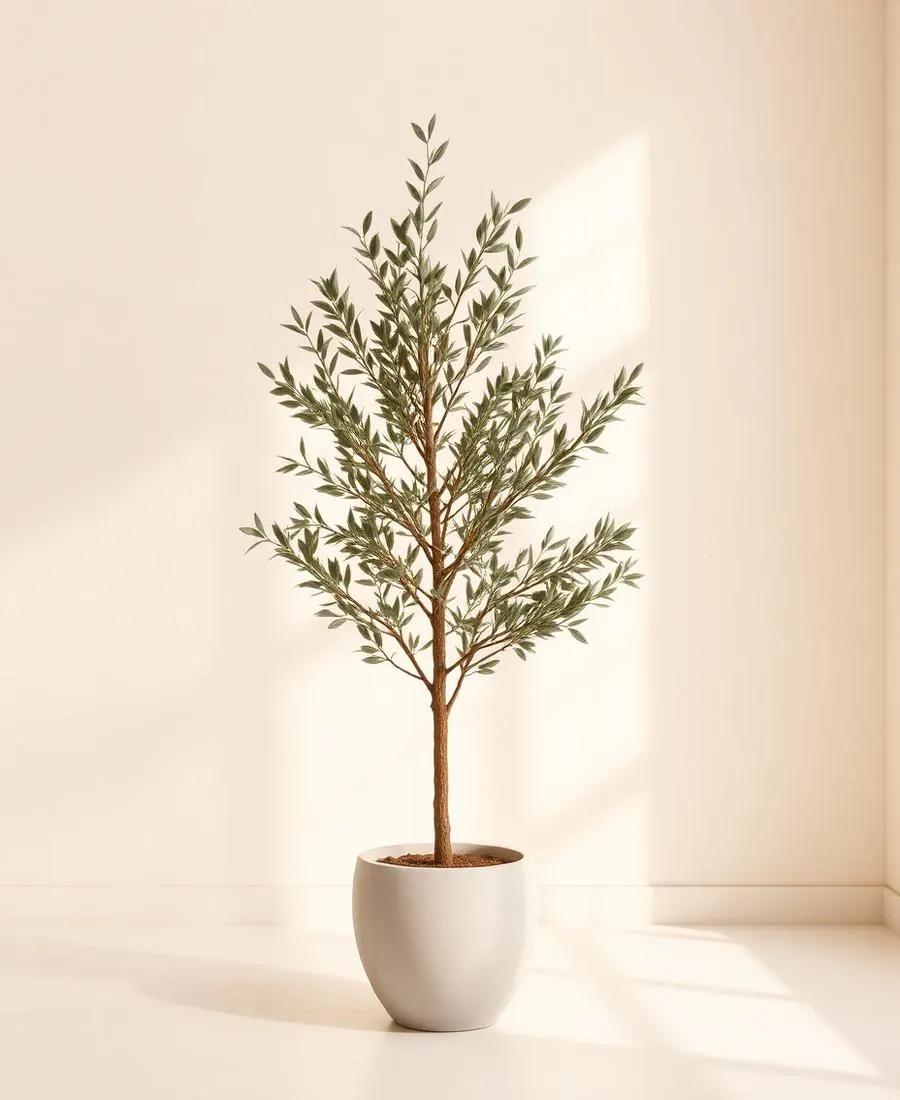
- Olive is the next most forgiving. A small, matte, silver-green leaf on an open branch structure. The leaf is irregular enough that fading reads as natural variation rather than damage, and the canopy is open enough not to act as a sail.
- Cedar, pine and other conifers hold structure well and look correct in a cold climate, which matters if the tree sits outdoors year round.
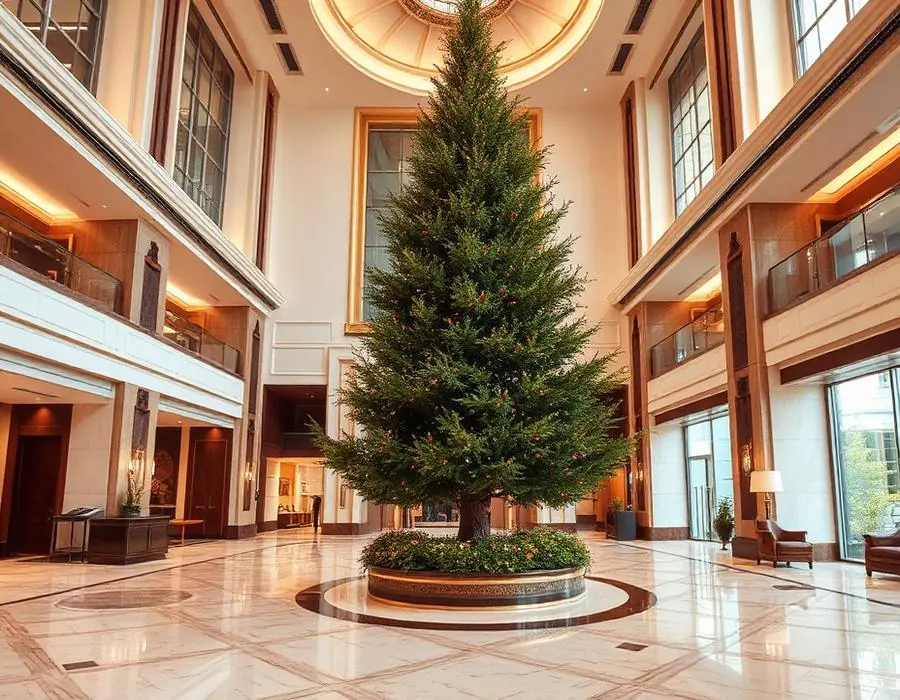
- Banyan, ficus and broad-canopy trees look superb and behave like sails. They belong in courtyards, covered atriums and sheltered gardens rather than exposed positions. See large artificial ficus and banyan trees.
- Flowering trees are the hardest outdoors. Blossom has more surface area per gram and more pigment than a green leaf, so it fades faster in the same position. White holds up better than pink or rose. It is still perfectly workable, but specify a full-outdoor build and expect blossom to be the part you refresh. See large artificial cherry blossom trees.
Builds that list outdoor exposure across those groups include a UV-resistant palm at 9.8 to 18 ft, a UV-resistant olive at 1.8 to 2.4 m, a cedar pine at 6.5 and 8.25 ft and a UV-resistant ficus banyan at 13 ft.
Wind: the specification nobody asks about
Height gets all the attention and canopy shape does the damage. A broad, dense canopy at 13 ft catches far more wind than a narrow one at 18 ft, and it transfers that load straight into the base.
Practical rules. In a genuinely exposed position, choose an open-canopy species or accept that the base has to be engineered rather than weighted. Ask for the canopy spread, not just the height, because spread is what sets the load. And if the tree sits where wind funnels, between buildings or along a waterfront, say so when you ask for a quote, because it changes the base recommendation.
Bases, concrete pads and bolt patterns
Above roughly 10 ft outdoors, the base is one of three things.
- Ballasted base. Cement- or sand-filled, sized to the height and spread. Adequate in sheltered positions.
- Bolt-down base plate. Fixed into a concrete slab with a defined bolt pattern. The normal answer for a permanent outdoor installation.
- Below-grade sleeve or footing. Used where the trunk should look like it grows out of the ground rather than standing on a plate.
If you are pouring a pad, get the base plate dimensions and bolt spacing in writing before the pour, not after the tree arrives. This is the single most common sequencing error on outdoor installations, and it is expensive to correct in concrete. Ask for the finished footprint at the same time, along with the section count and the longest single section, which together decide whether the tree can physically reach the position.
Eververda does not install. You arrange your own installer, and our job is to supply the correct parts and the information that installer needs.
What happens in winter?
Cold itself is not the problem. These trees do not rot, wilt or drop leaves at low temperature, which is the whole reason a faux olive or palm works in a climate where the real thing cannot live outdoors.
Ice load and freeze-thaw are the problems. Foliage that collects heavy snow or a coating of ice takes mechanical stress it was not designed for, and water that sits in a hollow base and freezes can split it. In a climate with real winters: choose a covered position, or drain and cover the base before the first freeze, or take smaller potted pieces indoors for the season. A bolted-down tree should have a drainage path in the base rather than a sealed cavity. Open-canopy species shed snow better than dense ones, which is another reason palms and olives do well in mixed climates.
Pool decks, salt air and irrigation
Pool and patio areas are one of the strongest cases for artificial trees, for reasons that have nothing to do with looks: no soil washing into the water, no leaf litter in the skimmer, no watering, and no root system near a pool shell or deck slab.
Plan for two things. Splashed chlorinated water leaves a mineral film as it dries, so a rinse with clean water a couple of times a season keeps foliage from going dull. In coastal air, salt does the same faster and also attacks unprotected metal, so specify stainless or properly coated fixings rather than plain steel. See artificial trees for pools and patios.
What should you ask any supplier for?
- Listed placement for that specific product: indoor, covered outdoor, or full outdoor. Not a category claim.
- Canopy spread, which sets the wind load and whether the tree fits.
- Trunk and frame construction, and whether fiberglass is over a steel core.
- Base type, bolt pattern and finished footprint, before any concrete is poured.
- Section count and longest section, to confirm the delivery route.
- What the UV treatment is and what the warranty covers if colour shifts. "UV resistant" alone is not an answer.
- Lead time and freight terms in writing before you commit.
- Fire documentation, if the space needs it. In the United States, the International Fire Code accepts either NFPA 701 (Test Method 1 or 2) or NFPA 289 (20 kW ignition source, 100 kW maximum heat release rate) for artificial vegetation, at Section 807.4.1 from the 2018 edition onward; it was Section 806.2 in the 2015 edition, which some jurisdictions still run. No product is automatically compliant for your building. Ask what test documentation exists, and confirm the requirement with your local fire marshal or authority having jurisdiction, which has the final say. See fire documentation for commercial artificial greenery.
Where Eververda fits, with the caveats
We ship to the United States and price in USD at checkout, which is where every figure on this page comes from. Each listing publishes the manufacturer's specification, including the listed placement, and anything the manufacturer has not documented is marked "Not specified" rather than filled in with a guess.
The caveats. Smaller potted pieces are bought at checkout; everything at feature scale is quoted rather than sold, so you cannot add a 16 ft tree to a basket. Send the height, the position, the exposure and the delivery access and we price the tree and its freight together. Exposure is the question to settle before ordering, and the listing's specification table is where to settle it: it holds what the manufacturer documented, and "Not specified" marks anything it did not. Returns run to 30 days, damage in transit is reported within 48 hours, and a piece that is damaged, defective or incorrect is repaired, replaced or refunded at our cost, with no restocking fee on those. And we do not install.
Start at outdoor trees, or go straight to palms, cherry blossom or ficus and banyan.
Frequently asked questions
How much do large outdoor artificial trees cost?
$295 to $15,250 USD on our own listings as of 21 October 2026. A UV-resistant potted outdoor tree at 5 to 8.5 ft runs $398 to $1,517. A feature tree at 6.5 to 11.5 ft runs $906 to $2,535. Palms at 8 to 18 ft run $1,721 to $7,113, and architectural specimens above 16 ft reach $15,250. Freight is quoted with the tree.
Which artificial trees are best for outdoors?
Palms first, because fronds spill wind rather than trapping it, then olive, which has a small matte leaf on an open branch structure that ages gracefully. Conifers hold structure well in cold climates. Broad-canopy trees such as banyan and ficus look excellent but act like sails, so they suit courtyards and covered atriums rather than exposed positions. Flowering trees fade fastest because blossom carries more pigment and more surface area than a green leaf.
Do outdoor artificial trees fade in the sun?
Yes, eventually, including UV-resistant ones. UV stabilisation slows the breakdown of pigment and polymer rather than preventing it. Exposure sets the pace: full southern sun ages foliage faster than a north-facing or partly shaded position, and a covered walkway slower still. Compare the listed placement and the warranty rather than the phrase "UV resistant", which every listing in the category uses.
How do you anchor a large artificial tree outdoors?
Above roughly 10 ft: a ballasted base sized to the height and spread for sheltered positions, a bolt-down base plate fixed into a concrete slab for permanent installations, or a below-grade sleeve where the trunk should appear to grow from the ground. Get the base plate dimensions and bolt spacing in writing before pouring any concrete, and give the supplier the exposure conditions, because canopy spread and wind funnelling change the recommendation.
Can artificial trees stay outside through winter?
In a mild climate, a tree listed for full outdoor placement can. The risks in a cold climate are not temperature but ice load on the foliage and water freezing inside a hollow base. Choose a covered position, drain and cover the base before the first freeze, or bring smaller potted pieces indoors. Open-canopy species shed snow better than dense ones.
Are artificial trees worth it outdoors compared with real ones?
It depends on what the position can support. Where a real tree would need irrigation, root space, seasonal replacement or a climate it cannot survive, an artificial one removes all of that and holds its appearance for years rather than weeks. Where a real tree will genuinely thrive, it will outlast and outperform any artificial version. The honest case for artificial outdoors is positions that are hostile to living plants: pool decks, paved courtyards, rooftops, shaded atriums and cold climates where the species you want will not grow.
Prices are USD as shown to US visitors at checkout and were read from our own listings on 21 October 2026. Fire code text was verified against the publishers' own published text on 24 October 2026.
Products in this article
- Artificial Palm Tree, 9.8 to 18 ft (3 to 5.5 m), UV Resistant, Outdoor$1,995 USD to $4,589 USD
- UV Resistant Olive Tree 1.8 m to 2.4 m Outdoor$1,194 USD to $1,795 USD
- Artificial Cedar Bonsai Pine Tree, 6.5 ft (2 m) and 8.25 ft (2.5 m), Indoor or Outdoor$1,995 USD to $2,497 USD
- Artificial Ficus Banyan Tree, 13 ft (4 m), Green, UV Resistant$3,749 USD