
How to Judge an Artificial Plant When You Can Only See the Photos
29 August 2026
Almost nobody buying an artificial tree or plant online gets to touch it first. You are working from a handful of photographs, a spec block that may or may not exist, and a review section skewed toward the day a box was opened. That is the actual situation, so the useful skill is reading a listing correctly, not hoping the product turns out fine. Four things carry almost all the signal: whether the photos show the whole piece, pot and base included, against a size reference; whether the listing names the trunk material and states a leaf or blossom count; whether the reviews you weight were taken weeks after delivery rather than on unboxing day; and whether price, return terms and the seller's answers to a direct question line up with what the listing claims. This applies to any seller, Eververda included.
What does a product photograph actually tell you?
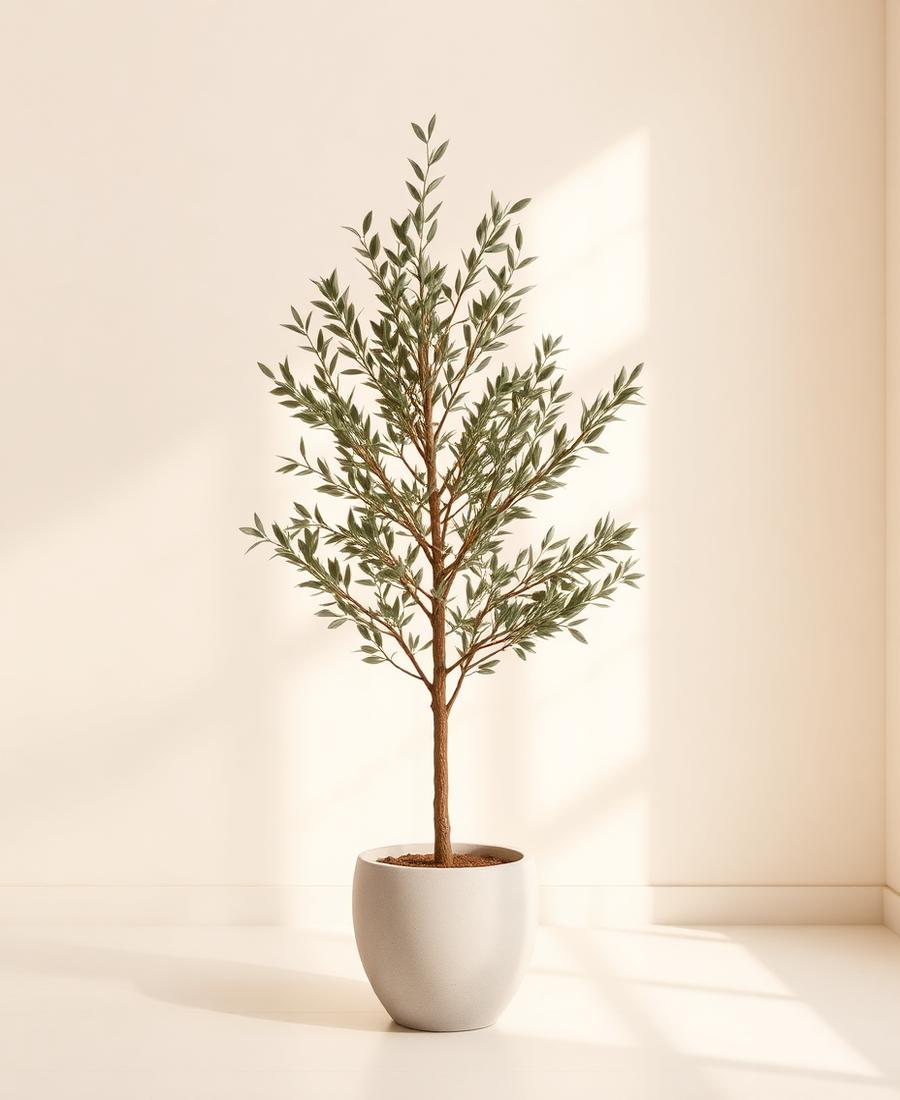
A styled hero shot is lit to sell the room, not to document the tree. Soft light and a shallow depth of field flatter almost any canopy and blur exactly the texture you'd want to check up close. Treat it as marketing, not evidence, and look for the photographs that are actually informative.
The single most useful image on a good listing is a full-length shot of the entire piece, pot and base included, against a plain background, with something of known size in frame - a doorway, a person, a tape measure. Without that reference, a canopy photographed close and cropped tight could belong to a 4 ft tree or an 8 ft one, and you cannot tell which from the image alone.
Heavy retouching has tells: saturation pushed uniformly across every leaf instead of the light-to-dark variation a real plant has in shadow and new growth; a trunk with no grain and no visible joins where branches meet the stem; backgrounds cloned out entirely, which can also hide a stand or support the finished product actually needs. None of this is disqualifying alone, but a full image set that shows this treatment throughout, with no plain shot anywhere, is telling you the plain version would look worse.
The clearest single warning sign is a listing that only ever shows the canopy close up - three or four crops of leaves or blossom, no full-length shot, no base, no scale. That's usually a choice, not an oversight: a full-length photograph is the easiest way to show a tree is well-proportioned, and the easiest way to expose one that isn't. What makes an individual tree look convincing up close - trunk construction, multi-tone foliage, canopy density - is covered in what makes an artificial tree look real; this piece is about reading the listing that's supposed to tell you those things before the tree arrives.
What should the written listing tell you?
Text is where a confident seller and a thin one diverge most clearly, because text costs nothing to write and a vague listing is a choice, not a limitation.
A published leaf or blossom count is a strong quality signal, because counting leaves on a mould is tedious and only worth doing if the number reflects well on the product. Eververda's 4-6 ft areca palm, $289 to $419 CAD, publishes 15 to 21 leaves depending on height; the 5.25-8 ft olive tree in silk foliage, $249 to $449 CAD, states counted leaves and fruit rather than leaving canopy density to the photograph. No count doesn't mean a sparse tree, but a published number means the seller checked it and was happy with what they found.
Named materials beat adjectives. "High-quality material" describes nothing you can act on. "Polyethylene," "PVC," or "polyester silk" tells you something real about how the foliage will behave - see what PE, PVC and silk actually mean, and what real-touch foliage is if the listing uses that term, since it names a coating, not a material category on its own.
A stated trunk construction beats silence. Natural wood, cast fibreglass, and moulded plastic behave and cost differently, and a seller who has invested in real wood or fibreglass says so, because it's the part of the build that costs the most to get right. Eververda's 5.25-7 ft olive tree on a natural wood trunk, $249 to $419 CAD, names the construction in the title, not buried three screens down.
Dimensions need a measuring method, not just a number. "6 ft" alone doesn't say whether that includes the pot or is measured to the tallest leaf. A listing stating "72 in including pot, measured to the highest point of the foliage" gives you something to check against your ceiling or doorway; see how to choose the right size for turning a stated dimension into a room decision.
An absent spec usually means the seller had nothing strong enough to publish. A listing with no material named, no count given and no trunk construction stated anywhere isn't automatically a bad product, but it's one you can't verify before it arrives, and that risk should be priced into the decision.
Which reviews are actually worth reading?
Reviews on artificial plants skew hard toward the first-impression photo: a customer unboxes the tree, fluffs it for ten minutes, and posts a bright, freshly-arranged shot the same day. That tells you almost nothing about how the piece looks after a few weeks in the room, whether colour has stayed even near a sunny window, or whether branches held their shaped position. The reviews worth weighting are the ones posted later, with a photo in an ordinary room rather than against the packaging - ideally a second photo added as an edit weeks after the first. A photo with no text beats text with no photo, because you can judge canopy density and colour yourself rather than take someone's adjective for it.
What should you ask a seller before buying a large piece?
For anything above a small tabletop plant, a direct question to the seller is worth more than another minute studying photographs. Ask: what the trunk is made of; whether the stated height includes the pot; what the base weighs and is filled with; for one more photo of the lower trunk and base, the area most listings crop out; and what happens if the piece doesn't match the listing on arrival. A specific, plain answer is a good sign regardless of what it says. A seller who won't answer, or just repeats the page copy, is telling you something too.
Why does the return policy matter more on a bulky item?
Return shipping on a small, light purchase is a minor cost either way. On a tree shipping in a box the size of a door, freight runs both directions, and that can be a meaningful fraction of the item's price on a large or heavy piece. Before buying anything freight-scale, check who pays return shipping, whether the box has to go back in its original packaging, and whether there's a restocking fee - with every seller you're considering, ours included, rather than assuming it matches something smaller you've returned before.
What are the clearest red flags?
A handful of signals are worth stopping on. A price far below what the category charges for the stated size and materials is the most reliable one - see why faux trees cost $80 or $900 for what drives that spread, since it usually comes down to trunk construction and foliage density rather than markup. A single stock photo reused across many differently-titled products, visible in identical crops and lighting on listings claiming to be different trees. No material stated anywhere - not the title, not the bullets, not the description. And a size claim that contradicts itself between the title and the body text, a title reading "7 ft" against a description stating 82 in including pot lower down, which usually means nobody checked the listing after it was assembled from a supplier feed.
| What to check | What a confident listing shows | What a thin listing usually does instead |
|---|---|---|
| Full-length photo | Whole tree, pot and base included, with a size reference in frame | Canopy close-ups only, no scale, no base shown |
| Foliage material | Named: polyethylene, PVC, or polyester silk | "High-quality" or "premium simulation" with no material named |
| Trunk construction | Stated: natural wood, cast fibreglass, or moulded plastic | Not mentioned; lower trunk not clearly photographed |
| Leaf or blossom count | A specific number, sometimes by height variant | No count given anywhere |
| Dimensions | A number plus how it was measured (with/without pot, to what point) | A single unexplained figure, sometimes contradicted elsewhere on the page |
| Reviews | Photos posted weeks after delivery, in an ordinary room | Only unboxing-day photos against the shipping box |
What our own listings publish
Applying this to Eververda specifically: our product pages state trunk material, foliage type, and leaf or fruit counts wherever we hold that figure, with a full-length photograph including the pot on every listing. Where a specification has not been verified, the field reads "Not specified" rather than a guess - the same standard this article is asking you to apply to any seller, including us.
Frequently asked questions
How can I tell if a product photo has been heavily edited?
Look for uniform saturation across every leaf with no lighter or darker variation, a trunk with no visible grain or colour break, and backgrounds cloned or blurred out entirely rather than just softly lit. None of these alone is disqualifying, but a full image set that shows this treatment on every photo, with no plain shot of the product, suggests the plain version would look noticeably different.
Why do so many listings avoid showing the base of the tree?
Because the base and lower trunk are the areas hardest to disguise. Cropping the canopy close and leaving out the base avoids showing a mould seam, a thin pot, or a trunk that looks visibly different from what the styled hero shot implies. A listing that photographs the whole piece plainly, base included, has less to hide there.
Is a low price always a red flag on an artificial tree?
Not always, but a price well below what comparable stated size and materials cost elsewhere in the category is worth investigating rather than treating as a bargain. Trunk construction and foliage density are the two biggest cost drivers, so an unusually low price on a tree claiming natural wood and a stated leaf count is worth a direct question to the seller before buying.
Should I trust reviews with no photos at all?
Weight them lower than reviews with photos, but they're not worthless if the text is specific rather than generic. A review naming a concrete detail - colour matching a swatch, branches holding their shape after a month - carries more information than a one-line "looks great," even without a picture.
What should I photograph or ask for before buying a large piece sight unseen?
Ask the seller for one additional photo of the lower trunk and base if the listing doesn't already show it clearly, confirm whether the stated height includes the pot, and ask what the base weighs and what it's filled with. Also confirm the return process and who pays return freight before you buy, since that matters more on a bulky item than a small one.
Checked 29 August 2026. Eververda prices are CAD and current as of that date.