What Makes an Artificial Tree Look Real?
22 August 2026
Prices mentioned in this article are Canadian dollar (CAD) list prices. Current US prices, in US dollars, are listed under Products in this article and on each product page.
Ask what the most realistic fake plant is and you get a lot of brand names back. Brand names are not an answer, because the same company will sell you an excellent 8 ft olive tree and a poor 4 ft one. Realism is a property of the individual product, and it comes down to five things you can actually check.
What is the most real looking fake tree?
The most realistic artificial trees are the ones built on a natural wood or cast fibreglass trunk, with hand-layered multi-tone foliage, a dense canopy, and a canopy spread of roughly half the tree's height. No species is inherently more realistic than another, but some are much less forgiving than others.
Olive, ficus and fiddle leaf are forgiving, because their real-world foliage is irregular and slightly imperfect anyway. Palms are unforgiving, because a real palm frond is a single long structure with hundreds of parallel leaflets and any shortcut in the moulding shows immediately. Cherry blossom sits in between: the blossom hides a lot, but a flat pink canopy with no depth reads as decoration rather than as a tree.
What is the most realistic artificial olive tree?
The one that gets the leaf underside right, which is the specific check for olive and the one almost nobody mentions.
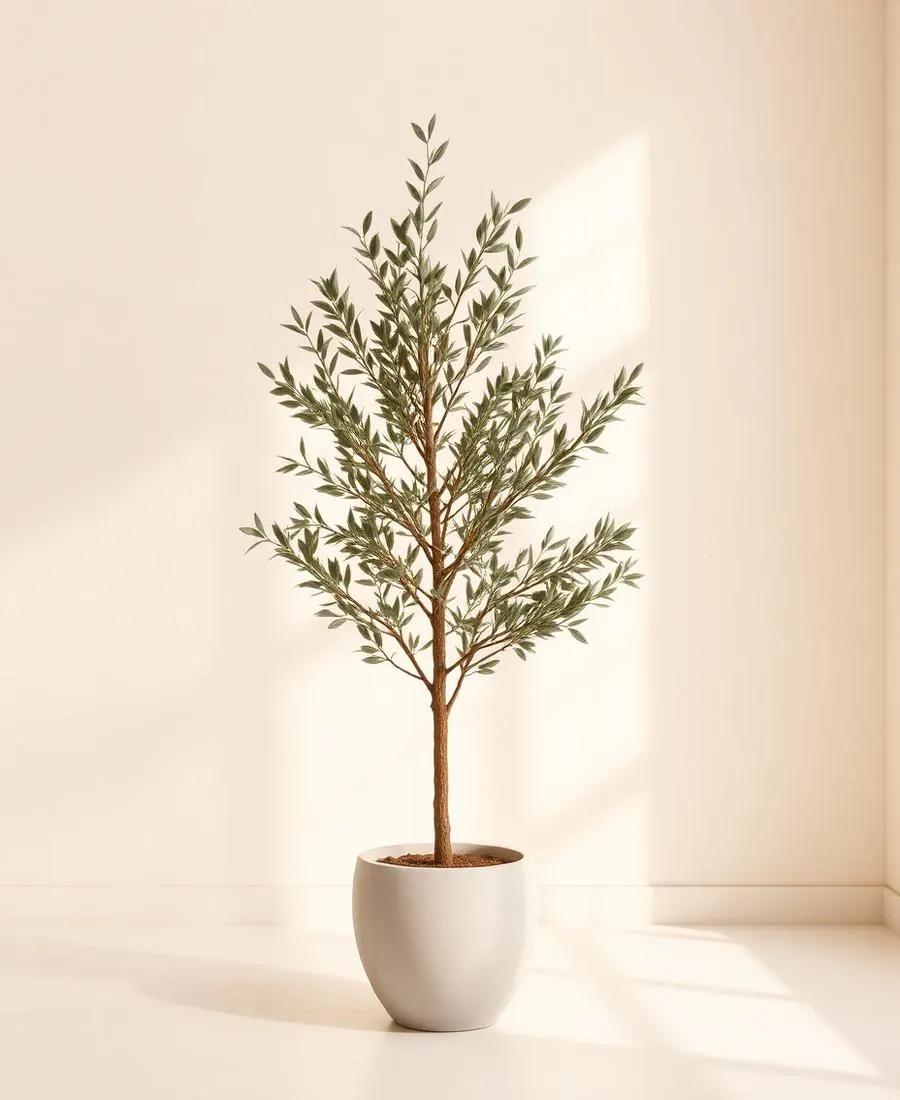
A real olive leaf is small, narrow and two different colours on its two faces: dull grey-green on top, close to silver underneath. That is why a real olive flickers when wind moves through it, and why a still photograph of one shows pale and dark leaves mixed across the canopy rather than a single tone. Cheap artificial olive is moulded one flat green on both faces, so the canopy goes dead and uniform. In any product photograph, look for leaves that have turned over: if the ones showing their backs are a visibly lighter shade, the maker has done the expensive thing.
Two more olive-specific checks. The fruit should not all match. A real olive tree carries green, red-brown and near-black fruit at the same time, all matte. A scatter of identical glossy black beads is the fastest way to spot a cheap one. And the trunk matters more on olive than on almost any species, because a real olive trunk is gnarled, fissured and often partly hollow with age. A smooth moulded pole under olive foliage is a mismatch your eye catches even if you cannot name it, which is why our 5.25 to 7 ft olive on a natural wood trunk, $249 to $419 CAD, is the one we point at when realism is the priority.
What is the most realistic artificial palm tree?
Palms are the hardest common species to fake, so the question is really which palm. Feathery, multi-stemmed species such as areca forgive a lot; single-trunk fan palms forgive nothing, because a fan frond is one large moulded sheet with nowhere to hide a shortcut.
Three checks, in order of how much they give away. Are the leaflets separated at the tips? On a real frond every leaflet ends independently. Cheap mouldings fuse them into a continuous scalloped edge, which reads as a plastic comb. Does the frond have a central rib that tapers? A real rachis is thick at the base and fine at the tip; a constant-width spine is a moulding shortcut. Does the frond bend in two directions? Real fronds arch downward and twist along their length at the same time. A frond that is flat in one plane looks pressed, because it was.
Leaf count is the other honest signal, and it is rarely published. Our areca palm lists 15, 18 and 21 leaves across its 4 to 6 ft range at $289 to $419 CAD, and for a sunny position the 5 to 6 ft palm with UV-resistant fronds runs $293.99 to $374.99 CAD.
What should an artificial tree trunk be made of?
This is the first thing to check and the thing most product pages are vaguest about. There are three constructions in common use.
Natural wood. An actual dried tree trunk or a set of real branches, with real bark. Nothing else looks this convincing up close, because it is not an imitation of bark, it is bark. The trade-offs are weight and consistency: real wood is heavy, and no two trunks are identical, so a set of four matched trees is harder to supply.
For price context, a 5.25 to 7 ft olive built on a natural wood trunk is $249 to $419 CAD.
Cast fibreglass. A mould is taken directly off a real trunk and cast in resin over a structural core. You get genuine bark relief, the same knots and fissures as the original tree, at a fraction of the weight, and it is stable outdoors where real wood eventually is not. Good fibreglass is hand-painted in several tones after casting. Poor fibreglass is sprayed one colour and looks like it.
Moulded plastic. Injection-moulded in sections and pushed together. The tells are a repeating bark texture that visibly loops every few inches, a uniform colour with no tonal variation, and a mould seam running the length of the trunk. If the listing does not say what the trunk is made of, and the photographs never show the lower trunk clearly, it is almost always this.
What should the foliage look like up close?
Look at any real tree outside your window. There is no single green in it. New growth at the branch tips is lighter and yellower, mature leaves in the middle are darker, leaves in shadow read almost blue, and the undersides of leaves are a completely different shade from the tops: dramatically so on olive, where the underside is nearly silver.
Cheap artificial foliage is moulded in one colour in one run. That single flat green is the thing your eye catches from across the room, even when you cannot say what is wrong. Better foliage is produced in several colourways and mixed on the tree, and the best has tonal variation printed or sprayed within the individual leaf.
Two other foliage details worth looking for. Real leaves have veins, and quality artificial leaves are pressed from casts of real ones so the veining is physically embossed rather than printed flat. And real leaves are not all the same size: a tree with uniformly sized leaves looks manufactured, because it is.
On material: polyethylene, usually shortened to PE, holds a three-dimensional leaf shape and is what you want for structural foliage. Silk, which in this trade means fabric rather than actual silkworm silk, is thinner and moves, which suits blossom, willow and anything that should look light. Most good trees use both.
How many leaves should an artificial tree have?
Leaf count is where cost gets cut, because leaves are the expensive part and removing them does not change the number on the listing. A tree described as 8 ft with a sparse canopy is still 8 ft.
The test is simple: look at the tree straight on and see how much of the wall behind it you can see through the canopy. A real broadleaf tree in leaf is substantially opaque through the middle of its canopy. If a product photograph shows a clear view straight through to the background, the canopy is underfilled, and no amount of shaping will fix it because the leaves are simply not there.
Reputable listings publish a leaf count. If a seller publishes one, that is a good sign in itself. Compare like with like: leaf counts are only comparable between trees of similar height and species.
Two examples of what publishing looks like: our areca palm lists 15 to 21 leaves depending on height across its 4 to 6 ft range and runs $289 to $419 CAD, and the 5.25 to 8 ft olive lists counted leaves and fruit at $249 to $449 CAD.
How wide should an artificial tree's canopy be?
This is the specification buyers most often overlook, and it is the one that decides whether a tree looks like a tree or like a stick with leaves on top.
As a working rule, a broadleaf tree's canopy spread should be around half its height. A 10 ft olive tree wants roughly a 5 ft spread. A 10 ft tree with a 3 ft spread is not a small tree, it is a wrong-shaped tree, and it will look wrong in the room no matter how good the foliage is.
Narrower ratios are correct for some species (cypress and some pines are genuinely columnar), but if a broadleaf tree lists a spread under 40 percent of its height, ask why. Canopy width is also the hidden price variable: a wider canopy needs more branches and far more leaves, which is exactly why cheaper trees are narrow.
Do artificial trees need shaping after unboxing?
Every artificial tree arrives compressed. Branches are folded against the trunk for shipping and the canopy is strapped flat. Straight out of the box, even an excellent tree looks like a closed umbrella, and a great many people stand it up in that state and decide they bought a bad tree.
Work outward from the trunk. Bend the main branches down and away, then fan each sub-branch to a different angle, then separate individual leaves so none sit flat against another. The critical part is depth: push some branches toward the viewer and some away, so the canopy occupies three dimensions rather than one plane. Deliberately make it asymmetric, because real trees are. Twenty minutes on a 10 ft tree is normal and it changes the object completely.
The five checks in one place:
| Check | What to look for |
|---|---|
| Trunk material | Natural wood or cast fibreglass; no repeating texture, uniform colour or mould seam |
| Foliage tone | More than one green on the tree, embossed veining, varied leaf sizes; PE for structural foliage, silk where movement helps |
| Leaf count | A published count, and a canopy that is substantially opaque straight through the middle |
| Canopy-to-height ratio | A spread around half the height for broadleaf species; query anything under 40 percent |
| Shaping | Twenty minutes budgeted after unboxing: branches at varied depths, deliberately asymmetric |
Frequently asked questions
What does PE mean on an artificial plant listing?
Polyethylene: the moulded plastic used for structural foliage. It holds a three-dimensional leaf shape, which is what you want for the body of a tree. Silk, in this trade, means fabric rather than actual silkworm silk; it is thinner and moves, which suits blossom, willow and anything that should look light. Most good trees use both materials in different parts of the canopy.
How do you spot a cheap artificial olive tree?
Check the leaf undersides and the fruit. Real olive leaves are grey-green on top and nearly silver underneath, so a good artificial olive shows two shades across the canopy wherever leaves have turned over; a cheap one is a single flat green on both faces. Real olives also ripen unevenly, so green, red-brown and black fruit appear together and all of it is matte. Identical glossy black beads are moulded in one run.
Why do artificial palms look fake more often than other trees?
Because a real palm frond is a single long structure with hundreds of parallel leaflets, and any shortcut in the moulding shows immediately. The three giveaways are leaflets fused into a continuous scalloped edge instead of ending independently, a central rib of constant width instead of tapering, and a frond that is flat in one plane instead of arching and twisting at once. Feathery multi-stemmed species such as areca hide these faults far better than single-trunk fan palms.
How do you tell what a trunk is made of before buying?
Read the listing and study the photographs. Sellers using natural wood or cast fibreglass say so, because it costs more to build. If the listing is vague about trunk material and the photographs never show the lower trunk clearly, it is almost always moulded plastic: the tells are a repeating bark texture, a uniform colour, and a seam line running the length of the trunk.
How much does a realistic artificial tree cost?
In our range, a 5.25 to 7 ft olive on a natural wood trunk is $249 to $419 CAD, and an areca palm with published leaf counts is $289 to $419 CAD. Whatever the price, the same specifications carry the realism: trunk material, multi-tone foliage, a published leaf count, and a canopy spread around half the height.
Where to see the difference
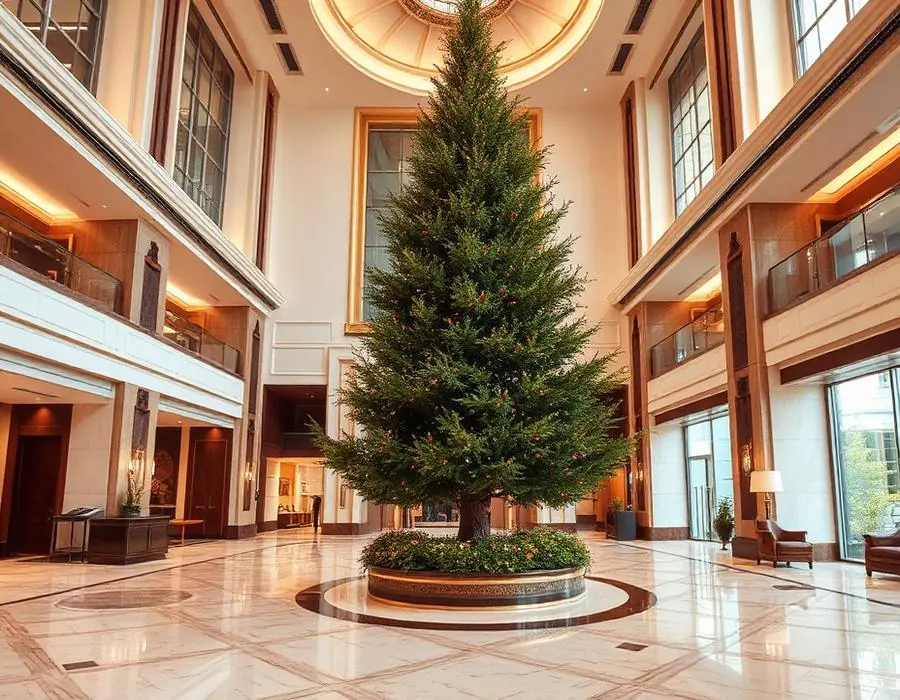
Trunk construction shows most at scale, which is why it matters most in our large artificial trees. For multi-tone foliage the artificial olive trees are the clearest reference, and the ficus and fiddle leaf trees show what dense canopy fill looks like. Where we hold a spec (trunk construction, canopy spread, pot diameter) we publish it. Where we do not, the field is left empty rather than filled with a guess.
Eververda prices are CAD, checked 12 October 2026.
Products in this article
- Artificial Olive Tree, 5.25 to 7 ft, Natural Wood Trunk$181.99 USD to $305.99 USD
- Artificial Areca Palm Tree, 4 to 6 ft, 15 to 21 Leaves by Height$210.99 USD to $305.99 USD
- Artificial Palm Tree, 5 to 6 ft, UV-Resistant Fronds, Black or White Pot$214.99 USD to $273.99 USD
- Artificial Olive Tree, 5.25 to 8 ft, Silk Leaves with Fruit, Black Pot$181.99 USD to $327.99 USD