
Commercial Christmas Trees for US Businesses: Real Prices by Height, 10 to 49 ft
21 October 2026
A commercial artificial Christmas tree in the United States costs between $2,819 USD and $104,762 USD at Eververda, depending on height and how the tree is built. Trees from 10 to 20 ft ship from our US warehouse and are sold at checkout with free delivery, starting at $2,819 USD. Above 20 ft the trees are quoted, because freight, lighting control and install access are priced with the tree rather than added at a basket. A 41 ft tree is $93,571 USD.
Our position on fire documentation. Eververda publishes a fire figure only where documentation exists for that specific piece, and describes nothing as "fire rated". On a commercial quote we establish the occupancy, the adopted code edition and what your authority having jurisdiction (AHJ) will accept as documentation, in writing, before the order. Where no documented route exists for a piece, we say so and set out the alternatives. We do not claim a certificate for any product.
That spread is the thing worth understanding before you brief anyone. Two trees of the same height on this site can differ by a factor of ten, and the reason is construction, not quality. This page sets out what each height actually costs, what changes the number, and what a buyer needs to settle before asking for a quote.
The range you can buy at checkout: 10 to 20 ft
These trees are in stock at our US warehouse, sold at checkout, with free delivery to US addresses in 1 to 3 weeks. No quote, no freight surcharge at the till. Prices in US dollars, checked 31 October 2026.
| Tree | Height | Price, delivered | Indoor or outdoor |
|---|---|---|---|
| Unlit flocked Norfolk pine | 12 ft | $2,819 USD | Indoor |
| Iridescent white slim, pre-lit | 12 or 15 ft | From $3,549 USD | Indoor |
| Frosted glitter pine, pre-lit | 12 ft | $3,629 USD | Indoor |
| Slim fir, pre-lit | 15 ft | $3,829 USD | Indoor |
| Spruce, pre-lit, 2,500 LEDs | 12 ft | $4,519 USD | Indoor |
| Oregon fir panel tower | 12, 16 or 20 ft | $8,769 to $26,159 USD | Indoor and outdoor |
| Commercial pine tower, steel frame | 12 or 16 ft | $12,239 or $21,289 USD | Indoor and outdoor |
Two things to note before you choose from that table. Most of the sectional trees are rated by their maker for indoor use only, because the lights are indoor lights; the panel and steel-frame towers are the ones rated for indoor and outdoor display. And a 20 ft tree you can add to a cart still arrives crated on a freight truck, in 13 cartons, so somebody has to be on site to receive it.
Order by Tuesday 1 December for delivery before Christmas. That is the real date for the in-stock range: roughly 3 to 7 business days to pack in peak season, then 2 to 7 days by freight.
What a commercial Christmas tree costs by height
Above 20 ft the trees are quoted. These are current Eververda prices in US dollars, for the United States, checked 21 October 2026. They are the tree itself, including its integrated lighting and frame where the product includes them. Freight and installation are quoted separately against your site.
| Height | Fibre optic giant tree | Warm LED red giant | Pixel LED spruce form |
|---|---|---|---|
| 9.8 ft | $4,772 USD | $3,653 USD | Not made at this height |
| 13.1 ft | $5,179 USD | $6,297 USD | Not made at this height |
| 16.4 ft | $5,993 USD | $10,468 USD | Not made at this height |
| 19.7 to 20 ft | $6,908 USD | $16,266 USD | $12,909 USD |
| 23 ft | $7,213 USD | $24,301 USD | Not made at this height |
| 26.2 to 26.5 ft | $7,519 USD | $37,830 USD | $22,775 USD |
| 29.5 ft | $8,027 USD | Not made at this height | $26,742 USD |
| 32.8 ft | $8,332 USD | Not made at this height | $52,172 USD |
| 39.4 ft | $8,535 USD | Not made at this height | $65,599 USD |
| 49.2 ft | $9,043 USD | Not made at this height | $104,762 USD |
A fourth range sits between those columns and covers the widest span of sizes in one product. It runs $4,161 USD at 11.5 ft, $7,112 USD at 14.8 ft, $11,994 USD at 18 ft, $18,113 USD at 21.3 ft, $27,353 USD at 24.6 ft, $38,237 USD at 27.9 ft, $59,903 USD at 34.4 ft and $93,571 USD at 41 ft. It comes in red, green, white or yellow, which is the reason to choose it when one holiday programme has to look consistent across sites of different sizes.
The commercial ranges on this site are listed individually: the fibre optic giant tree at 9.8 to 49.2 ft, the LED spruce form at 20 to 49.2 ft, the red giant with LEDs at 9.8 to 26.2 ft and the red tree on a steel frame at 11.5 to 41 ft.
Why two trees the same height cost $7,519 and $37,830
Look at the 26 ft row above. One tree is $7,519 USD and another is $37,830 USD. Height is not what separates them.
The cheaper tree is a fibre optic structure. Light is carried along optical strands from a small number of sources, so the cost of the lighting barely moves as the tree gets taller. That is why its price curve is almost flat: $4,772 USD at 9.8 ft and $9,043 USD at 49.2 ft, roughly double the money for five times the height. It is the economical way to put something very large and very visible on open ground.
The more expensive trees carry more than 2,000 individually wired LEDs, or in the case of the pixel LED spruce, an individually addressable lamp at every point. Lighting cost scales with surface area, and surface area scales with the square of height. That is the whole explanation for the steep curve: $12,909 USD at 20 ft becoming $104,762 USD at 49.2 ft.
So the question that decides your budget is not how tall, but how much control you need over the light. A static warm glow that reads from across a parking lot is inexpensive at any height. A tree that holds corporate colours, changes scene during trading hours, or runs a timed show against music costs several times more at the same height, and that gap widens as the tree grows.
Choosing a height for the space
Height is a viewing-distance decision, not a ceiling decision. A tree sized to the room reads as furniture. A tree sized to the sightline reads as a landmark.
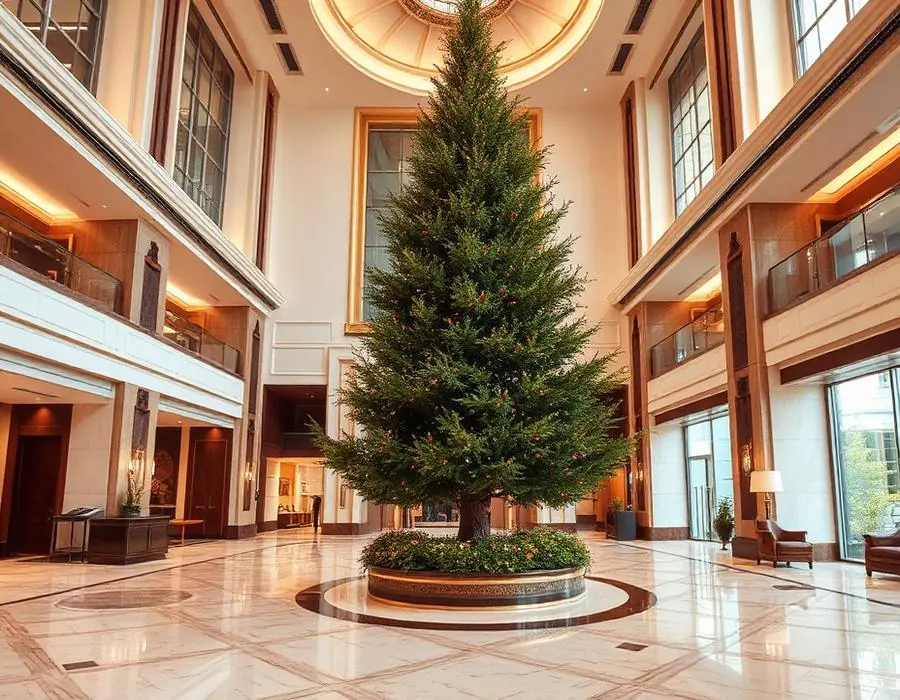
- 9.8 to 14.8 ft. A mall entrance, a hotel forecourt, a large atrium, a double-height lobby. Someone walks past it at ten to twenty feet. Detail matters here, because people will stand next to it and photograph it.
- 18 to 24 ft. A mall court, a central concourse, a covered plaza. Seen from a balcony or an escalator as much as from the floor. This is the most common commercial size and the one with the widest choice.
- 26 to 34 ft. Open civic ground, a main street, a large forecourt. Needs clear approach for an install crew and a lift. Nobody inspects it closely, so an architectural cone outperforms a botanically accurate tree at this scale.
- 39 ft and above. Town squares and civic installations. At 41 ft you are specifying a crane, a permit and a traffic plan alongside the tree, and those are often the bigger half of the project.
On ceiling height, the working rule is the tree plus 18 in for a topper and clearance. A 12 ft tree wants a ceiling of 14 ft or higher, a 16 ft tree 18 ft or higher, a 20 ft tree 22 ft or higher. Check the base width against your floor space as well: our 20 ft panel tower is 116 in across at the base.
Why the trees above 20 ft are quoted and not priced at checkout
Everything on this page carries a price. The 10 to 20 ft range has a working add-to-cart button; above that, the price is the start of a conversation rather than a button, and that is deliberate rather than evasive.
A 27 ft tree does not ship in a parcel. It moves on a pallet or several, on a truck, to an address that may or may not have a loading dock, and the freight on that is a real number that changes with your zip code and your access. Pricing it at checkout would mean either guessing high on every order or discovering the shortfall afterwards. Both are worse for you than a quote.
The second reason is that the tree is rarely the whole order. Lighting control, spare lamp stock, ballast, a second colour for a different site: these get settled in a conversation, not in a basket. Requesting a quote is the faster route to a correct number, and the price above is what the conversation starts from rather than a figure that moves once you ask.
Lighting and control: three levels
Almost every commercial tree arrives with its lighting integrated into the frame rather than wrapped on afterwards. On a 26 ft tree that difference is roughly a day of labour and a scaffold tower, so it is worth confirming before comparing two quotes.
Plug-in warm white. The simplest and the cheapest. It switches on and it stays on. Nothing to program, nobody to train, nothing to go wrong on a Saturday in December.
RGB with a remote handset. Scene, colour and brightness change from ground level without a laptop or a lighting technician. This is the right level for a site that wants a quieter daytime setting and a fuller evening one, or a tree that has to carry a brand colour for a private event and then go back to red and green.
DMX. The standard lighting-control protocol, so the tree runs from the same desk as the rest of the venue's lighting and can be cued to audio for a switch-on event or a nightly programme. Specify this only if somebody on site can operate a DMX desk. If nobody can, the control system is most of what you would be paying for and none of what you would use.
Outdoor installation: four things to settle first
The frame is free-standing, not staked. These trees sit on a hard surface. They do not drive into soft ground. That makes the base and its ballast a site decision your installer has to make against local wind loading, and it is the single most common thing left out of a commercial brief.
Folding frames change the logistics. Several of these ranges fold. A 41 ft tree on a foldable steel frame ships in fewer pallets, moves through a service corridor, and stores in a fraction of the space for the eleven months it is not standing. On a multi-year programme that storage difference usually outweighs any price gap at purchase.
Power is mains, at the base. None of these run on batteries. Confirm a feed at the install position, and confirm who is running it, before the tree arrives rather than after.
Access decides the crew. Anything above about 26 ft needs a lift and a ground crew. Measure the approach, not just the footprint.
Fire documentation: ask for the test report, not the adjective
In the United States, the International Fire Code accepts either NFPA 701 (Test Method 1 or 2) or NFPA 289 (20 kW ignition source, 100 kW maximum heat release rate) for artificial vegetation, at Section 807.4.1 from the 2018 edition onward; it was Section 806.2 in the 2015 edition, which some jurisdictions still run. NFPA 701 is a flame-propagation specimen test, and NFPA 289 is a whole-item heat release test. A product either has a test report against the route your venue names, or it does not.
Eververda publishes a fire figure for a tree only where documentation exists for that specific piece. If your venue requires NFPA 701 or NFPA 289 documentation, say so when you request the quote and we will tell you plainly what, if anything, the manufacturer can provide for the piece you want. Our guide to fire documentation for US commercial buyers sets out what to ask a supplier for and what an acceptable answer looks like.
Timing
For the in-stock 10 to 20 ft range the date is 1 December. Above that, these are made-to-order commercial pieces moving by freight, not stock pulled off a shelf. The practical consequence is that the useful question in late October is not "can I have it" but "what can still land in time, and what will it cost to make that happen". Ask for both answers in the same message: the quote and the realistic date. We will give you the date we actually believe rather than the one that wins the order.
If the date does not work for this season, the better move is almost always to specify now for next year rather than to buy something smaller in a hurry. A commercial tree is a five to ten year asset, and the version bought under time pressure is the one that gets replaced early.
Frequently asked questions
What is the cheapest commercial Christmas tree you sell?
$2,819 USD, for a 12 ft unlit flocked Norfolk pine, in stock in the US with free delivery. The cheapest pre-lit 12 ft is $3,629 USD and the cheapest 15 ft is $3,829 USD. Below those prices you are into the retail range rather than the commercial one.
Can I buy a 20 ft Christmas tree online without asking for a quote?
Yes. The Oregon fir panel tower is $26,159 USD at 20 ft, in stock in the US, with free delivery and a working add-to-cart button. It ships crated on a freight truck in 13 cartons, so arrange for someone to receive it.
How tall can a commercial Christmas tree go?
49.2 ft, in two of the ranges above. At that height the fibre optic version is $9,043 USD and the pixel LED version is $104,762 USD. Both are real options; they are built for different jobs.
Do the lights come fitted?
On the commercial ranges, yes. The lighting is integrated into the frame rather than supplied separately to be wrapped on site.
Can these trees stand outside?
It depends on the tree, and the honest answer matters here. Most of the sectional 12 and 15 ft trees are rated by their maker for indoor use only, because the lights are indoor lights. The panel and steel-frame towers, and the giant quoted ranges, are rated for indoor and outdoor display. Anchoring and ballast for wind loading are decisions for your installer, because they depend on the site rather than the tree.
Can I get one in a colour other than green?
Yes. Red, white and yellow are available across the widest quoted range, and the RGB tree mixes colour on demand from a remote. In the in-stock range there are iridescent white, blush pink, champagne, matte silver and red flocked trees at 10 to 15 ft.
Do you ship to the United States?
Yes. The prices on this page are US dollars for delivery in the United States, and the in-stock range ships free from a US warehouse.
Where to go next
The full range sits in commercial Christmas trees. If the project is year-round rather than seasonal, architectural scale pieces and trees over 15 ft are the two collections to look at, and our guide to specifying a commercial artificial tree covers the same ground for a permanent installation.
In-stock prices checked 31 October 2026 and quoted-range prices on 21 October 2026, in US dollars, for delivery in the United States. Prices change; the figure on the product page is the current one. Fire code text was verified against the publishers' own published text on 24 October 2026.
Products in this article
- 12 ft Unlit Flocked Norfolk Pine Christmas Tree$2,819 USD
- Iridescent White Slim Christmas Tree, 12 ft or 15 ft, Pre-Lit with Winter White LED Rice Lights$3,549 USD to $5,099 USD
- 12 ft Pre-Lit Frosted Glitter Pine Christmas Tree, 1,400 Warm White LEDs$3,629 USD
- 15 ft Pre-Lit Slim Fir Christmas Tree, 2,250 Warm White LEDs$3,829 USD
- 12 ft Pre-Lit Spruce Christmas Tree, 2,500 Warm White LEDs$4,519 USD
- Commercial Oregon Fir Panel Tower Christmas Tree, 12, 16 or 20 ft, Pre-Lit Warm White LEDs$8,769 USD to $26,159 USD
- Commercial Pine Tower Christmas Tree, 12 or 16 ft, Steel Frame, Pre-Lit Warm White LEDs$12,239 USD to $21,289 USD
- Fibre Optic Giant Christmas Tree 9.8 to 49.2 ft$4,702 USD to $8,911 USD, quoted
- Spruce Christmas Tree, 20 to 49.2 ft (6 to 15 m), LED, Metal Frame$12,720 USD to $103,226 USD, quoted
- Red Giant Christmas Tree with LEDs 9.8 to 26.2 ft$3,600 USD to $37,275 USD, quoted
- Artificial Red Christmas Tree, 11.5 to 41 ft (3.5 to 12.5 m), LED, Steel Frame$4,100 USD to $92,200 USD, quoted