

Artificial Plants for Home Staging
Artificial plants for home staging are lightweight, soil-free greenery used to warm a vacant property for photography and viewings, then packed down and reused at the next address. Stagers and flippers buy on different criteria from homeowners: nothing that drops, nothing that needs watering between showings, and nothing that quietly dies in an empty house with the thermostat turned down to twelve degrees.
Showing 3 of 3 products


Artificial plants for home staging are lightweight, soil-free greenery used to warm a vacant property for photography and viewings, then packed down and reused at the next address. Stagers and flippers buy on different criteria from homeowners: nothing that drops, nothing that needs watering between showings, and nothing that quietly dies in an empty house with the thermostat turned down to twelve degrees.
Are fake plants considered tacky?
Not in a staged property, and the market settled that argument years ago. What reads as tacky is never the material — it is the giveaways: moulded plastic soil, a uniform flat green, glossy leaves catching a flash, and a pot a size too small for the plant. Choose matte foliage with colour variation, hide the base under real moss or a fabric liner, and buy one good specimen rather than four cheap ones. A single well-scaled fiddle leaf fig in a dead corner does more for a listing photo than a shelf of small pots.
Which plants photograph best in listing shots?
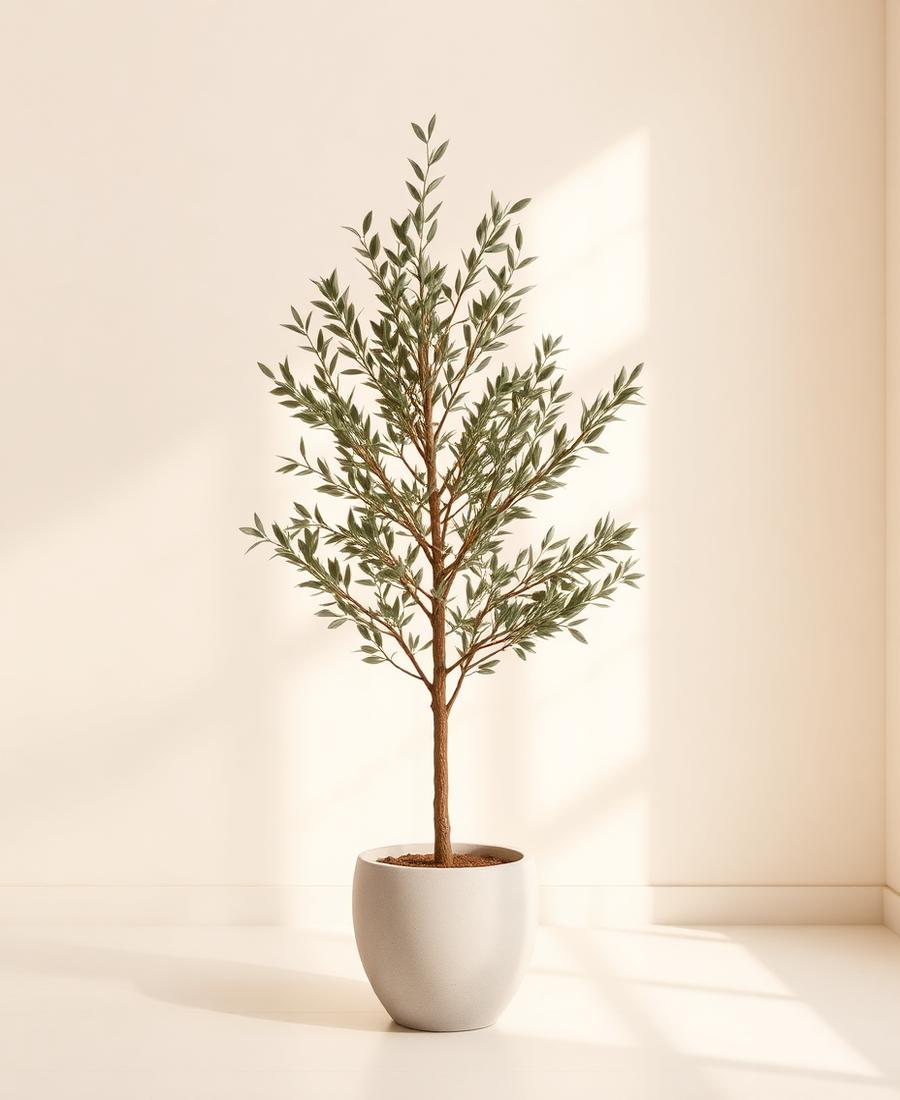
Broad, matte, mid-green foliage with a visible trunk. Cameras flatten depth, so plants with a distinct leaf shape — fiddle leaf, monstera, areca palm, olive — keep their form in the wide-angle lens every listing photographer uses, while fine or feathery foliage collapses into a green blur. Avoid anything with a sheen; a flash or a window bounce will find it. Place greenery to break a hard vertical line — beside a fireplace, at the end of a kitchen run, in the empty corner every vacant bedroom has — rather than centred in a room.
How to choose the right size
Stage to the ceiling. Most Canadian homes run 8 to 9 feet, so a 5 to 6 ft tree fills a corner without crowding the frame, and 6 to 7 ft suits a stairwell landing or an open-plan great room. Anything under 3 ft disappears in a wide-angle shot unless it sits on a counter or console. Weight matters as much as height, because staging stock gets carried in and out repeatedly — favour trees one person can lift and pots you can weight with sand on site. See also Medium Trees (2–7 ft) and Artificial Plants.
Frequently asked questions
How do we keep staging plants clean between listings?
Dust before every showing, not just occasionally — a grey film is far more visible in a bright, empty room than in a lived-in one, and it shows up in listing photography. A soft brush, a microfibre duster or a vacuum on low suction with a brush attachment handles most of it, and a cool hairdryer clears dust from tight foliage clusters. Full method in our cleaning guide.
How do we store and transport plants between properties?
Fold or unclip what the piece allows, protect the foliage from being crushed under other stock in transit, and keep the pot separate where it's heavy, since a full pot adds weight and risk of chipping in a vehicle. Between listings, store upright where possible rather than stacked flat, which reduces the reshaping needed at the next property. See how to store artificial trees and plants for the full approach.
How much setup time should we budget when staging a property?
A tabletop or small potted plant needs only unpacking and a quick fan-out of the foliage. A floor tree needs more — sections slotted together and branches fanned out to remove flattening from transit or storage — so budget meaningfully more time for a 6 ft tree than for a console plant when scheduling a staging visit. See our unboxing and shaping guide for what to expect by size.
Do these plants come with a pot, or do we need our own?
It varies by product, so check the individual page rather than assuming. Many stagers deliberately buy pieces without a fixed decorative pot so the same plant can be dropped into whatever container suits each property's finishes, then weighted with sand or gravel on site for stability during showings. Where a pot is included, it's noted in the product title and details.
Will the plant we receive match the height shown in listing photography?
Yes — the height stated on the product page is what ships. A single plant photographed alone in a room can look larger or smaller than it is, since there's often nothing else in frame for scale, so always check the stated height against your ceiling and the specific room rather than judging by the photo. Where a product offers several heights, select the one you're staging for rather than assuming the pictured example is the only size.