
Modern and Minimalist Interiors: Choosing One Perfect Artificial Tree
29 August 2026
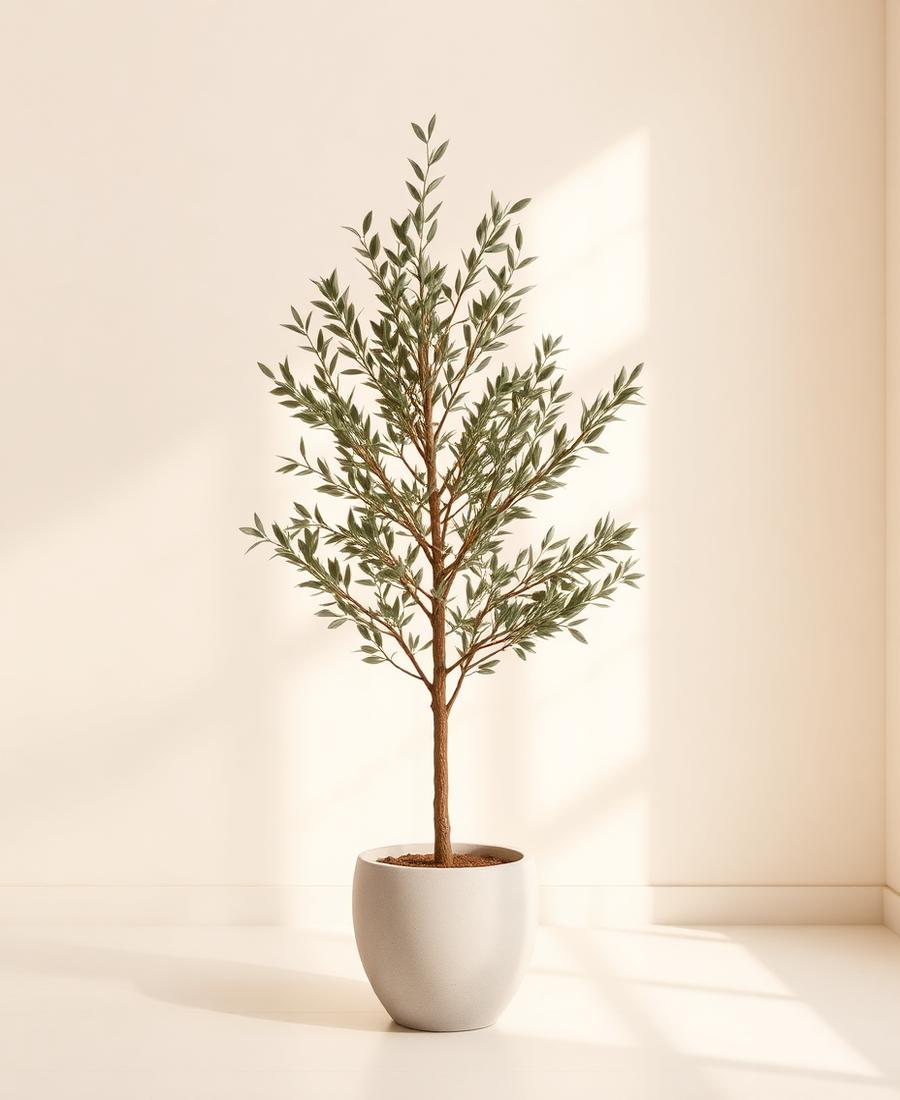
In a modern or Scandinavian-influenced room, one confident tree beats three matching plants. The empty floor and wall space around it isn't unfinished — it's part of the design, the same way a blank wall around a single piece of art makes the art read as deliberate. A minimalist interior earns its calm by leaving space alone, so the plant it does contain has to work harder: one graphic silhouette, one clean pot, one clear job. This is the governing principle behind every other choice in this guide — species, pot, size, placement — and it's what separates a room that reads as edited from one that reads as decorated.
This overlaps with Japanese design, which shares the same instinct toward restraint, but the two are not interchangeable. Japanese interiors lean on asymmetry, natural material texture and a garden tradition of pruned, sculptural form — see our guide to Japanese-style artificial trees for a zen garden look and the broader japandi plants guide if that's the direction you want. Western modern and Scandinavian minimalism take a different route to a similar quiet: symmetry or a single strong axis, graphic rather than gnarled silhouettes, and a harder material palette (matte black, poured concrete, unglazed ceramic) rather than warm wood and rattan. This piece stays in that lane.
Why does one plant work better than three in a minimalist room?
Multiple plants force the eye to keep moving and comparing, which is exactly what a busy room does and a minimalist one avoids. A single well-chosen tree gives the eye one place to land, and everything around it — the negative space, the sightline to a window, the plain wall behind it — stays legible. Three plants of similar height and green also compete with each other rather than reinforcing one idea, which is why mixed groupings that suit a maximalist or cottage room usually look cluttered in a minimalist one. The fix isn't fewer leaves; it's fewer decisions. Pick the one species and pot that says what you want the room to say, then stop.
Which artificial trees actually read as modern?
Species matter here as much as styling does, because some silhouettes are inherently graphic and some are inherently busy, and no amount of pot choice fixes the wrong plant. The fiddle leaf fig is the clearest modern signifier in the artificial-tree category: large, flat, individually distinct leaves on a bare stem read as a single graphic shape rather than a mass of foliage, which is exactly the quality a minimalist room wants. Eververda's 4–6 ft fiddle leaf fig in a black planter with a weighted base runs $319 to $449 CAD, and the smaller 4 ft version in a white planter is $219 CAD for a condo-scale room or a console table.
Monstera deliciosa does the same job at a lower, broader scale: its split-leaf silhouette is unmistakable and reads as sculptural rather than leafy, particularly as a single specimen rather than a cluster. The 90–120 cm monstera in a black pot, sold single or as a pair, is $189 to $449 CAD — buy the single for a minimalist room and save the pair for a space that can take symmetry on either side of a doorway. Snake plant contributes a different kind of modern shape: stiff vertical blades instead of a leafy canopy, which reads as almost architectural and suits a narrow console or bathroom corner where a canopy tree wouldn't fit. The 3 ft snake plant in a cement pot is $469 CAD, pairing a graphic plant with a material that matches the rest of a modern room. ZZ plant is close cousin to the snake plant in effect — glossy, structured, low-drama — and Eververda's 29 in ZZ plant with 72 real-touch leaves in a black pot is $459 CAD.
Dracaena earns its place on this list for the same reason: narrow, upright, strappy leaves on a clean trunk, with none of the density that makes a plant read as "arrangement" rather than "object." The 6 ft dracaena in a tapered cement, iron and PE planter with a river-rock ballast is $489 CAD. Olive breaks the pattern slightly — it's softer and greyer than the others — but a well-shaped olive in a plain black pot still reads as modern rather than traditional, because the leaf is small, the colour is muted, and the silhouette is airy rather than dense. The 5.25–8 ft olive with silk foliage in a black pot runs $249 to $449 CAD.
What reads as traditional or busy here: dense flowering trees (cherry blossom, magnolia, hydrangea) in full bloom, mixed arrangements combining two or three species in one pot, and heavy ornamentation on the container itself. None of that is wrong — a flowering tree is the right call in a room built around colour and pattern — it's just the opposite instinct to a minimalist room, and mixing the two languages tends to read as indecision rather than eclecticism.
Does the pot matter as much as the plant?
In a minimalist room, yes — the pot is roughly half the composition, not an afterthought under it. Because there's little else in the frame competing for attention, the container's material and colour carry as much visual weight as the foliage above it. Four pot languages do the job reliably: matte black (the most versatile, disappears against almost any wall colour), poured concrete or a concrete-look composite (adds weight and a slightly industrial edge), plain white (best against a dark or saturated wall, where black would just add another dark shape), and unglazed terracotta or stoneware left in its raw colour rather than painted or patterned. What all four have in common is a single, flat, matte finish — no metallic trim, no printed pattern, no visible brand marking. A glazed pot with a floral motif undoes a graphic fiddle leaf fig as fast as a busy arrangement would. For a fuller walk-through of pot shapes, materials and proportions, see the guide to choosing a planter for an artificial tree.
How much negative space should the tree actually have?
Enough that the eye reads the plant as an object placed in a room, not a filler stuffed into a gap. A practical rule: give the canopy or crown at least as much clear wall or floor space around it as the canopy itself takes up, and resist the pull to put a second smaller plant "to balance it" — that second plant is usually what turns a considered placement into clutter. Corners and the far end of a sightline work better than the middle of a wall, because a corner placement lets negative space wrap around two sides of the plant rather than one. If a room already has a strong single object — a floor lamp, a low bench, an artwork leaning against the wall — put the tree opposite it or well clear of it rather than beside it; two focal points fighting for the same wall reads as clutter no matter how minimal each individual piece is.
What size fits the ceiling and the room?
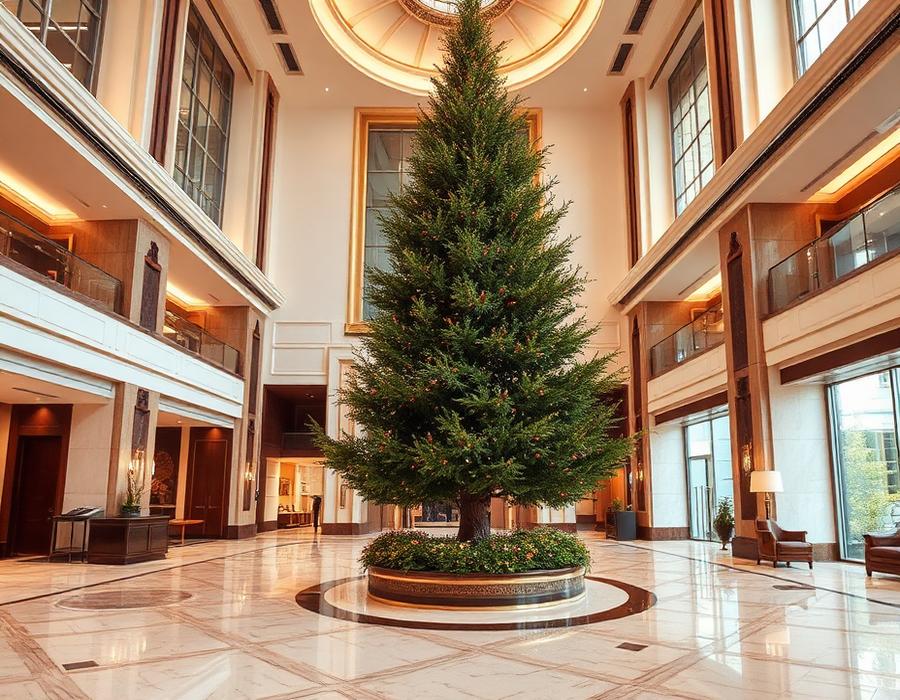
Scale errors are more visible in a minimalist room than anywhere else, because there's nothing else in the frame to soften a tree that's too short for the ceiling or too tall for the furniture around it. A tree that tops out well below a standard 8 ft ceiling reads as an accessory; one that reaches within a foot or so of the ceiling reads as architecture, which is usually the effect a minimalist room wants from its one plant. Full sizing guidance — including how to measure for taller ceilings and how canopy width interacts with furniture clearance — is in the guide to choosing artificial tree size.
Why does realism matter more here than in a busy room?
Because there's nothing else to distract the eye. In a room full of pattern, texture and colour, a slightly stiff leaf or an obviously uniform green gets absorbed into everything else going on. In a minimalist room, that same plant is often the only organic object in the frame, sitting against a plain wall with nothing competing for attention, so any tell — repeated leaves that are identical instead of individually shaped, a canopy that's too symmetrical, foliage with a flat plastic sheen — reads immediately. This is the main reason a minimalist room is not the place to economize on realism the way a busy, plant-filled room can get away with. What separates a convincing tree from an obvious one, leaf by leaf and trunk by trunk, is covered in the guide to what makes an artificial tree look real — worth reading before buying for a room this exposed.
Species at a glance for a modern room
| Species | Why it reads as modern | Typical pot for the look | Eververda price (CAD) |
|---|---|---|---|
| Fiddle leaf fig | Large, individually distinct graphic leaves on a bare stem | Matte black planter | $219–$449 |
| Monstera deliciosa | Unmistakable split-leaf silhouette, sculptural as a single specimen | Matte black pot | $189–$449 |
| Snake plant | Stiff vertical blades, near-architectural shape | Cement pot | $469 |
| ZZ plant | Glossy, structured, low-density foliage | Matte black pot | $459 |
| Dracaena | Narrow strappy leaves on a clean trunk | Tapered cement/iron planter | $489 |
| Olive (plain pot) | Small muted leaf, airy rather than dense silhouette | Plain black pot | $249–$449 |
Frequently asked questions
Can a minimalist room have more than one plant?
Yes, if the second plant does a different job rather than repeating the first — a low snake plant on a console next to a tall fiddle leaf fig in the corner, for instance, rather than two fiddle leaf figs of similar size. The failure mode is two plants competing for the same visual role; the fix is giving each one a distinct height, silhouette and location.
Is a fiddle leaf fig or a monstera the better choice for a minimalist living room?
Both read as modern; the choice usually comes down to ceiling height and available floor width. Fiddle leaf fig is taller and narrower, suiting a corner with height to spare. Monstera is broader and lower, suiting a wider but shorter space, such as beside a low sofa or under a slanted ceiling.
Should the pot match the room's other metal finishes?
It helps but isn't essential. Matte black works with almost any other finish because it reads as neutral rather than metallic. Where a room already commits hard to one finish — brushed brass hardware throughout, for instance — a plain concrete or white pot is a safer match than trying to find a black that coordinates exactly.
What's the biggest mistake people make styling artificial plants in a modern room?
Buying more than one plant to fill a space that one well-chosen, well-scaled plant would fill better. The second plant rarely adds interest; it usually just divides attention that a single tree was holding on its own.
Does a minimalist room need a real-touch or premium finish, or will a standard artificial tree work?
A minimalist room is the one place where the finish is worth prioritizing, because the plant sits in more visual isolation than it would in a busier room. Individually shaped leaves and a naturally asymmetric canopy matter more here than the total leaf count.
Product prices are CAD and current as of 29 August 2026, per Eververda's published catalogue.