
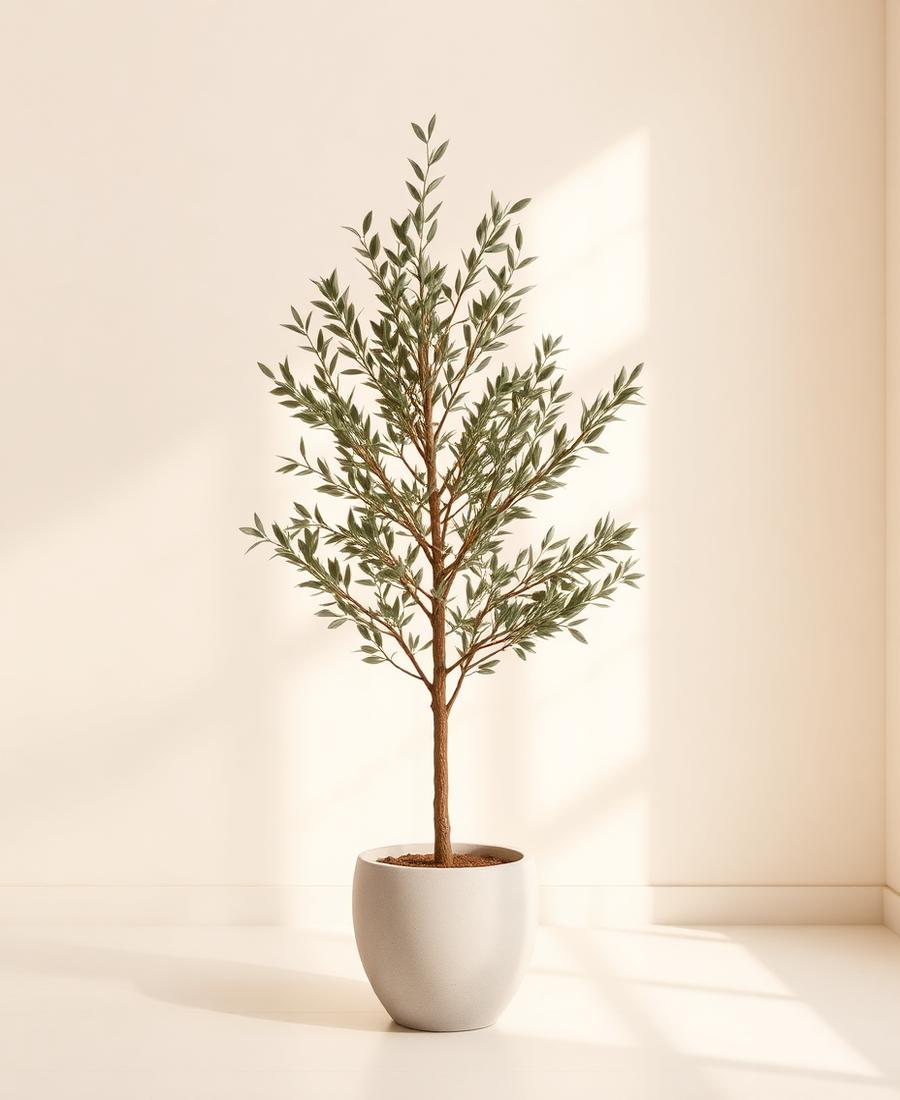
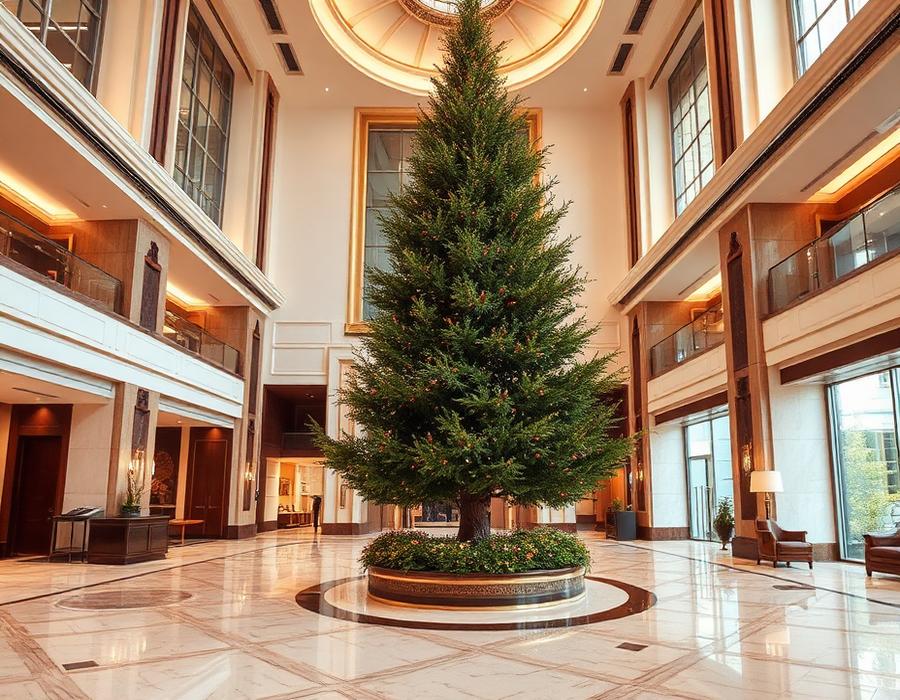
Japanese-Style Artificial Trees: Building a Zen Corner or Indoor Garden
29 August 2026
A Japanese-style indoor garden needs three things: the right species, deliberate empty space, and restraint in the container. The species palette is short and specific — pine, Japanese maple, cherry blossom, bamboo, ginkgo, and moss at ground level — and every one of them exists as a convincing artificial tree. At retail, a 6 ft bamboo with three trunks and 830 leaves costs $279 CAD, a 5–6 ft cherry blossom in white or pink runs $329 to $419 CAD, and a 17 in tabletop bonsai pine is $829 CAD. Commercial pieces for restaurants and spas start around $1,246.99 CAD and scale up from there. This guide covers the species, the design principles behind the tradition, a one-shelf zen corner recipe, and what to specify for a commercial fit-out.
One boundary first: this is not a japandi article. Japandi is an interior-design trend that blends Japanese and Scandinavian styling, and we cover it separately in our japandi plants guide. This article is about the older thing underneath the trend — the Japanese garden tradition itself, and how to bring its species and its logic indoors.
What makes an artificial tree "Japanese-style"?
Mostly the species, and then the shape. Japanese gardens work from a restrained palette that reads as a landscape in miniature: black pine and cedar for structure, maple for autumn colour, cherry for spring blossom, bamboo for vertical rhythm, ginkgo for gold, and moss or gravel as the ground plane. An artificial tree earns the label when it copies not just the foliage but the growth habit — the layered, cloud-pruned pads of a trained pine, the low horizontal sweep of a maple, the open asymmetric lean of a garden cherry rather than the dense symmetrical lollipop of a Western ornamental.
That is why bonsai forms dominate this category. A trained pine takes decades to shape and daily attention to keep; the artificial version fixes the silhouette permanently. Our artificial bonsai guide covers that family in depth, from tabletop pieces to the 220 cm cedar pine bonsai at $1,246.99 CAD. For blossom, the cherry blossom guide is the deep dive — sizes, colours, and event use.
What do Japanese garden principles actually say?
The tradition is old enough to have a written manual. The Sakuteiki, attributed to Tachibana Toshitsuna and dated to the mid-to-late 11th century, is the oldest surviving Japanese text on garden design; it describes garden-making as "the act of standing up stones" and tells the designer to follow the desire of the stone rather than force a plan onto it (checked 29 August 2026). Translated to a living room: place the tree where the room wants it — off-centre, against a plain wall, beside a window — not dead centre on the console because symmetry feels tidy.
The second principle is negative space, often discussed as ma, and the famous demonstration is the rock garden at Ryoan-ji in Kyoto: fifteen stones in five groups on roughly 248 square metres of raked white gravel, arranged so that from the viewing veranda at least one stone is always hidden (checked 29 August 2026). The empty gravel is not leftover space; it is most of the composition. Alongside it sits kanso — simplicity, the discipline of leaving things out. For an indoor garden the practical reading is blunt: one tree, one tray, one wall. A zen corner with five plants is a plant corner.
Three working rules fall out of this:
- Asymmetry. Odd numbers, off-centre placement, and a tree whose canopy leans one way. If you buy a pair of anything, separate them.
- Negative space. Give the tree two to three times its own width of visually empty wall or floor. Resist filling it.
- Restraint in the container. Low, wide, unglazed or matte pots in charcoal, cement grey, or dark brown. No bright ceramics, no ornate planters.
How do you build a zen corner with one bonsai?
The recipe is one tree, one gravel tray, low light, and nothing else. Start with a tabletop bonsai — the 17 in potted bonsai pine at $829 CAD is sized for a console, shelf, or reception desk. Set it on or beside a shallow tray of fine light-grey gravel or crushed granite; the tray stands in for the raked gravel plane and costs a few dollars at any garden centre. Rake or comb the gravel in straight parallel lines and re-rake when it gets disturbed — the maintenance ritual is thirty seconds and is half the point.
Light matters more than people expect. A real bonsai demands a bright window; an artificial one is better away from it, because direct sun both fades foliage over time and flattens the sculptural shadows that make a trained pine read as real. A dim corner, a hallway end, or a north-facing wall — the placements where every real plant dies — are exactly where this arrangement belongs. If you want deliberate lighting, one small uplight or a warm picture light raking across the canopy does more than any overhead fixture.
Scale up the same recipe for a floor arrangement: a 5–6 ft tree, a larger gravel field or a low wooden platform, and a single flat stone. For height guidance relative to your ceiling, our tree sizing guide applies unchanged.
Which species gives you which season?
A real Japanese garden is designed around seasonal change; with artificial trees you choose the season and it holds. That is a genuine design decision, not a compromise — a spa that wants permanent spring can have it, and a home can keep autumn maple colour through a grey February.
| Season expressed | Species | Example piece | Price (CAD) |
|---|---|---|---|
| Spring | Cherry blossom | 5–6 ft cherry, white or pink | $329–$419 |
| Spring, fuller form | Cherry blossom, four-trunk | 5–6 ft four-trunk, cement pot | $469–$529 |
| Summer / year-round green | Bamboo | 5.9 ft bamboo, 924 leaves | $669 |
| Autumn | Japanese maple | 10 ft Japanese maple (commercial) | from $2,368.99 |
| Winter / permanence | Pine bonsai | 17 in tabletop bonsai pine | $829 |
Pine is the anchor: evergreen in the real garden, it symbolises endurance and carries the composition in winter, which is why a pine bonsai is the default first purchase. Cherry is the opposite — two weeks of real bloom a year, held permanently in the artificial version. Bamboo is the budget entry and the fastest way to add height: the $279 CAD three-trunk bamboo reads well grouped in odd numbers or as a screen beside a doorway.
What works for Japanese restaurants and spas?
Commercial spaces use the same palette at larger scale, where real specimens are impractical: a trained black pine of lobby size is a five-figure nursery purchase that needs specialist pruning, and real bamboo indoors is invasive and messy. The artificial commercial line covers this directly. A 10 ft Japanese maple starts from $2,368.99 CAD for a dining-room focal point; larger builds like the ginkgo with a natural wood trunk are quote-priced through our project process. The silk pine bonsai for landscape feature displays spans $547.99 to $4,889.99 CAD depending on size, which covers everything from a sushi counter to a hotel entry.
Placement follows the same principles as the home version, and they matter more at scale: one specimen tree visible from the entrance, gravel or moss-effect ground treatment at its base, and generous clear space around it. Spas in particular benefit from the low-light logic — treatment corridors and relaxation rooms are exactly the dim, windowless spaces where artificial pine and bamboo hold up and real plants fail. For the full commercial checklist — access, anchoring, cleaning cycles, and fire documentation — see our guide to specifying artificial trees for a restaurant fit-out; where fire ratings apply, request documentation from every supplier, ours included, via the quote process, since the local authority makes the final call.
Frequently asked questions
What is the difference between japandi and a Japanese-style indoor garden?
Japandi is an interior-design trend that blends Japanese and Scandinavian styling across a whole room — furniture, colour, and plants together. A Japanese-style indoor garden draws on the older garden tradition itself: a restrained species palette of pine, maple, cherry, bamboo and ginkgo, asymmetric placement, and deliberate empty space. You can build one inside any interior style, japandi included.
What do I put under an artificial bonsai to make a zen corner?
A shallow tray of fine light-grey gravel or crushed granite, raked in straight parallel lines. The tray stands in for the raked gravel plane of a temple garden and costs a few dollars to fill. Keep the rest of the surface empty — one tree, one tray, and clear space around them is the whole recipe.
Do artificial Japanese-style trees work in rooms with no natural light?
Yes, and they arguably work better there. Artificial foliage needs no light to survive, and keeping it out of direct sun prevents fading and preserves the sculptural shadows that make a trained pine read as real. Dim hallways, north-facing corners, spa treatment rooms and windowless reception areas are the placements where this category makes the most sense.
How much does an artificial Japanese maple cost in Canada?
Commercial-grade Japanese maples start from $2,368.99 CAD for a 10 ft tree suited to a restaurant or lobby, with larger and custom builds quote-priced. At residential scale, autumn colour is usually the reason to go this route, since maple is the one species in the palette where retail options are limited and the commercial line does the work.
Is bamboo the cheapest way to start a Japanese-style corner?
Yes. A 6 ft artificial bamboo with three trunks and 830 leaves costs $279 CAD, which is the lowest entry point in the palette. Bamboo adds height and vertical rhythm quickly, groups well in odd numbers, and works as a screen beside a doorway. A tabletop bonsai pine at $829 CAD is the more traditional anchor if the budget allows.
Product prices are CAD and current as of 29 August 2026; external references on Japanese garden history were checked on 29 August 2026.