
The Artificial Bonsai Guide: How to Choose Well
29 August 2026
Every other artificial tree imitates nature. An artificial bonsai imitates craft. A real bonsai is a cultivated object - years of pruning and wiring toward a deliberate silhouette - so when you buy the artificial version you are not really buying a species, you are buying the quality of someone's shaping decisions. That changes what to check before ordering, and it changes the scale of what the word covers, which surprises many buyers.
What makes a bonsai different from every other artificial tree?
The sculpted form is the product. With an olive or a fiddle leaf fig, the question is whether the tree looks like its real species; with a bonsai, the question is whether the shaping convinces - the lean and movement of the trunk, the asymmetry of the canopy, the negative space between the foliage pads. Species matters far less: pine, cedar and podocarpus all read as bonsai when shaped well, and none of them does when shaped badly.
This is also why the bonsai silhouette carries so much weight in Japandi and Japanese-inspired rooms, where a single sculptural object is asked to do the work of a whole grouping. The Japandi styling guide covers that context in full - one specimen rather than a cluster, offset placement, and the pot treated as half the purchase.
How big is an artificial bonsai, actually?
Often much bigger than the word suggests. Bonsai makes people picture a tabletop object, and those exist - our bonsai range starts around $128 CAD for small specimens - but the category runs all the way to architectural scale, where the same cloud-pruned shaping is applied to full-height trees.
At that end of our range, a cedar pine bonsai at 220 cm - about 7.2 ft - is $1,246.99 CAD, a silk pine bonsai built for landscape feature displays spans sizes from $547.99 to $4,889.99 CAD, and a 7.2 ft podocarpus bonsai with a UV-resistant build is $1,246.99 CAD. So read the listed height in the specifications, not the word bonsai in the title, before you commit to a photograph with no scale reference in it. The sizing guide applies here as everywhere.
What carries the credibility on a faux bonsai?
The trunk and the pot, in that order.
The trunk faces more scrutiny than on any other artificial tree, because bonsai is bought to be looked at closely - on consoles, counters and entry tables, at exactly arm's length. What convinces is movement and taper: a trunk that leans, turns and narrows the way a trained tree does, with real bark texture rather than a moulded repeat. Several of our bonsai builds use a natural wood trunk with the canopy built onto it, which is what makes that close range survivable. The general trunk logic - and why moulded plastic betrays itself - is in what makes an artificial tree look real.
The foliage should sit in pads, not a blob. A cloud-pruned tree holds its foliage in distinct, layered pads with air between them; that negative space is the whole aesthetic. An artificial bonsai whose canopy reads as one solid mass of green is topiary wearing the wrong label. Check the straight-on profile photograph for daylight between the layers.
The pot finishes the argument. Low, wide and matte is the rule - stoneware, unglazed clay, muted colour - because a glossy or ornate pot undoes the restraint of the shaping above it. The Japandi guide's pot advice applies to bonsai double, and it is worth budgeting for the vessel as part of the purchase rather than an afterthought.
Where do large bonsai work in commercial spaces?
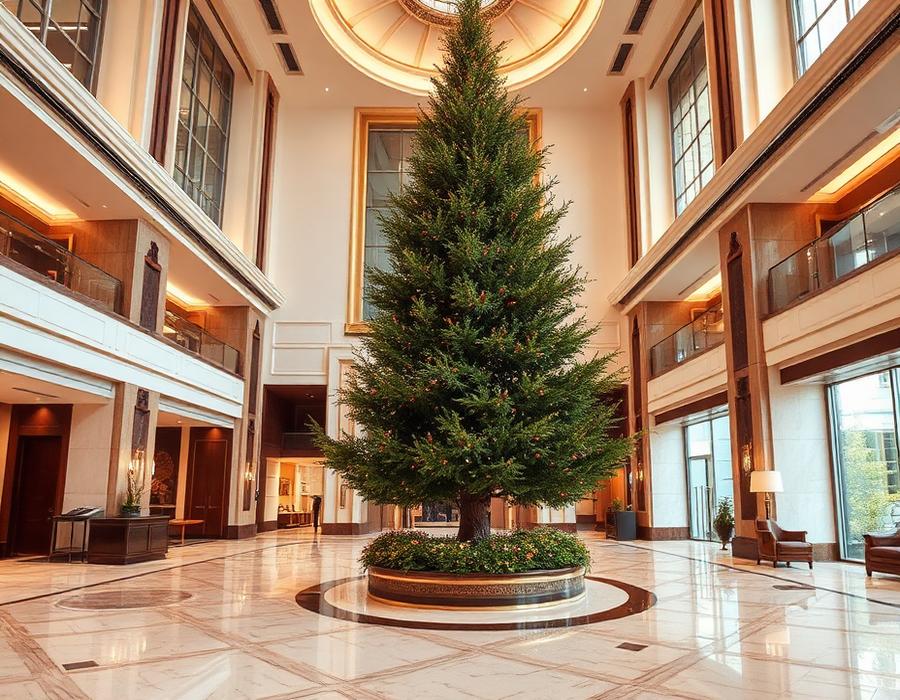
Better than almost anything else, because a sculptural tree reads from a distance and needs no explanation. At lobby scale, a shaped pine is a focal point rather than background greenery - the thing guests photograph rather than walk past. Our 6.5 ft cedar bonsai pine is built for indoor or outdoor use at $2,787.99 to $3,489.99 CAD, the UV-resistant podocarpus handles exposed positions at $1,246.99 CAD, and the landscape silk pines scale up to $4,889.99 CAD for feature displays. Projects above $3,000 go through our quote service.
For the specification method at that level, artificial trees for hotel lobbies covers focal-point placement and maintenance access, the restaurant fit-out guide covers hospitality specifics, and anything destined for a terrace should be checked against the outdoor guide for UV, wind and drainage.
The scales, mapped:
| Use case | Bonsai scale and type |
|---|---|
| Entry console, shelf or counter | Tabletop specimen, from around $128 CAD |
| Japandi or Japanese-inspired living room | One mid-scale pine or cedar specimen in a low matte pot |
| Double-height hall or hotel lobby | Cedar pine at 220 cm, $1,246.99 CAD |
| Covered terrace or restaurant patio | Indoor/outdoor cedar at 6.5 ft, $2,787.99 to $3,489.99 CAD, or UV-resistant podocarpus, $1,246.99 CAD |
| Landscape or feature display | Silk pine in landscape sizes, $547.99 to $4,889.99 CAD |
Frequently asked questions
Do artificial bonsai trees look cheap?
Only when the shaping does. A bonsai's credibility lives in three places: a trunk with real movement, taper and bark texture, foliage held in layered pads with air between them, and a low matte pot. Get those three right and the tree reads as a considered object at arm's length; get them wrong and no species choice or price tag rescues it.
Why do some artificial bonsai cost thousands of dollars?
Scale and build. The word covers everything from tabletop pieces - ours start around $128 CAD - to architectural trees like our landscape silk pines at up to $4,889.99 CAD and the 6.5 ft indoor/outdoor cedar at $2,787.99 to $3,489.99 CAD. The large pieces are commercial-grade sculptural objects with engineered builds, priced accordingly and usually bought through a quote.
Can an artificial bonsai go outside?
Specific builds can. Our 6.5 ft cedar bonsai pine is rated for indoor and outdoor use, and the 7.2 ft podocarpus carries a UV-resistant build at $1,246.99 CAD. The general rules still apply - UV stabilisation slows fading rather than stopping it, wind wants anchoring, and drainage before the first freeze is what actually saves a tree in Canada - and the outdoor guide covers all three.
What kind of pot suits an artificial bonsai?
Low, wide and matte: stoneware, unglazed clay or muted ceramic, in the oatmeal-to-charcoal range. A glossy or ornate pot undoes the restraint that makes bonsai shaping work, which is why the pot deserves a share of the budget rather than whatever the tree happened to ship in. Cover the base with stones or moss so no plastic rim shows.
Is a bonsai a good choice for a small apartment?
One of the best, at the right scale. A tabletop specimen - our range starts around $128 CAD - delivers a sculptural focal point on a console or shelf without claiming any floor area, and a single well-shaped piece does the work a whole grouping of ordinary plants would. Just read the listed height carefully, because the category also includes trees over 7 ft tall.
For the other silhouettes, see the olive guide, the fiddle leaf fig guide and the palm guide. Buying in the GTA? The Toronto buying guide covers the local routes.
Eververda prices are CAD and current as of 29 August 2026.