
The Artificial Palm Tree Guide: How to Choose Well
29 August 2026
Palms are the species artificial-tree buyers get burned on most often, and the reason is structural. A real palm frond is a single long structure carrying hundreds of parallel leaflets, and any shortcut in the moulding shows immediately - there is no irregular canopy for the flaws to hide in, the way there is on an olive or a ficus. The good news is that this cuts both ways: because everything shows, palm quality is unusually easy to judge before you buy, if you know what to look at.
Why are palms the hardest artificial tree to get right?
Geometry. A palm frond is one continuous architecture - a central stem with leaflets ranked evenly along both sides, tapering toward the tip - and the human eye is extremely good at spotting a broken pattern. On a cheap artificial palm the leaflets come welded into clumps, the plastic carries a hard sheen, and every frond is identical and splayed at the same angle, like a fan that was never real. Broadleaf species forgive all of these sins because their real foliage is irregular anyway; a palm forgives none of them. The general realism method is in what makes an artificial tree look real, and it names palms as the least forgiving species for exactly this reason.
What should you check on the fronds?
Arc and droop first. Real fronds rise from the crown and arch over, with the leaflets softening and drooping toward the tips. Artificial fronds that stick straight out from the trunk read wrong instantly, from any distance. Look for photographed arc in the listing, and for internal wiring, which lets you set and adjust the droop yourself after unboxing.
A published count second. Frond and leaf counts are only comparable between palms of similar height, but a seller publishing one is a good sign in itself. Our areca palm publishes 15 to 21 leaves by height across its 4 to 6 ft range and runs $289 to $419 CAD - which means density is a specification you can compare, not a guess from a flattering angle.
Tone third. As on every species, one flat green is the tell. A good palm mixes lighter new fronds with darker mature ones, and the leaflets carry some variation rather than a single moulded colour.
Should you buy one palm or a pair?
Palms suit symmetry more than any other artificial tree, which is why they are so often bought in twos: flanking a doorway, a sofa, a console or a hallway mirror, where the repeated silhouette does the framing. A single palm works differently - it fills a corner and reads as a specimen rather than as architecture.
Decide which job you are buying for before you price it. Our golden cane palm sells as a single or as a pair across 4.5 to 9 ft, at $289 to $869 CAD, so the symmetric arrangement is priced honestly up front rather than assembled from two separate orders.
Can an artificial palm go on a patio or balcony?
A covered outdoor spot, yes - with the right build. Our 5 to 6 ft palm with UV-resistant fronds runs $219 to $289 CAD and is made for exactly that setting. What decides how any outdoor palm ages is covered in the outdoor guide: what UV stabilisation actually does and does not do, why wind is the risk people underestimate, and why drainage before the first freeze matters more than the summer does. All of it applies to palms with extra force, because long fronds give a palm a large sail area for its weight.
What about lobby and commercial scale?
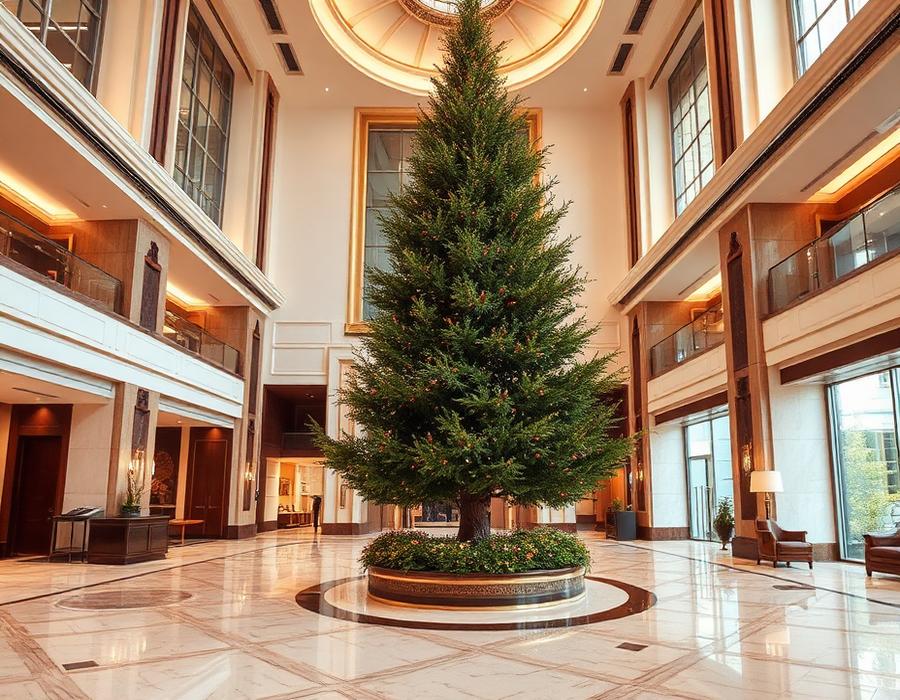
The palm is the classic commercial-atrium tree, and the construction changes at that scale: glass fiber replaces moulded plastic, and bases are engineered rather than weighted. Our 9 ft coconut palm is that grade - a glass fiber commercial build for indoor or outdoor use at $2,787.99 to $6,291.99 CAD - and projects above $3,000 go through our quote service, which is how lobby work should be bought anyway. For how to specify at that level, artificial trees for hotel lobbies covers sightlines, bases and maintenance access, and the fire-ratings guide covers what building codes will ask of the foliage.
The settings, mapped:
| Setting | Palm type |
|---|---|
| Living room or office corner | Areca, 4 to 6 ft, published leaf counts, $289 to $419 CAD |
| Flanking a doorway, sofa or console | Golden cane as a pair, 4.5 to 9 ft, $289 to $869 CAD |
| Covered patio or balcony | UV-resistant fronds, 5 to 6 ft, $219 to $289 CAD |
| Hotel lobby, atrium or poolside commercial space | Glass fiber coconut palm, 9 ft, $2,787.99 to $6,291.99 CAD |
Frequently asked questions
How can you spot a cheap artificial palm online?
Look at the fronds, not the tree. Stiff fronds that stick straight out, leaflets moulded into clumps rather than ranked individually, a hard plastic sheen, and every frond identical at the same angle are the four tells - and a listing with no frond close-ups is usually hiding them. A published leaf or frond count is the opposite signal: it means the seller measured.
How many fronds should an artificial palm have?
There is no universal number, because counts are only comparable between palms of similar height and species. What matters is that the count is published at all - our areca lists 15 to 21 leaves depending on height across its 4 to 6 ft range - and that the crown looks full rather than gappy in a straight-on photograph. Compare like with like, and treat an unpublished count on a sparse-looking crown as your answer.
Do artificial palm trees fade outdoors?
Every artificial plant in direct sun fades eventually - UV stabilisation slows the reaction rather than stopping it. The practical difference is large: it separates visible fading in one season from acceptable colour after several years. A covered position, a UV-stabilised build like our $219 to $289 CAD palm, and an occasional rinse and quarter-turn are what stretch the timeline; the outdoor guide covers the mechanics.
What does a commercial-grade artificial palm cost?
Our 9 ft coconut palm, a glass fiber build rated for indoor and outdoor commercial use, runs $2,787.99 to $6,291.99 CAD depending on configuration. At that scale the purchase should run through a quote rather than a cart - we quote projects above $3,000 - because bases, site access and installation decide as much of the outcome as the tree does.
Is a palm a good first artificial tree?
Only if you buy it on frond quality. Palms are the least forgiving species to manufacture, so a cheap one fails harder than a cheap olive or fiddle ever will - but a good one, with arched wired fronds and a published count, is as convincing as anything in the category. If you want the most forgiving first tree, the olive and fiddle guides cover the easier species.
For the other silhouettes, see the olive guide, the fiddle leaf fig guide and the bonsai guide. Buying in the GTA? The Toronto buying guide maps the local routes, showrooms included.
Eververda prices are CAD and current as of 29 August 2026.