
Japandi Plants: Styling Faux Greenery in a Japandi Interior
22 August 2026
Japandi rooms are hard to fill with plants, and the reason is built into the style. Japandi asks for restraint, negative space and a small number of considered objects, while most houseplant styling advice tells you to group pots in odd numbers and layer heights. Those two instincts fight each other. This is how to resolve them, and where faux greenery genuinely helps.
What are the 7 rules of Japandi home style?
Japandi is the meeting point of Japanese wabi-sabi and Scandinavian hygge, and it is usually summarised in seven principles:
- Restraint over abundance. Fewer objects, each one chosen. Empty space is a design element, not a gap to fill.
- Natural materials. Wood, paper, linen, stone, clay. Matte finishes over gloss.
- A muted, warm-neutral palette. Oatmeal, clay, charcoal, soft black, warm white, with green as the only real colour.
- Low, horizontal furniture. Floor-level seating, low tables, long clean lines.
- Function first. Nothing decorative that is not also useful, or beautiful enough to earn its keep alone.
- Imperfection welcomed. The wabi-sabi half. Irregular glazes, visible grain, asymmetry.
- Craft and quality over quantity. One well-made object rather than three cheap ones.
Every plant decision in a Japandi room follows from rules one and seven. One good plant, well placed, beats five average ones.
What are some popular Japanese style house plants?
The plants that read as Japanese in an interior are the ones with strong, legible silhouettes and sparse foliage:
- Bonsai. The definitive one. A gnarled trunk with an asymmetric canopy is pure wabi-sabi and reads instantly.
- Japanese maple. Fine palmate leaves, layered horizontal branching, and a colour that shifts the whole room warm.
- Bamboo. Vertical, rhythmic, architectural. Works as a screen as much as a plant.
- Cherry blossom. Seasonal drama, and the one place Japandi permits a soft colour other than green.
- Pine. The classic niwaki shape, cloud-pruned and open.
- Moss and ferns. Ground-level texture, usually in a shallow dish.
Why use faux greenery in a Japandi room at all?
Because most of the plants on that list are difficult or impossible to keep indoors in Canada. A Japanese maple is a deciduous outdoor tree; indoors it needs a cold dormancy it will never get in a heated apartment. Bonsai demands daily attention and a light level a north-facing condo cannot supply. Cherry blossom flowers for perhaps two weeks a year outdoors and not at all indoors.
A faux specimen holds the silhouette year-round, which matters more in Japandi than in almost any other style, because when a room contains four objects the shape of each one carries real weight. A tree that goes leggy or drops half its canopy in February breaks the composition.
We should be straight about the trade-off too. Artificial foliage is plastic. Ours included. It does not clean the air, it does not change with the seasons, and up close a uniform leaf size gives it away. Placing a faux tree where people walk past it rather than sit beside it is the honest answer, and if the room has good light and you enjoy the ritual, a real plant is a better object.
How do you style faux plants in a Japandi interior?
Six rules that do most of the work:
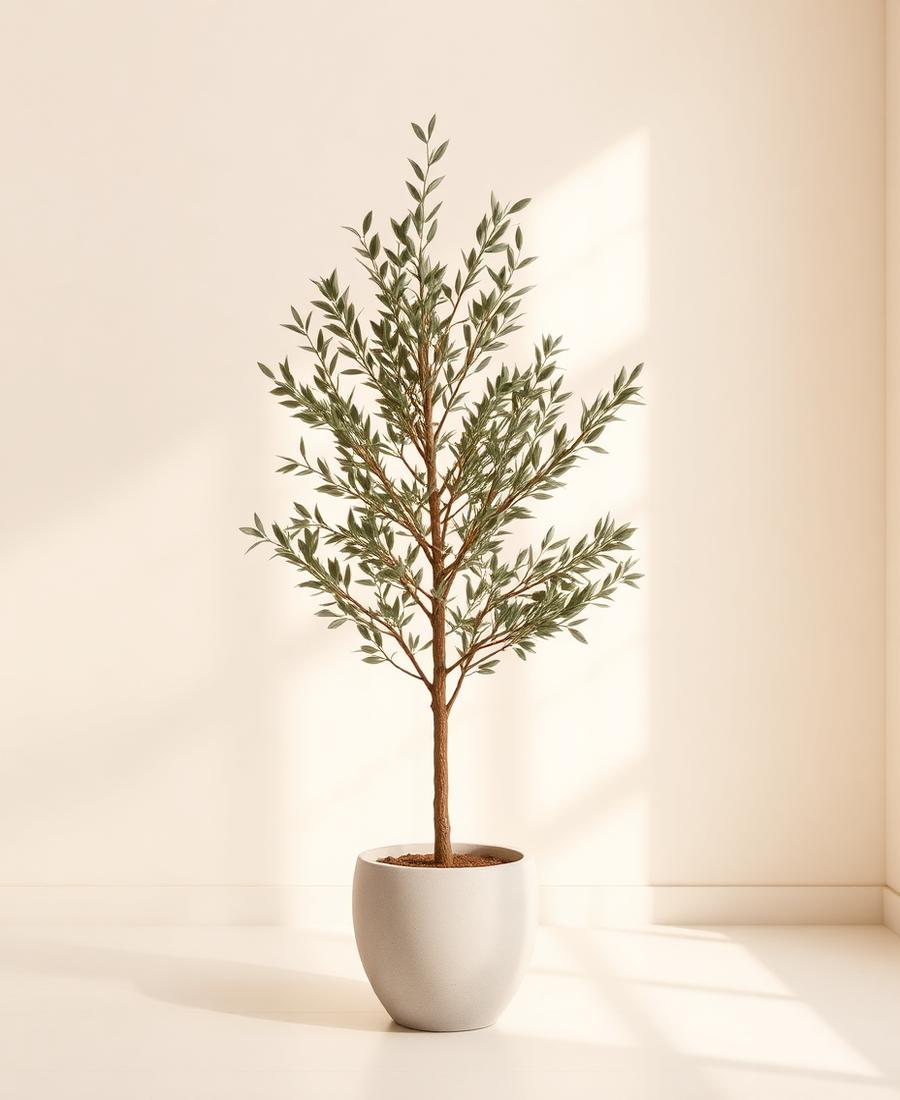
One specimen, not a group. The single hardest habit to break. Japandi wants one considered tree in one considered pot, with space around it. Resist the urge to cluster.
Choose the pot as carefully as the plant. This is where most faux styling fails. A matte stoneware, unglazed clay or hand-thrown ceramic vessel in oatmeal, charcoal or warm grey does more for realism than any upgrade to the foliage. Avoid gloss, avoid gold, avoid anything with a pattern. Worth knowing: most artificial trees, from most sellers including us, arrive in a plain nursery pot. Budget for the real vessel separately and treat it as half the purchase.
Cover the base. A visible plastic nursery pot rim inside a decorative vessel ruins the illusion faster than anything else. Use river stones, coarse gravel, sheet moss or a linen collar. This is a five-dollar fix that does more than a five-hundred-dollar tree upgrade.
Respect the horizontal. Japandi furniture is low, so a tall narrow tree can feel like it is standing to attention. A maple or a cloud-pruned pine with layered horizontal branching echoes the furniture line. Bamboo is the exception, where the vertical is the point.
Let asymmetry happen. Do not centre the tree on the wall. Do not balance it with a matching object on the other side. Offset placement is the wabi-sabi principle applied.
Adjust the branches after unpacking. Faux trees ship compressed and arrive looking like a closed umbrella. Any tree with a metal internal support can be re-angled and will hold the new position. Spend twenty minutes opening the canopy, pulling branches to different depths and removing any obvious repetition in the leaf pattern. This single step separates a faux tree that works from one that looks like a faux tree.
Which faux plant should go where?
| Space | Plant | Why it works |
|---|---|---|
| Entryway or console | Bonsai or small pine | Low, sculptural, reads at close range where people pause |
| Living room corner | Japanese maple | Horizontal branching echoes low furniture; warm colour against neutrals |
| Beside a window or as a screen | Bamboo | Vertical rhythm, filters light without blocking it |
| Dining room or a feature wall | Cherry blossom | The one permitted moment of colour; strong silhouette against a plain wall |
| Bedroom or a quiet corner | Small pine or moss dish | Ground-level texture, no visual noise |
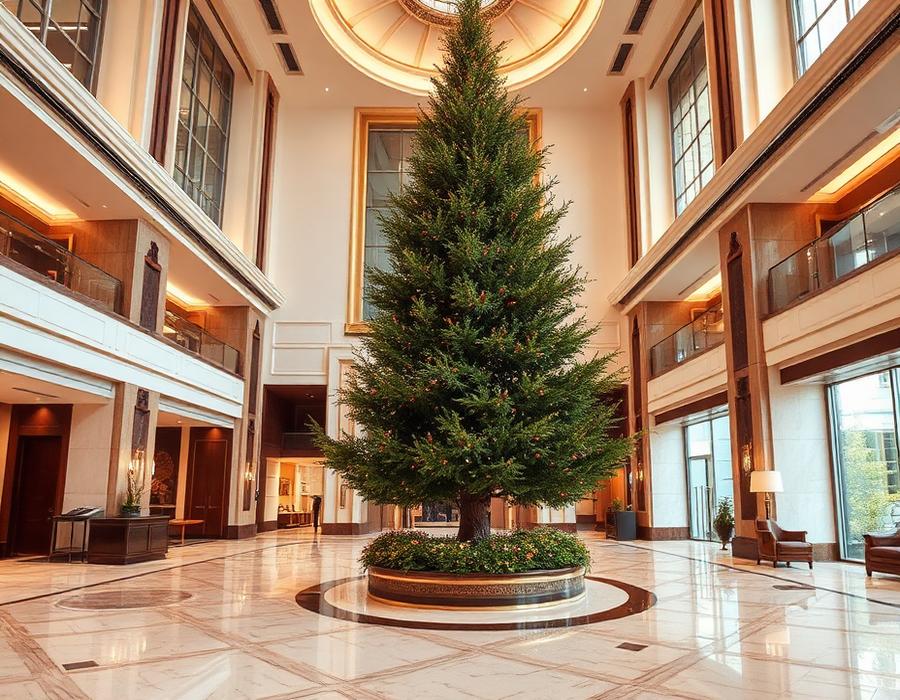
| Tall stairwell or double-height room | Large pine or maple | Fills vertical volume that furniture cannot reach |
Frequently asked questions
Do fake plants work in a Japandi room?
Yes, with one honest caveat. Japandi depends on silhouette more than almost any other style, and a faux specimen holds that silhouette year-round where a real tree can go leggy or drop half its canopy in February. The caveat is that artificial foliage is plastic and does not change with the seasons, so place it where people walk past it rather than sit beside it - and if the room has good light, a real plant is a better object.
Can you grow a real Japanese maple or bonsai indoors in Canada?
Realistically, no. A Japanese maple is a deciduous outdoor tree that needs a cold dormancy it will never get in a heated apartment. Bonsai demands daily attention and a light level a north-facing condo cannot supply, and cherry blossom flowers for perhaps two weeks a year outdoors and not at all indoors. That is exactly why faux versions of these particular plants earn their place.
What kind of pot should a faux bonsai or tree go in?
Matte stoneware, unglazed clay or a hand-thrown ceramic vessel in oatmeal, charcoal or warm grey - avoid gloss, gold and anything with a pattern. Most artificial trees, from most sellers including us, arrive in a plain nursery pot, so budget for the real vessel separately and treat it as half the purchase. Then cover the base with river stones, gravel, sheet moss or a linen collar, because a visible nursery-pot rim ruins the illusion faster than anything else.
How much does a faux bonsai or cherry blossom tree cost?
Our bonsai range runs from around $128 CAD for small specimens into four figures for the large sculptural pieces - a 220 cm cedar pine bonsai and a 7.2 ft podocarpus bonsai are each $1,246.99 CAD. Cherry blossom sits lower: $329 to $419 CAD for a 5 to 6 ft tree in white or pink, and $469 to $529 CAD for a four-trunk version in a cement pot. Those are our prices, and the pot is usually a separate purchase.
How do you make an artificial tree look less fake?
Spend twenty minutes on it after unpacking. Faux trees ship compressed and arrive looking like a closed umbrella, so re-angle the branches - any tree with a metal internal support will hold the new position - pull them to different depths, and remove obvious repetition in the leaf pattern. Then hide the base and use a proper vessel: covering the nursery pot is a five-dollar fix that does more than a five-hundred-dollar tree upgrade.
Where to find these
Our artificial bonsai trees run from around $128 CAD for small specimens up into the four figures for large sculptural pines, and several use a natural wood trunk with the canopy built onto it, which is what makes a bonsai convincing at the close range an entryway demands. At the sculptural end of that band, a cedar pine bonsai at 220 cm, about 7.2 ft, is $1,246.99 CAD, and a 7.2 ft UV-resistant podocarpus bonsai is the same $1,246.99 CAD. Artificial maple trees and cherry blossom trees cover the seasonal-colour end - a 5 to 6 ft cherry blossom in white or pink runs $329 to $419 CAD, and a four-trunk version in a cement pot is $469 to $529 CAD - and artificial bamboo handles screening. If you would rather browse the whole aesthetic at once, our Japanese-inspired collection gathers them.
Two honest notes before you buy from us or anyone else. First, most of these ship in a plain nursery pot, so plan the vessel as a separate purchase. Second, our range spans a very wide price band, from small accent pieces to commercial-scale specimens that cost several thousand dollars, so filter by size before you fall in love with a photograph. Every listing states the trunk material, the real height in feet and metres, and what is actually in the box.
Japandi rewards buying one good thing slowly. That principle applies to the tree as much as to the room.
Eververda prices are CAD and current as of 29 August 2026.