
How Much Does Each Extra Foot of an Artificial Tree Really Cost?
21 October 2026
Is a 9 ft artificial tree really 50% more expensive than a 6 ft one, just because it is 50% taller? No, and the actual relationship is the opposite of what most buyers assume. Eververda measured its own live catalogue, size step by size step, to find what an extra foot of height actually costs across the range, and re-verified every price in this article in US dollars on 21 October 2026. The short answer: the price per extra foot gets cheaper the taller the tree gets, not more expensive.
Across 89 products that publish four or more foot-labelled variant heights (464 adjacent size-steps in total, Christmas SKUs excluded because their pricing follows a different logic entirely), the median price growth per extra foot works out to roughly +23% below 8 ft, falling to +16% between 8 and 12 ft, and easing further to +8.5% above 12 ft. Those percentages are the same whichever currency you shop in, because the US price list is a fixed multiple of the catalogue price, so a percentage step does not move with the exchange rate. If you have ever wondered why a 13 ft tree does not cost anywhere near double a 10 ft one, this is the reason, and it is measurable rather than a rule of thumb.
Why does the cost per foot fall as trees get taller?
Because a large share of what you are paying for does not scale with height. A tree's base, its root plate or ballasted foot, its packing and crating, and a meaningful chunk of the labour to assemble and ship it are close to fixed costs regardless of whether the finished tree is 6 ft or 16 ft. Below 8 ft, that fixed cost is a large fraction of the total price, so each additional foot of canopy and trunk pushes the price up sharply in percentage terms. Above 12 ft, the fixed cost has already been amortised by the lower rungs, and each further foot is mostly incremental material (more foliage, a slightly longer trunk section), so the percentage jump shrinks even though the dollar jump often gets larger in absolute terms.
This is worth saying plainly because most buying guides in this category imply the opposite: that height is a linear multiplier on price, so doubling the height roughly doubles the cost. Across Eververda's own 89-product sample, it does not. The lower bands of this curve are also the more method-sensitive part of the finding: small trees have fewer size rungs to measure from, so treat the below-8-ft figure as directionally solid rather than precise to the decimal.
What does a real price ladder actually look like?
Numbers in the abstract are easy to misread, so here is one product's actual size run. The artificial red maple tree for indoor landscape displays runs from 3.9 ft at $602 USD up to 8.2 ft at $2,331 USD across six published sizes, with each step landing between roughly 21% and 51%: steep, consistent with the below-8-ft band, and driven by a tree that is still mostly base cost at its smallest size. The steepest jump of all is the very first one, 3.9 ft to 4.9 ft, which alone adds just over 50%.
Compare that with the hanging pine tree, which publishes twelve sizes from 3.9 ft at $602 USD all the way to 16.4 ft at $6,806 USD. The early steps run high, same as the maple, but the pattern flattens through the middle rungs and the tree reaches exactly double the height of the maple's top size for about 2.9 times the price: nowhere near the 4x-plus you would expect from a naive per-foot multiplier.
At the tall end, the tall artificial date palm tree for commercial interiors goes from 11.5 ft at $2,534 USD to 19.7 ft at $7,112 USD: a 71% taller tree for 181% more money, which compounds out to roughly 13% per extra foot across the eight extra feet. That is above the 8.5% median for the 12 ft-plus band, so this particular ladder runs hotter than the catalogue average, but it is still less than half the per-foot rate the same catalogue shows below 8 ft.
Does the curve hold in the mid-height range too?
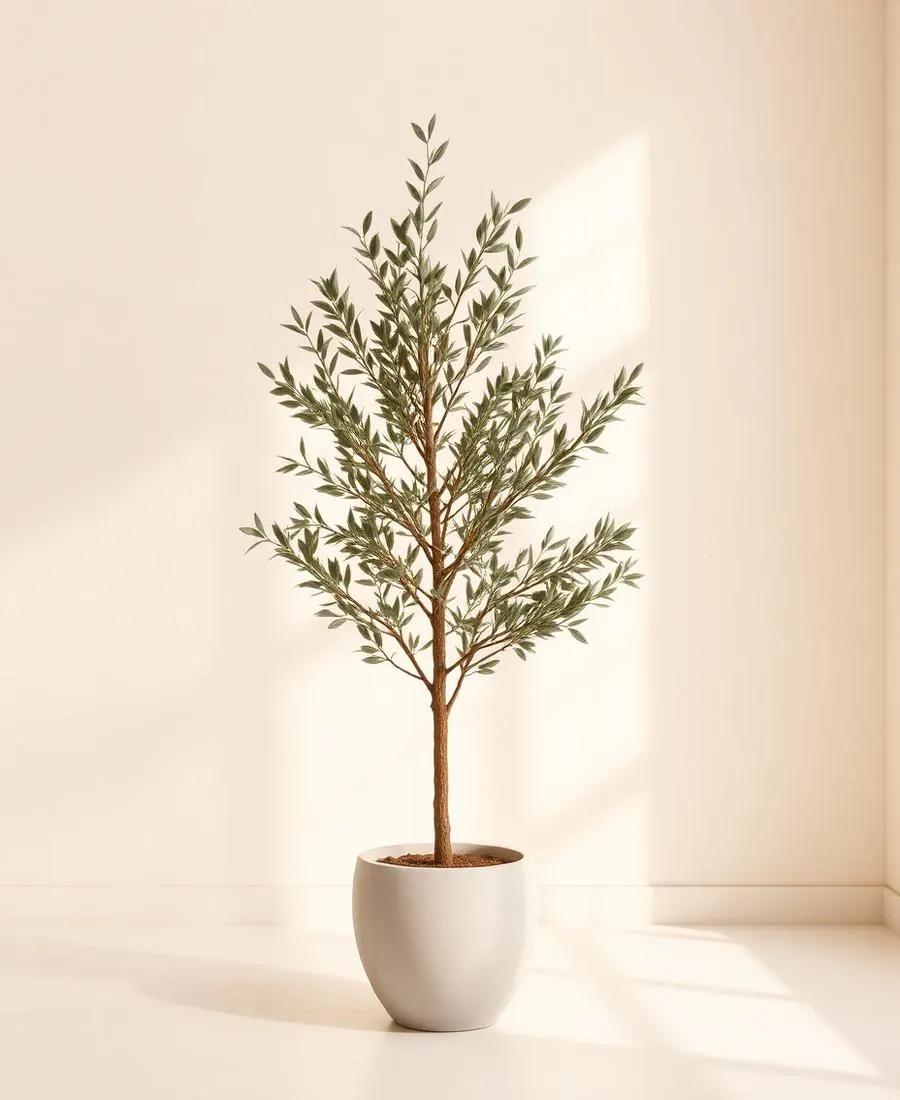
Yes, and this is the range most buyers actually shop in. The Nordic-style faux olive tree on a floor-standing base runs from 4.9 ft at $906 USD through eight sizes to 11.5 ft at $3,043 USD, crossing the 8 ft threshold between $1,618 USD at 7.2 ft and $1,924 USD at 8.2 ft. Its individual steps sit mostly in the 15 to 23% range, bracketing the published medians for the below-8-ft and 8-to-12-ft bands on either side of that line.
The artificial crabapple blossom tree for indoor landscape displays tells the same story from a different species: 6.6 ft at $1,313 USD stepping up to 11.5 ft at $3,551 USD across seven sizes, with per-step growth clustering between 13% and 25%, right in the middle of the curve.
Is this pattern universal, or does it depend on the tree type?
It shows up across species and construction types, but the fixed-cost mechanism means it is strongest on trees where the base and trunk are a large share of the build: potted floor trees especially. On smaller potted plants, the effect is present but noisier because the total price is lower and a single component change (a bigger pot, a wider canopy) can move the percentage more than height alone. The artificial areca palm floor potted indoor plant is a useful example: 5.2 ft at $398 USD to 8.5 ft at $662 USD across five sizes, with growth ranging from about 4% to nearly 28% step to step. The median trend holds directionally, but a single product's ladder is not a clean substitute for the 89-product average.
Should I size up if I can afford the next rung?
Usually yes, if the room can take the height, and the maths above is the reason. Going from a 6 ft to a 7 ft tree typically costs meaningfully more in percentage terms than going from a 12 ft tree to a 13 ft one: the smaller jump costs proportionally more, not less. If you are choosing between two adjacent sizes and the room genuinely fits either, the taller option is very often the better value per foot of visual impact, especially once you are already above 8 ft. This is exactly the decision facing anyone weighing a 12 ft against a 15 ft specimen, and both sit inside our artificial trees in the 10 to 15 ft range. Below 8 ft, budget more carefully, because that is where the percentage cost of an extra foot is highest.
The curved artificial coconut palm tree for outdoor landscapes illustrates the upper end of this well: 9.8 ft at $2,025 USD to 18 ft at $4,569 USD across six sizes. The tree nearly doubles in height for about 126% more money, which compounds out to roughly 10% per extra foot, landing between the 8 to 12 ft and 12 ft-plus medians.
What should this change about how I shop by size?
Stop budgeting by multiplying a small tree's price by a height ratio. It overstates the cost of going taller and understates the cost of small trees relative to their size. If your room can plausibly take a 7 ft tree instead of a 6 ft one, price both rather than assuming the taller one costs proportionally more: on Eververda's own numbers, it usually costs less per foot than the size below it, not more.
| Height band | Median price growth per extra foot | What drives it |
|---|---|---|
| Under 8 ft | ~+23% per foot | Base, root plate and packing are a large share of total cost; method-sensitive at the smallest sizes |
| 8 ft to 12 ft | ~+16% per foot | Fixed costs partly amortised; canopy and trunk material still add real cost |
| Above 12 ft | ~+8.5% per foot | Fixed costs fully amortised; extra height is mostly incremental material |
Frequently asked questions
Is a taller artificial tree always better value per foot?
In percentage-per-foot terms, usually yes above 8 ft. Across the 89-product sample, the median cost of an extra foot falls from roughly 23% below 8 ft to about 8.5% above 12 ft. That does not make every tall tree cheap in absolute dollars (a 16.4 ft pine still costs $6,806 USD against $602 USD for the 3.9 ft version of the same tree) but the rate of increase slows the taller you go.
Why is the smallest size in a product line often the worst value?
Because the base, root plate, packing and a chunk of the labour cost are close to fixed regardless of tree height, and on the smallest size in a line that fixed cost is a larger share of the total price. Each extra foot on a small tree therefore adds a bigger percentage than the same extra foot on a tall one, which is measured here at roughly +23% per foot below 8 ft.
Does this pricing pattern apply to every species Eververda sells?
It shows up across the 89 products in the sample, but it is clearest on floor-standing trees where the trunk and base are a large share of the build. On smaller potted plants the percentage step is noisier, because a single change in pot size or canopy width can move the number as much as height does, so treat any single product's ladder as illustrative rather than as proof of the average.
Should I trust the below-8-ft figure as precisely as the taller bands?
Treat it as directionally reliable rather than exact. Smaller trees have fewer published size rungs to measure a step from, which makes that band more sensitive to which products happen to be in the sample. The 8 to 12 ft and 12-ft-plus figures, at +16% and +8.5%, rest on more size steps and are more stable.
Do these percentages change if I am buying in US dollars?
No. The US price list is a fixed multiple of the catalogue price, so every size-step percentage is identical whichever currency you check it in. Only the absolute dollar amounts change, and every figure in this article is the live US price as of 21 October 2026.
If I can only afford one size, which one should I buy?
Buy the size the room actually needs rather than the size that looks like the best percentage deal: the pricing pattern here is a budgeting tool, not a reason to oversize a room. If two adjacent sizes both genuinely fit, the taller one is very often better value per foot once you are above 8 ft, and worth stretching for; below 8 ft, each extra foot costs more, so size to the room rather than to the curve.
For help matching a size to the room itself rather than to price, see how to choose the right size artificial tree. If you are specifying for a lobby, atrium or other commercial space rather than a room at home, what a commercial specimen costs and how to specify one covers the specification side of the same purchase. If you are shopping above 15 ft, giant artificial trees over 15 feet covers specification and lead times at that end of the range, and artificial trees for high ceilings and stairwells covers the room-fit side of the same decision. For the wider question of what separates an $80 USD tree from a $900 USD one beyond height alone, why faux trees cost $80 USD or $900 USD is the companion piece. And if palm species specifically are your size question, how much artificial palm trees cost breaks the same curve down by palm size.
Band medians are computed from Eververda's live product catalogue, 89 products with four or more foot-labelled variant heights (464 adjacent size-steps), Christmas SKUs excluded. Every price shown is the live US price, re-verified in USD on 21 October 2026.
Products in this article
- Artificial Red Maple Tree, 3.9 to 8.2 ft (1.2 to 2.5 m), Indoor$827.99 CAD to $3,209.99 CAD
- Artificial Hanging Pine Tree Cascade Style 6.5 ft$827.99 CAD to $9,372.99 CAD
- Artificial Date Palm Tree, 11.5 to 19.7 ft (3.5 to 6 m), Plastic$3,489.99 CAD to $9,794.99 CAD
- Artificial Olive Tree, 4.9 to 11.5 ft, Nordic Style, Flocked Silk Foliage$1,246.99 CAD to $4,189.99 CAD
- Artificial Crabapple Blossom Tree 6.6 to 11.5 ft Indoor$1,807.99 CAD to $4,889.99 CAD
- Artificial Areca Palm, 5.2 to 8.5 ft (1.6 to 2.6 m), Floor Potted, Indoor$547.99 CAD to $910.99 CAD
- Artificial Coconut Palm Tree, 9.8 to 18 ft (3 to 5.5 m), Curved Fiberglass Trunk$2,787.99 CAD to $6,291.99 CAD