
Artificial Trees and Greenery for Car Dealerships and Showrooms
29 August 2026
A car dealership showroom is one of the harder rooms in retail for a live plant to survive, and one of the easier rooms for artificial greenery to earn its keep. The building is mostly glass on one elevation and mostly nothing on the others: a strip of direct, intensified sun a few metres deep, and a dead zone everywhere else. The floor is polished concrete with no planting bed. HVAC runs hard to offset solar gain through that glass. Cleaning is contracted and happens after close, so nobody is watering at 7am. The short version: UV-stated pieces within reach of the glass, everything else back from it, weighted bases against trolleys and dollies, and greenery doing a job — softening the box, marking the lounge, screening the service department, giving handover photos something alive in the frame — rather than just filling a corner.
Why is a dealership showroom a hostile environment for live plants?
Several things work against a live plant here at once, and none are things staff did wrong. Showroom architecture now runs toward a "double-height display area with the main frontage in full-height glazing," in the words of one commercial-doors trade publication describing the current design brief for new dealership builds (checked 29 August 2026) — full-height glass sells the cars, but it turns the floor next to it into a greenhouse for several hours a day and leaves everything further back in comparatively low, flat light. The same source notes that "comfort cooling is required to manage solar gains in highly glazed areas": the air near the glass runs hot and dry, then cold and dry everywhere the ducted system fights to compensate.
Underneath all of that is polished concrete with no planting bed anywhere on the floor — every plant goes into a pot, full stop. What actually kills live plants on a commercial floor is ownership, not drainage. A dealership's cleaning is a contracted crew working nights, and nobody on the sales or service floor has watering written into their job. We cover this in depth for offices in artificial vs real plants for the office: the failure mode is never a bad plant choice, it is a plant with no owner, and a showroom has fewer potential owners than an office does.
What job does greenery actually do on a dealership floor?
Four jobs, specifically. It softens a room built from concrete, glass, steel, and painted sheet metal — a showroom has almost no soft surfaces, and greenery is one of the few elements that can sit on the floor and read as anything other than hard and reflective. It defines zones a wide-open floor plan does not define on its own: a pair of trees marks where the customer lounge starts, and a line of foliage along the service-drive threshold marks the delivery bay, without a wall or a rope stanchion doing it. It screens sightlines into the service department — customers waiting on a car should see enough of the shop to trust it is real, not so much that they are staring at a lift and a parts rack from the sofa. And it is the backdrop for handover photos: nearly every dealership photographs a customer with their new vehicle at delivery, and a bare corner reads worse in that photo than one with something green in it. This is the same logic retailers use on a sales floor generally — the visual-merchandising case is in artificial trees for retail stores — a dealership just has fewer other soft elements competing for the job.
Where does the sun hit hardest, and what actually belongs there?
The glass wall is the harshest placement in the building, full stop — worse than an outdoor patio in a lot of cases, because glass concentrates heat as well as light. A south- or west-facing showroom front gets several hours of direct, magnified sun a day, every day, all year, and no ordinary indoor artificial tree is built for that. The rule for that zone is simple: only UV-stated products go within a few metres of the glass, and everything else stays indoor-away-from-glass, no exceptions for a tree that "looks tough."
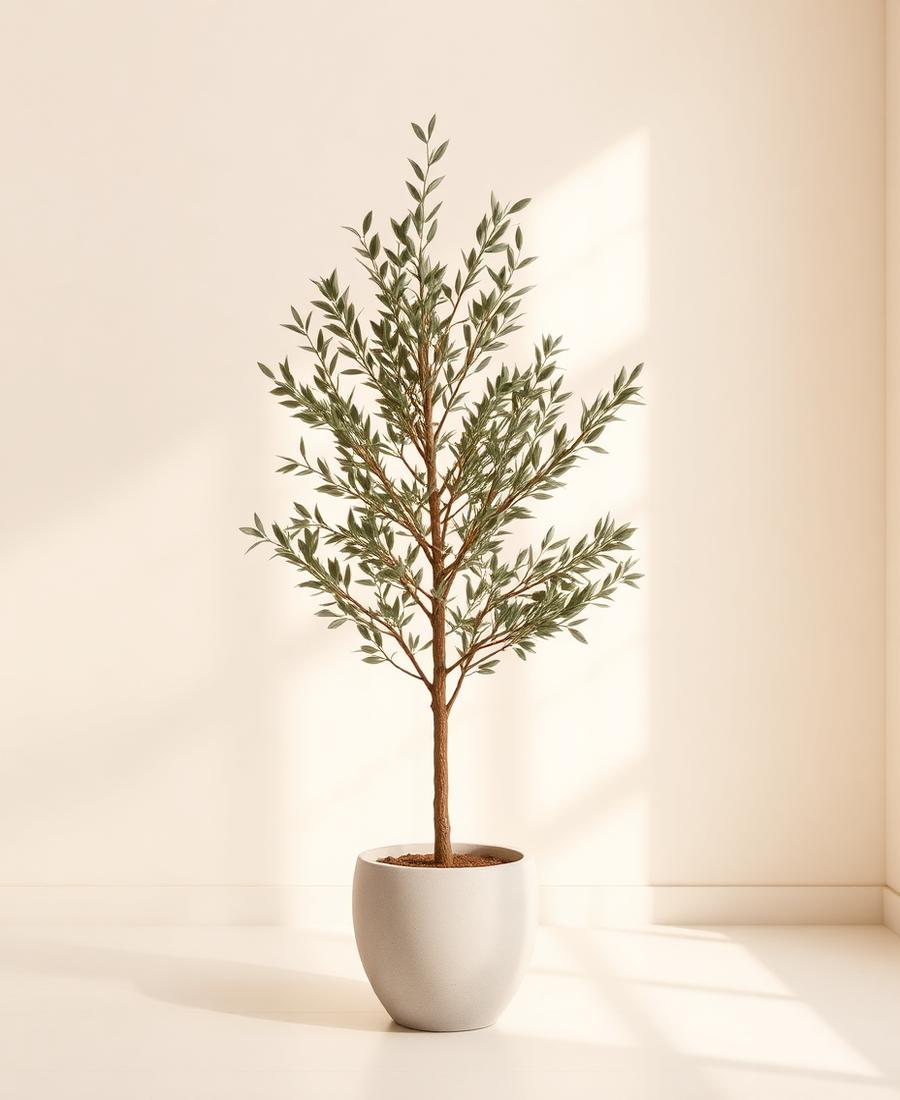
Eververda's UV-stated pieces for that zone: a 5–6 ft palm with UV-resistant fronds at $219–$289 CAD, a 5 ft UV-resistant olive in a white taper planter at $529 CAD, and a 6 ft UV-resistant dracaena in a river-rock-ballasted planter at $489 CAD. For a double-height glass wall needing a real statement piece, a 15 ft UV-protected fiberglass-trunk olive is quote-priced. Be honest about what "UV-resistant" buys: it slows fading, it does not stop it, and even a rated product in direct glass-magnified sun will fade faster than the same product ten metres back. Everything else — the fiddle figs, the areca palms, the cherry blossoms — carries no UV claim and belongs away from the glass, not tucked in front of it because it happened to fit the space.
How does anything survive trolleys, dollies, and delivery-bay traffic?
A showroom floor moves more than most retail floors: parts trolleys, tire dollies, a mechanic wheeling a battery cart through on the way to the shop. A tree in a light nursery pot gets clipped once and is on its side. The fix is the one that applies to any tall artificial tree, worked out in full in stop artificial trees tipping over: a weighted or cement-filled base rather than a stock nursery pot, canopy above knee height wherever a cart passes. A 4–6 ft fiddle leaf fig with a weighted black planter base at $319–$449 CAD is built for exactly this kind of floor — set back from the primary travel lane between showroom and service drive, not directly in it.
What about a double-height showroom?
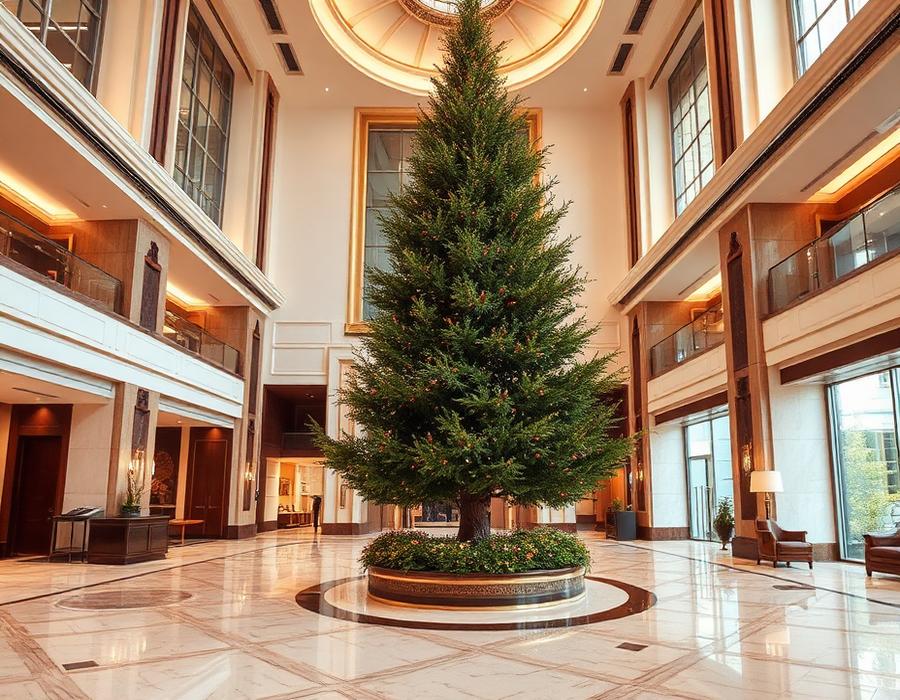
Full-height glazing usually comes with a full-height ceiling, and a single 6 ft tree looks lost under 20 feet of it — an afterthought rather than a design element. The scale math for that, including anchoring and freight over 15 ft, is set out in giant artificial trees over 15 feet. For an atrium or lounge corner away from direct glass, a 16.5 ft banyan tree is quote-priced and holds the space the way it actually needs — a canopy near the ceiling, not a shrub on the floor.
What works in the customer lounge and waiting area?
The lounge is usually the one part of the floor plan that behaves like a normal indoor room — away from the glass, away from trolley traffic, and the one place a customer sits still long enough to actually look at what is around them. An areca palm, 4–6 ft with leaf counts published by height, in a white pot, at $289–$419 CAD, reads as a real furnishing rather than a prop, and the published leaf count is the kind of specification detail that survives a customer looking closely while they wait. For the service-department sightline, an ivy privacy screen with a willow trellis, UV-resistant and 3.3 ft, at $225.99 CAD, softens the view into the shop without blocking it — set two or three along a half-wall or railing rather than as a single panel.
Not every zone in a dealership has natural light either — the finance office and service write-up desk are frequently interior rooms with no glass at all, a different problem covered in the best artificial plants for offices with no natural light.
What about fire documentation?
A showroom is assembly or mercantile-type occupancy, and any greenery specified for it should come with fire-performance documentation for the exact product, requested in writing from every supplier — ours included — through the quote process. In Canada the reference standard for decorative fabrics and films is CAN/ULC-S109, with provincial fire codes governing how it applies; the US equivalent is NFPA 701. Neither standard is self-certifying — acceptance in a given building is decided by your fire consultant and the local authority having jurisdiction, not a product label. The full explainer, including what "fire-retardant" foliage means and the questions to put to a supplier, is in fire ratings and commercial artificial greenery.
How does a dealership actually buy this?
Two routes, split by price. Anything under roughly $3,000 CAD — the UV pieces near the glass, the fiddle fig for the delivery-bay edge, the lounge palm, the screening panels — is a straight order: pick it, buy it, place it. Past that threshold, Eververda's commercial orders move to a quote, which is how the 15 ft olive and the 16.5 ft banyan above are priced: a large tree ships crated on a freight pallet, and a double-height floor usually needs the delivery date coordinated with a slow morning rather than a Saturday during a sales event. The quote is also where the fire documentation above gets attached in writing. Start at the commercial page or go straight to a quote request with your floor plan and glazing orientation.
Frequently asked questions
Will artificial plants fade next to a dealership's glass wall?
Any product without a UV rating will fade there, often within a season, because south- or west-facing glass concentrates sun rather than just admitting it. Only UV-stated products belong within a few metres of full-height glazing, and even those fade eventually — a UV rating slows the process, it does not stop it. Everything else should sit back from the glass regardless of how the floor plan wants to use the space.
What is the best artificial tree for a car dealership showroom?
It depends on the zone, not a single product. Near glass, a UV-stated palm, olive, or dracaena; in the lounge or away from the glass, an areca palm or fiddle leaf fig with a weighted base; for a double-height floor, a 15 ft-plus commercial piece bought through a quote. The placement decides the product, not the other way round.
How do you stop a showroom tree from getting knocked over by a parts trolley?
Buy one with a weighted or cement-filled base rather than a stock nursery pot, and set it back from the primary travel lane between the showroom floor and the service drive. A weighted base absorbs a glancing hit from a dolly or cart; a light nursery pot tips at the first real contact.
Does dealership greenery need fire certification?
Request fire-performance documentation for the specific product from any supplier, ours included, because a showroom is assembly or mercantile occupancy — but no document is self-executing. CAN/ULC-S109 is the reference standard in Canada, NFPA 701 in the US, provinces and states apply them differently, and the local authority having jurisdiction makes the final call for your building.
How much does greenery for a dealership showroom cost?
Individual pieces run from about $220 CAD for a screening panel or small UV palm up to roughly $500 CAD for a UV-rated dracaena or olive, and a weighted-base fiddle fig for traffic areas runs $319–$449 CAD. Statement pieces for double-height floors — a 15 ft UV olive or a 16.5 ft banyan — are quote-priced, with orders over roughly $3,000 CAD moving through Eververda's commercial quote process for freight and delivery scheduling.
The trade-publication facts on dealership glazing and HVAC design were checked on 29 August 2026 and are quoted as displayed at the source. Eververda prices are CAD and current as of 29 August 2026.