
Artificial Trees and Greenery for Retail Stores: A Visual Merchandising Guide
29 August 2026
If you run a store and are deciding whether artificial greenery deserves floor space, here is the short version. Greenery is one of the cheapest atmospheric signals a retailer can buy: shopping-environment research has linked trees and plants to better perceptions of merchants and higher willingness to pay, and artificial versions deliver it without the light, water and replacement costs that kill live plants in stores. The working formula is a pair of cedar topiary bushes framing the entrance ($169 to $789 CAD depending on height and whether you buy the pair), one taller feature tree at a sightline anchor such as an aisle end, green wall panels behind a feature or photo wall at $249 to $279 CAD per set, and small unkillable plants at the cash-wrap and fitting-room corridor. Keep one permanent green scheme year-round and swap only accent pieces by season. Many of the pieces in this guide carry listed retail prices, with delivery in Canada quoted individually; pieces priced $3,000 CAD and above, some pieces at any price depending on how they are supplied, and mall-scale and multi-store fit-outs all go through a quote process, which is also where to ask what fire documentation, if any, the manufacturer can provide. The rest of this guide works through each zone.
Our position on fire documentation. Eververda publishes a fire figure only where documentation exists for that specific piece, and describes nothing as "fire rated". On a commercial quote we establish the occupancy, the adopted code edition and what your authority having jurisdiction (AHJ) will accept as documentation, in writing, before the order. Where no documented route exists for a piece, we say so and set out the alternatives. We do not claim a certificate for any product.
Why does greenery earn floor space in a retail store?
Floor space is the scarcest thing a retailer has, so a tree must justify its square metre. The honest case rests on atmosphere research, not any direct plants-equal-sales study. The idea that the buying environment itself is a selling tool goes back to Philip Kotler's 1973 paper in the Journal of Retailing, which coined the term "atmospherics" for the deliberate design of a space to produce emotional effects that raise the probability of purchase (checked 29 August 2026). Greenery is a standard atmospheric tool because it reads as care: a maintained plant says someone is paying attention to this space.
The most-cited numbers come from street trees rather than indoor plants, and it is worth being precise about that. Research by Dr. Kathleen Wolf at the University of Washington, summarised in Arborist News in April 2009, found that surveyed shoppers said they would pay about 9 percent more in small cities and 12 percent more in large cities for equivalent goods in business districts with tree-lined streets, and rated products and merchants in greener streetscapes more positively (checked 29 August 2026). That is evidence about greenery outside the shop, not faux trees inside it, so treat it as directional: people consistently read green as a quality signal. Inside the store, practical logic carries the rest. A tree softens hard fixtures, gives the eye a resting point between merchandise runs, marks navigation points, and photographs well.
Live plants rarely survive retail conditions: low light, HVAC draughts, nobody owning the watering. So the real question for most stores is not real versus faux but which faux and where.
Where should artificial trees go in a store?
Window displays. The window is the highest-value zone and the one where honesty about sun matters most: direct sun through glass fades standard silk and PE foliage, and a south-facing window is the harshest spot in the building. For windows that get real sun, use only products with a published UV treatment, such as a 5 ft cypress topiary with UV-treated foliage at $349 CAD or a 5 to 6 ft palm with UV-resistant fronds at $293.99 to $374.99 CAD, and rotate window stock back into the interior on a schedule anyway. A north-facing or awning-shaded window is far more forgiving.
Entrance framing. A matched topiary pair either side of the door is the oldest visual merchandising trick because it works: symmetry signals a threshold and slows the walk-in. The cedar topiary bushes come in five heights from 60 to 180 cm, single or as a set of two, at $169 to $789 CAD, which lets you scale the pair to your frontage. For a more formal look, a 4 ft boxwood spiral in a grey pot runs $599 CAD.
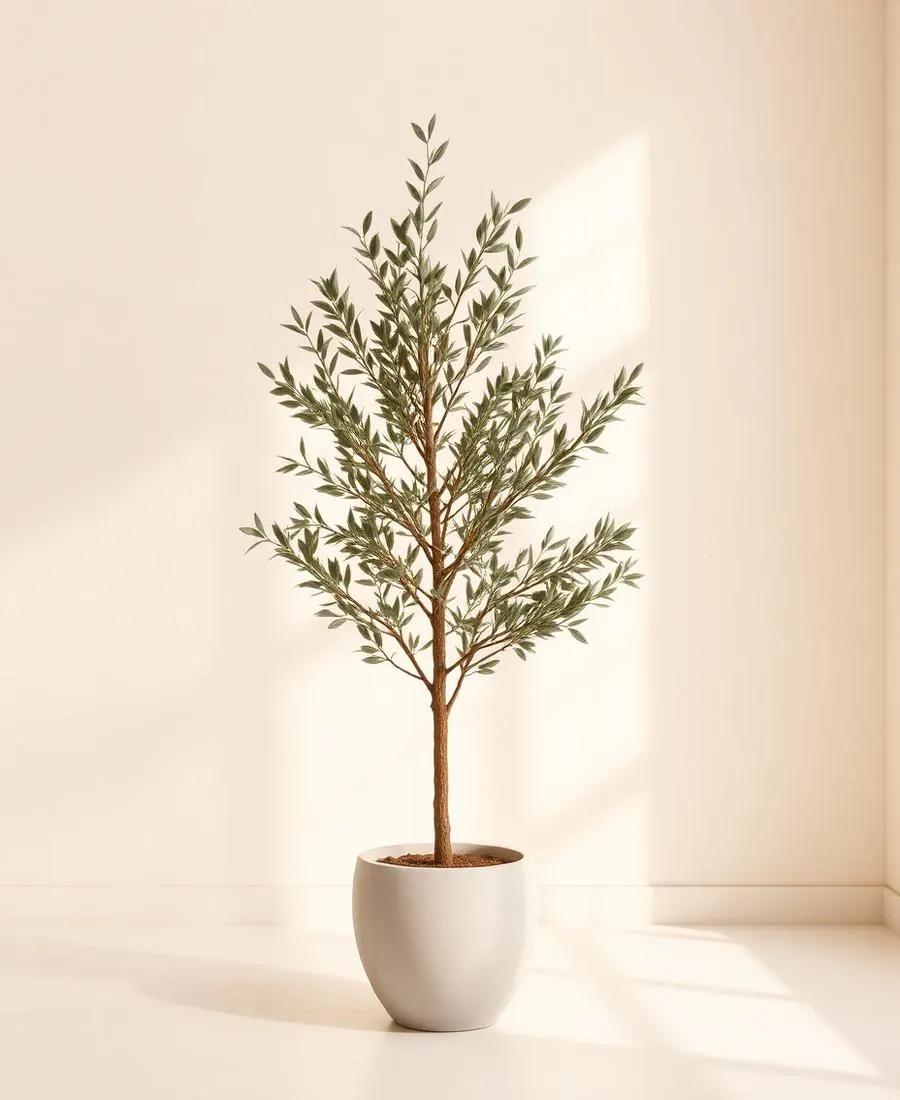
Aisle-end features. End caps and gondola ends are where the eye lands at the top of each run. One 4 to 7 ft tree turns an aisle end into a landmark customers navigate by. A fiddle leaf fig in a white planter with a weighted base is $244.99 to $450.99 CAD depending on height; an olive tree at 5.25 to 8 ft is $249 to $449 CAD and suits fashion and homeware floors.
Fitting-room corridors. Dead space that shoppers experience at close range while making the actual buying decision. Narrow footprints work: a pair of 3 ft snake plants at $279 to $299 CAD for the two fills a corridor without eating walkway width.
Cash-wrap. Keep it small and below sightline: a 4 ft fiddle leaf fig at $244.99 CAD beside the counter, or a tabletop piece on it. A green wall panel section behind the till also frames the staff member customers face; a twelve-panel PE hedge wall set covering 2.88 square metres is $279 CAD, and a six-panel mixed-greenery set at 1.44 square metres is $249 CAD for smaller feature walls.
| Zone | What works | Typical spend (CAD) |
|---|---|---|
| Window display | UV-treated topiary or palm only if sunlit; rotate stock | $293.99 to $374.99 |
| Entrance | Matched topiary pair, scaled to frontage | $169 to $789 |
| Aisle ends | One 4 to 7 ft tree as a navigation landmark | $244.99 to $450.99 |
| Fitting-room corridor | Narrow-footprint floor plants in pairs | $279 to $299 |
| Cash-wrap | Small tree below sightline; panel wall behind till | $244.99 to $279 |
| Mall atrium / flagship | Commercial-grade trees, 8 ft and up | from $3,209.99, or quote-priced |
Which artificial plants survive high-traffic retail?
Retail is the hardest environment most artificial plants will ever see: strollers, delivery trolleys, children, a thousand brushes a day. Three specifications matter. First, weighted bases. Anything in a walkway will be knocked, so choose cement-filled or otherwise weighted pots rather than lightweight nursery pots; the fiddle leaf and topiary lines above list weighted or cement bases on their product pages. Second, foliage material. PE (polyethylene) moulded foliage is wipeable and springs back from contact; delicate silk belongs on displays and window beds, not at trouser height in an aisle. Third, the dusting reality. Under retail lighting, dust shows within two to three weeks, and a dusty plant reverses the care signal you bought it for. Put a monthly wipe-down of everything below 6 ft on the same rota as your mirrors and glass, and a quarterly clean on taller pieces; our guide to dust, fading and upkeep covers methods.
How do you rotate displays seasonally without rebuying everything?
The workable strategy is one permanent green scheme plus seasonal swap pieces. Your entrance pair, wall panels, aisle-end trees and cash-wrap plant stay year-round; they are the fixed grammar of the store. Season then arrives as one or two swap pieces in the window and at the main feature point. In spring, a blossom tree does the work: our cherry blossom tree guide covers retail-priced options from $309 CAD. For the holiday flip, the entrance pair and feature tree stay put and a commercial-grade Christmas tree takes the atrium or window slot; our commercial Christmas tree guide for Canadian businesses covers ordering deadlines, which start earlier than most first-time buyers expect. Storing two swap pieces costs far less than re-theming the floor four times a year, and the permanent scheme means the store never looks stripped between seasons.
What scale do malls and atriums need?
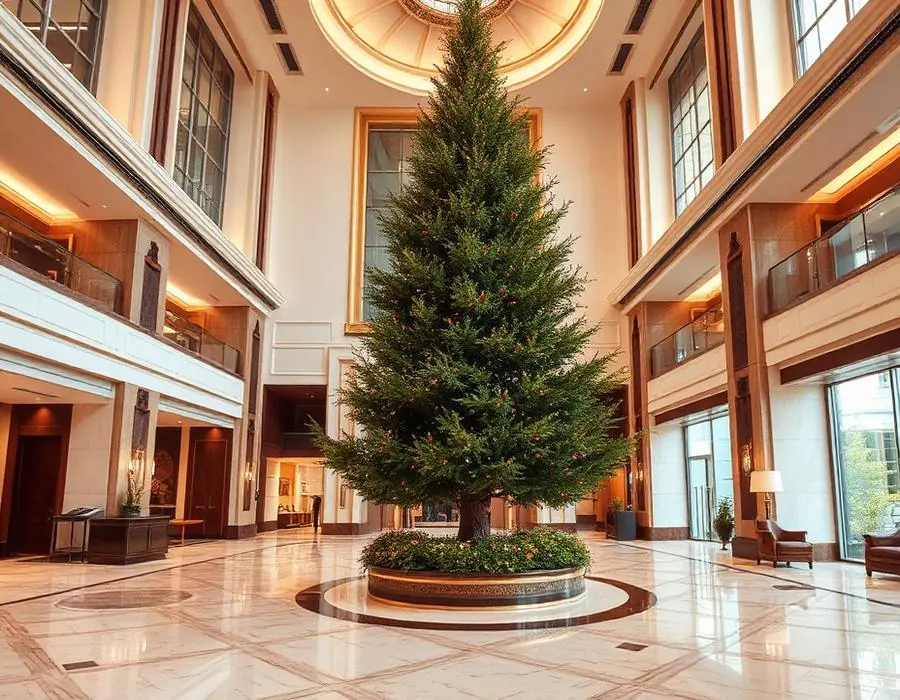
A 6 ft tree that anchors a boutique disappears in a two-storey mall atrium. Common areas, double-height frontages and anchor courts need commercial-grade pieces: 8 to 20 ft, fiberglass or steel-cored trunks, engineered bases. A custom-shape banyan built for indoor commercial display starts from $1,807.99 CAD, and a tall date palm specified for commercial interiors and a 15 ft olive on a UV-protected fiberglass trunk are both quote-priced, sized and specified per project. For the full treatment of heights, trunk engineering, freight and installation at this scale, see our guide to giant artificial trees in Canada.
Should you buy at retail prices or request a quote?
The catalogue splits cleanly. Everything a single boutique needs, from the $169 entry topiary to a $789 tall pair, wall panel sets at $249 to $279 CAD and feature trees from $244.99 to $789, is listed at plain CAD prices, with delivery in Canada quoted individually before you pay. Pieces priced $3,000 CAD and above, which in practice means atrium-scale trees, are quote-only, and multi-store rollouts or a full fit-out also go through a quote process: sizing against ceiling heights and fixture plans, freight to site, staged delivery across locations.
The quote stage is also where fire documentation belongs. A mall or landlord may set its own documentation requirements in the lease, on top of whatever the code asks. Ontario's Fire Code (O. Reg. 213/07, Division B, Article 2.3.2.1) requires drapes, curtains, netting and other similar or decorative materials, including textiles and films, to meet CAN/ULC-S109 in listed locations, a lobby or exit among them. The Code does not mention artificial trees or vegetation by name, so applying it to a tree rests on a broad reading of “other similar or decorative materials”. Outside Ontario, confirm the code in force with your AHJ. In the United States, the International Fire Code accepts either NFPA 701 (Test Method 1 or 2) or NFPA 289 (20 kW ignition source, 100 kW maximum heat release rate) for artificial vegetation, at Section 807.4.1 from the 2018 edition onward; it was Section 806.2 in the 2015 edition, which some jurisdictions still run. No listing claim substitutes for paperwork, so treat no product, from any supplier, as certified until you hold the test documentation; ask every supplier what exists (for our listings, ask through the quote process and we will tell you what, if anything, the manufacturer can provide), and confirm requirements with your landlord and local authority having jurisdiction (AHJ), whose decision is final. Our guide to fire documentation for commercial artificial greenery explains the standards in detail.
Frequently asked questions
Do artificial plants actually increase retail sales?
No study we could verify links artificial plants directly to sales lifts, and you should distrust vendors who cite one. The verified evidence is adjacent: University of Washington research published in April 2009 found shoppers said they would pay 9 to 12 percent more for goods in tree-lined shopping districts, and atmosphere research since Kotler's 1973 paper treats the environment as a purchase influence. Greenery is a low-cost, zero-maintenance-risk way to buy that atmospheric signal.
What should a small boutique budget for artificial greenery?
Roughly $700 to $1,500 CAD at listed prices covers a full single-store scheme: an entrance topiary pair from $169 to $789 by height, an aisle-end feature tree between $244.99 and $450.99, a fitting-room pair at $279 to $299, and a cash-wrap plant at $244.99. Wall panel sets at $249 to $279 add a feature wall, all as a one-time spend with no watering contract.
Can I put artificial trees in a sunny shop window?
Only if the product is published as UV-resistant, and even then rotate it. Direct sun through glass fades standard silk and PE foliage, and south-facing windows are the worst case. UV-treated pieces such as a $349 cypress topiary or a $293.99 to $374.99 palm are the right choices for sunlit glass; move window stock into the interior periodically to spread exposure.
How often do artificial plants in a store need cleaning?
Plan on a monthly wipe-down for anything below 6 ft and a quarterly clean for taller pieces. Retail lighting makes dust visible within two to three weeks, and a dusty plant signals neglect, the opposite of what you bought it for. Put plants on the same cleaning rota as mirrors and glass so the job has an owner, and favour wipeable PE foliage in high-touch zones.
Do mall landlords require fire documentation for artificial trees?
Some do, especially for common areas, and the decision sits with your landlord and the local authority having jurisdiction, not the supplier. Check the lease. In Ontario, Fire Code Article 2.3.2.1 cites CAN/ULC-S109 for decorative materials in listed locations such as a lobby or exit, and it does not mention artificial trees by name; in the United States, the International Fire Code accepts either NFPA 701 or NFPA 289 for artificial vegetation. Ask every supplier what test documentation exists (for our listings, ask through the quote process and we will tell you what, if anything, the manufacturer can provide), and confirm the exact requirement in your lease before installing.
External research facts are dated in-text as published; product prices are CAD list prices current as of 27 September 2026. Fire code text was verified against the publishers' own published text on 24 October 2026.
Products in this article
- Artificial Cedar Topiary Bushes, 60 to 180 cm, Single or Set of 2$169 CAD to $789 CAD, quoted
- Artificial Cypress Topiary, 5 ft, UV-Treated Foliage, Black Pot$349 CAD, quoted
- Artificial Palm Tree, 5 to 6 ft, UV-Resistant Fronds, Black or White Pot$293.99 CAD to $374.99 CAD, quoted
- Artificial Boxwood Spiral Topiary, 4 ft, Slender Profile, Grey Pot$599 CAD, quoted
- Artificial Fiddle Leaf Fig Tree, 4 to 7 ft, Grey Pot with Weighted Base$244.99 CAD to $450.99 CAD, quoted
- Artificial Olive Tree, 5.25 to 8 ft, Silk Leaves with Fruit, Black Pot$249 CAD to $449 CAD, quoted
- Artificial Snake Plant, 3 ft, Set of 2, 24 Leaves Each, UV Resistant$279 CAD to $299 CAD, quoted
- Artificial Hedge Wall Panels, 12-Piece Set, 2.9 m² Coverage$279 CAD, quoted
- Artificial Greenery Wall Panels, 6-Piece Set, 1.4 m² Coverage$249 CAD, quoted
- Artificial Banyan Tree Realistic Indoor Decor$1,807.99 CAD to $9,794.99 CAD, quoted
- Artificial Date Palm Tree, 11.5 to 19.7 ft (3.5 to 6 m), Plastic$3,489.99 CAD to $9,794.99 CAD
- 15 ft Fiberglass Olive Tree UV Protected Hotel Lobby$6,990.99 CAD