
Seasonal Decor for Restaurants and Cafés: A Year-Round Greenery Plan
29 August 2026
Prices mentioned in this article are Canadian dollar (CAD) list prices. Current US prices, in US dollars, are listed under Products in this article and on each product page.
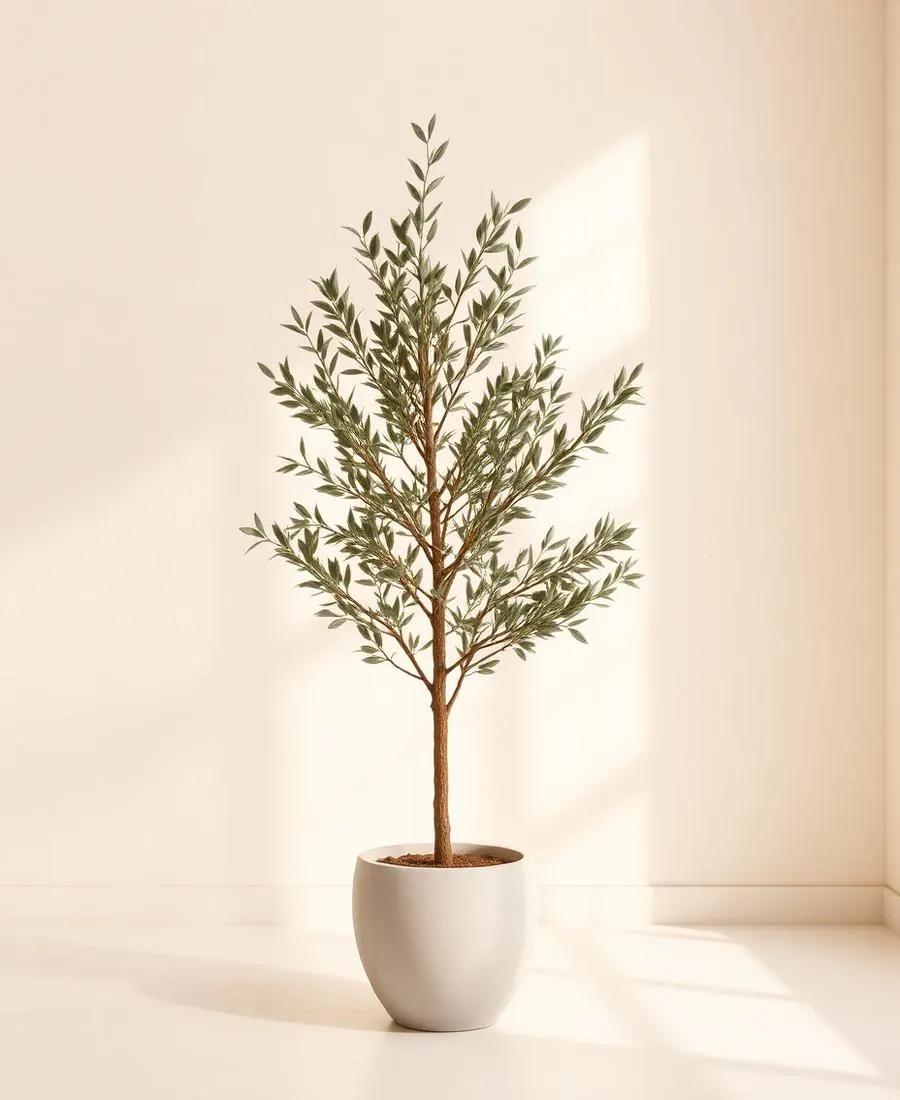
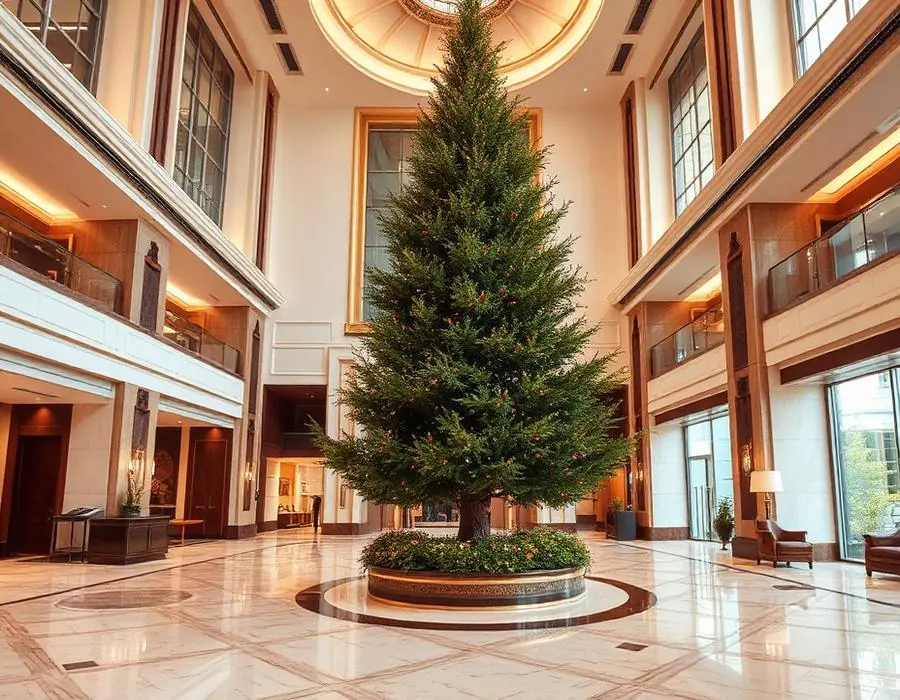
A seasonal decor plan for a restaurant or café is not a Christmas plan with the dates changed. It is a permanent evergreen base that stays in place all year, plus a small kit of accent pieces that rotate four or five times: winter greens after the holiday teardown, spring blossom, summer patio foliage, and autumn colour, with the Christmas period handled as its own separate flip. This guide covers that rotation and the economics behind owning rather than re-buying it each season. For the Christmas-specific mechanics (commercial tree sizing, order timing, install crews), see our commercial Christmas tree buying guide and August-to-January installation timeline; for choosing pieces to match a dining room's sightlines, fire code and traffic pattern at the design stage, see specifying artificial trees for a restaurant fit-out. This piece is about what happens the other eleven months: a base of olive trees or fiddle leaf figs that never moves, spring blossom from $329 to $419 CAD, a patio palm with UV-resistant fronds from $293.99 to $374.99 CAD, and autumn maple from around $827.99 CAD.
Our position on fire documentation. Eververda publishes a fire figure only where documentation exists for that specific piece, and describes nothing as "fire rated". On a commercial quote we establish the occupancy, the adopted code edition and what your authority having jurisdiction (AHJ) will accept as documentation, in writing, before the order. Where no documented route exists for a piece, we say so and set out the alternatives. We do not claim a certificate for any product.
Should a restaurant own a seasonal kit or rent one each time?
The math is the same one that applies to retail visual merchandising, covered in detail in our retail stores guide: a permanent green scheme plus a small rotating accent kit beats renting or re-buying seasonal decor from scratch, because the accent pieces get reused every year rather than discarded. Applied to hospitality, that means two budgets. The permanent base (an olive tree or fiddle leaf fig at the host stand, a run of cedar topiary or a green wall panel behind the bar) gets specified once at fit-out and stays through every season change; it is what a regular's eye expects to see and what absorbs day-to-day wear. The seasonal kit is smaller by design: three or four accent pieces per dining room, sized to the same footprint each time so the same planter can hold whichever piece is in rotation. A single-location café can usually cover a full year of swaps for a total outlay in the low thousands of CAD, spread across pieces reused for several years. A multi-location group buys the kit once per format and repeats it, which is also where a quote-priced matching order across sites makes sense rather than several small ones.
What does a month-by-month rotation look like for a Canadian restaurant?
The shape of the year is the same across most of Canada, though exact swap dates shift with the local patio calendar (see below). The pattern below assumes a single dining room with one or two feature spots plus a bar or host-stand base.
| Window | Look | Example piece | Price |
|---|---|---|---|
| January to March (post-holiday) | Winter greens, plain pine, no ornament | Norfolk pine, 5 ft, real-touch | $389 CAD |
| April to May | Spring blossom | Cherry blossom, 5 to 6 ft, white or pink | $329 to $419 CAD |
| June to August (patio season) | Tropical, palm, sun-tolerant only outdoors | Palm, 5 to 6 ft, UV-resistant fronds | $293.99 to $374.99 CAD |
| September to October | Autumn colour | Red maple, indoor landscape display | from $827.99 CAD |
| November to early January | Holiday flip | see commercial Christmas guide | None |
Winter, once the Christmas pieces come down in early January, calls for something that reads as evergreen rather than festive: a plain pine or Norfolk pine without lights or ornament, or for a larger dining room, a landscape-scale bonsai-form pine feature (quote-priced) at a sightline anchor. Spring is the easiest swap to sell to a design-conscious operator: cherry blossom on a four-trunk base in a cement pot runs $469 to $529 CAD and reads well at a host stand or window table, and a pink magnolia in a tip-resistant weighted pot at $359 to $529 CAD covers the same season. Summer moves the accent to whatever gets the most light: patio specifics are below. Autumn maple is the piece most restaurants skip and shouldn't: a golden-red maple from $827.99 CAD reads as a distinct, deliberate seasonal choice rather than a tired summer plant left up too long, which is the actual competitor for an autumn swap in most dining rooms.
What changes for patio season?
Patio season itself is a municipal calendar, not a fixed date. Vancouver's summer sidewalk patio permits, for example, run from April 1 to October 31 each year, with patios required to come down by November 1 (as of the season checked 29 August 2026): other Canadian cities run similar but not identical windows, so the actual swap date follows the local permit, not a national default. The rule that matters more than the calendar is the UV one: only pieces the manufacturer publishes as UV-resistant belong in direct sun, full stop. In our current retail line that means the UV-resistant palm at $293.99 to $374.99 CAD, or an areca palm ($289 to $419 CAD) and golden cane palm ($289 to $869 CAD) for a shaded or covered patio where the piece is not in direct sun for extended stretches: neither of those two is published as UV-resistant, so both belong under an awning or indoors, not on an open sun-facing deck. This is the same test we apply in the pool-and-patio guide: no product on this site is described as sun-safe unless its own listing says so, because foliage with no UV claim left in full sun fades and turns brittle faster than any operator wants to budget for. For the fuller mechanics of anchoring tall pieces against wind on an open deck and protecting bases from foot traffic, see our pool and patio guide.
Where do the swap pieces go for the other nine months?
Between rotations, foliage needs to survive storage better than it survives display, which is a different set of risks. Keep pieces out of direct sun and away from heat sources such as a kitchen pass or radiator, since both accelerate fading and can soften glue joints on silk foliage. A dry, temperature-stable storage room or basement beats a hot attic or an unheated exterior shed that swings through a Canadian winter. Store each piece upright where the base allows it, or lay it flat and supported rather than leaning it on a bent trunk, and use a breathable cover: a garment bag or loose sheet, not sealed plastic, which traps moisture. Label each piece by season so a swap is a ten-minute job for whoever is on shift rather than a guessing exercise, and keep the weighted or cement-filled base with its matching trunk since bases are not always interchangeable between products.
How often should greenery be cleaned in a food-service environment?
In most homes and offices the enemy is dust. In a restaurant or café, especially anything near an open kitchen, grill station or expo pass, the real enemy is airborne grease, which settles on foliage slowly and less visibly than it settles on a kitchen surface. Greenery closer to the cook line, in a higher-volume kitchen, or in a space that runs longer hours accumulates a greasy film faster than a piece near the front door or in a quieter café. A practical cadence follows the same logic: a wipe-down or light vacuum weekly to monthly for foliage near the pass or grill, and monthly to quarterly for pieces in the dining room proper. A greasy film also matters beyond appearance, and it is one more reason to ask for fire documentation on any commercial piece near a cook line, covered below.
What fire documentation should a restaurant ask for?
Any artificial greenery placed in a commercial dining room sits under the same fire code as the rest of the space, and no retailer, Eververda included, can tell you a product is "certified" for your location, because that call belongs to the local authority having jurisdiction (AHJ), typically the fire marshal or building inspector who signs off on your space. Ontario's Fire Code (O. Reg. 213/07, Division B, Article 2.3.2.1) requires drapes, curtains, netting and other similar or decorative materials, including textiles and films, to meet CAN/ULC-S109 in listed locations, a lobby or exit among them. The Code does not mention artificial trees or vegetation by name, so applying it to a tree rests on a broad reading of “other similar or decorative materials”. Outside Ontario, confirm the code in force with your AHJ. In the United States, the International Fire Code accepts either NFPA 701 (Test Method 1 or 2) or NFPA 289 (20 kW ignition source, 100 kW maximum heat release rate) for artificial vegetation, at Section 807.4.1 from the 2018 edition onward; it was Section 806.2 in the 2015 edition, which some jurisdictions still run. Ask every supplier you're considering what documentation exists before an order ships (for our listings, ask through the quote process and we will tell you what, if anything, the manufacturer can provide), and keep whatever you receive on file for your inspector rather than trying to source it after the fact. This applies across every seasonal swap piece, not only the Christmas installation: a spring blossom tree at a host stand is under the same code as a December tree in the same spot.
Frequently asked questions
How many seasonal accent pieces does a typical restaurant need?
Most single-location restaurants and cafés get full coverage from three to four accent pieces on top of a permanent base scheme: one for spring, one for summer patio, one for autumn, and either a plain winter pine or a direct move into the Christmas period. Multi-location groups buy the same small kit per format and repeat it across sites.
Can the same planter or base be reused across seasonal swap pieces?
Often yes if the pieces are chosen to a consistent pot size and trunk diameter at purchase, but bases and trunks are not universally interchangeable between products, so check the planter and base dimensions on each listing before assuming a swap will drop into an existing pot without adjustment.
Does a restaurant need different fire documentation for seasonal pieces versus Christmas trees?
No, the same code and the same documentation question apply year-round. In Ontario that is Article 2.3.2.1 of the Fire Code and CAN/ULC-S109 for decorative materials in listed locations; in the United States it is the International Fire Code route through NFPA 701 or NFPA 289. The local AHJ makes the final call for your space regardless of which season's piece is on display. Request documentation from any supplier at quote stage.
Is it worth buying a palm that publishes a UV-resistant claim if the patio is only used four months a year?
Yes, because the alternative, a piece with no such claim left in full sun even for one patio season, typically fades and turns brittle within that single season, costing more in replacement than the price difference between a palm that publishes the claim and a standard piece up front. The palm with the claim is also reusable in following summers, though the claim covers sunlight only, so it still belongs under cover or indoors through a Canadian winter.
What's the difference between this rotation and the restaurant fit-out spec guide?
The fit-out guide covers choosing and placing pieces once, at build-out: sightlines, fire code, traffic clearance. This guide covers what happens after opening day: which pieces change with the seasons, when, and how the swapped pieces are stored and cleaned between rotations.
Should winter greenery go up immediately after Christmas decorations come down?
Most operators move straight from the holiday teardown into a plain evergreen piece, a Norfolk pine or similar without ornament, rather than leaving the space bare through January and February, since an empty planter reads as neglected rather than seasonal. The swap to spring blossom typically follows in April.
Product prices are CAD and current as of 27 September 2026. External sourcing facts (patio permit dates) were checked 29 August 2026. Fire code text was verified against the publishers' own published text on 24 October 2026.
Products in this article
- Artificial Olive Tree, 5.25 to 8 ft, Silk Leaves with Fruit, Black Pot$181.99 USD to $327.99 USD
- Artificial Fiddle Leaf Fig Tree, 4 to 7 ft, Grey Pot with Weighted Base$198.99 USD to $366.99 USD
- Artificial Cherry Blossom Tree, 5 to 6 ft, White or Pink Blossoms$239.99 USD to $305.99 USD
- Artificial Palm Tree, 5 to 6 ft, UV-Resistant Fronds, Black or White Pot$214.99 USD to $273.99 USD
- Artificial Red Maple Tree, 3.9 to 8.2 ft (1.2 to 2.5 m), Indoor$593 USD to $2,159 USD
- Artificial Norfolk Pine Tree, 5 ft, Real-Touch Foliage, Potted$283.99 USD
- Natural Touch Pine Bonsai Tree 16.5 ft Indoor$7,008 USD, quoted
- Artificial Cherry Blossom Tree, 5 to 6 ft, Four-Trunk Base in Cement Pot$342.99 USD to $385.99 USD
- Artificial Pink Magnolia Tree, 4 to 6 ft, Weighted Pot, UV Resistant$261.99 USD to $385.99 USD
- Artificial Golden Red Maple Tree, 5.3 to 8.2 ft, Red or Yellow, Potted$593 USD to $1,395 USD
- Artificial Areca Palm Tree, 4 to 6 ft, 15 to 21 Leaves by Height$210.99 USD to $305.99 USD
- Artificial Golden Cane Palm, 4.5 to 9 ft, Single or Pair$210.99 USD to $633.99 USD