
How Much Do Artificial Bonsai Trees Cost in Canada?
29 August 2026
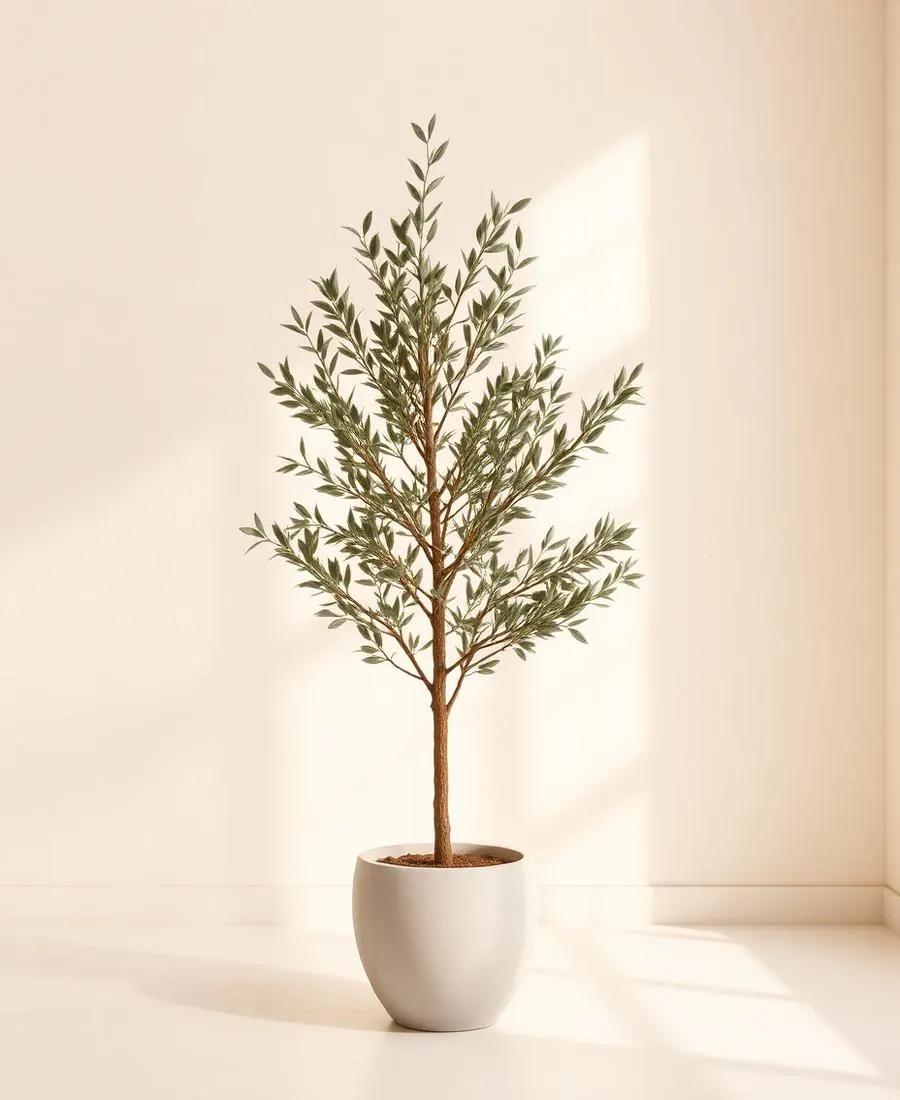
An artificial bonsai you can buy at checkout in Canada starts at $827.99 CAD and runs to several thousand for a large feature specimen, with some pieces quoted at any price depending on how they are supplied, and price does not track with size the way it does for most other artificial trees. A 17 in tabletop bonsai pine at $829 CAD can cost more than an entire 5.25 to 7 ft olive tree with a natural wood trunk at $249 to $419. That is not a pricing error. In bonsai, the object being sold is a sculpted trunk and a structured canopy of foliage pads, not height and not leaf count, so a 17 in tree with a convincingly aged, tapered trunk does more difficult work than a 7 ft tree with a straight pole and a wide green mass. This article maps what artificial bonsai cost across our range, explains each price driver in turn, and compares that spend honestly against a real, trained bonsai. For species, growth styles and shaping vocabulary, see the bonsai species guide; for the broader framework on why any faux tree costs what it costs, see why faux trees cost $80 or $900.
Why does a small bonsai cost more than a large olive tree?
Most artificial trees price by volume: more trunk, more branches, more leaves, more cost. Bonsai breaks that rule because its design premise is compression: decades of trunk movement and branch structure squeezed into a container-sized tree. An artificial bonsai has to fake that compression with far fewer parts than a full-height tree uses, and every part does more visible work. The trunk is not hidden behind mass foliage the way an olive tree's trunk is; it is the focal point, visible from base to apex, so it has to carry real-looking bark texture, taper and grain. The foliage sits in a small number of dense, clearly separated pads rather than one continuous canopy, so each pad has to be built up in layers to read as mature growth. Take away height as the price lever and what is left is sculpting labour and material quality, which is why a well-made 17 in bonsai can cost close to double a well-made 7 ft olive.
What does an artificial bonsai actually cost in Canada?
Across our range, bonsai you can buy at checkout start at $827.99 CAD, with the bulk of residential-scale trees between $827.99 and $2,227.99. Anything priced $3,000 CAD and above is sold by quote only, and some pieces are quoted at any price depending on how they are supplied, so the product page is the authority.
| Tier | Price (CAD) | What you are paying for | Example |
|---|---|---|---|
| Small tabletop, 1 to 2 ft | quote-priced | Lightly shaped trunk, single foliage pad, decorative scale | Pine bonsai, 24 in, natural-wood-look trunk |
| Tabletop, shaped trunk | $829 | Naturalistic tapered trunk, layered pads, tabletop pot | 17 in bonsai pine |
| Mid commercial, 6.5 to 7.2 ft | $1,246.99 to $3,489.99, quote-priced | Taller sculpted trunk, multiple pad layers, some foliage with a UV-resistant claim | 2 m cedar pine bonsai, 7.2 ft podocarpus, 6.5 ft cedar bonsai pine |
| Large feature specimens | $547.99 to $4,889.99, quote-priced | Oversized sculpted trunk for landscape and lobby features | silk pine bonsai for landscape features |
| Statement specimens | quote-priced | Natural-touch foliage, trunk diameter and pot specified per project | natural-touch pine bonsai |
Two kinds of price sit in that column. Rows marked quote-priced are supplied by quote rather than bought at checkout. The cheapest bonsai you can buy at checkout is $827.99 CAD.
Our bonsai range is deep, so the table shows the shape of the ladder rather than every rung. A few named points worth knowing: the olive tree grown in bonsai form, 8.2 ft, is $1,807.99; the 2 m cedar pine bonsai and the 7.2 ft UV-resistant podocarpus both sit at $1,246.99; and the largest natural-touch specimens, where trunk diameter and foliage density are built to a brief, are quote-priced rather than shelf-priced.
What makes one bonsai trunk cost more than another?
Trunk work is the single biggest price driver in this category, and three things inside it move the number. The first is taper and movement: a trunk that narrows convincingly from base to apex and carries a believable bend takes more sculpting than a straight pole, and it is the first thing a trained eye checks. The second is material: a trunk built over a natural wood core, wrapped and finished to show bark texture and grain, reads as more convincing and costs more than a moulded plastic or PVC trunk painted to imitate wood: the same trade-off that runs across the whole faux-tree category, covered in our guide to PE, PVC and silk materials. The third is scale: past roughly 6 to 7 ft, a trunk stops being a single moulded or wrapped piece and becomes a built structure engineered to carry a heavy canopy without tipping, which is where prices jump from the $800 to $1,200 band into the $2,000-plus band.
What do the foliage pads add to the price?
A bonsai's canopy is not one mass of leaves, it is a set of distinct pads positioned to show the trunk's structure through the gaps between them, and that arrangement is more labour-intensive to build than a continuous crown. Each pad has to be dense enough at its edges to read as mature foliage while staying thin enough, top to bottom, to look wind-pruned rather than sheared. Layering more pads, spacing them precisely along the trunk, and finishing individual leaves rather than moulded clusters all add cost without adding height, which is another reason two bonsai of the same size can be priced hundreds of dollars apart.
Why does the pot matter for bonsai pricing?
In most artificial trees the pot is packaging. In bonsai the pot is part of the composition: proportion, glaze and shape are chosen to complement a specific trunk and canopy, the way a frame is chosen for a specific picture. A shallow, well-proportioned pot in a quality glaze or weighted cement-style finish costs more to source and pair correctly than a generic planter sized to hold roots, which is one reason tabletop and large feature tiers price differently even when trunk complexity is comparable.
What does UV resistance add, and when do you need it?
Bonsai listed for outdoor placement (a courtyard, a covered patio, a landscape feature) carry foliage treated to resist fading and embrittlement under direct sun, a material cost indoor-only trees skip. The 7.2 ft podocarpus bonsai is UV-resistant and priced at $1,246.99, in the same band as indoor-only pieces of similar size, so a UV claim on its own is not always the dominant cost driver. It is one input alongside trunk and pad complexity. If a bonsai will sit in a sunroom, a covered entrance or an outdoor feature, confirm the UV claim specifically rather than assuming it from size or price; nothing about a high price guarantees weather resistance unless the listing publishes it, and a UV claim describes an additive in the plastic rather than a passed test, covering sunlight only.
How does that compare with a real, trained bonsai?
A genuine trained bonsai is priced on different terms entirely: not size, but years of directed growth. US nursery Brussel's Bonsai (which describes itself as the largest dedicated bonsai nursery in the United States, in business more than 50 years) lists young starter trees such as a Chinese Elm at $34 USD and a Trident Maple at $58 USD, checked 29 August 2026. Its specimen-tier trees, potted in ceramic, ran $275 to $695 USD in the listings checked the same day, with the site indicating further, higher-priced specimens beyond that page. Wikipedia's bonsai entry notes that yamadori, trees collected from the wild rather than grown from nursery stock, are typically the most expensive and prized category, reflecting decades of natural trunk development a grower did not have to create by hand (checked 29 August 2026). We could not verify a Canadian-dollar retail figure for trained bonsai; treat the US figures above as a reference point for the shape of real-bonsai pricing, not a Canadian quote.
Price is only half the comparison. A real bonsai is a living plant kept artificially small, and its care schedule reflects that. Per bonsai care reference Bonsai Empire, there is no fixed watering interval: check the soil directly, water once it has begun to dry roughly 1 to 2 cm down, and never let it dry out completely, with demand rising sharply in spring and summer and dropping to occasional in autumn and winter dormancy (checked 29 August 2026). Repotting is needed every two years or sooner for young, fast-growing trees and every three to five years for mature ones, checked by lifting the tree each spring to inspect the roots (checked 29 August 2026). Placement is species-dependent: most outdoor species need to live outdoors year-round, following the local seasonal cycle, while indoor species need a stable, humid, bright spot such as a south-facing window (checked 29 August 2026). An artificial bonsai needs none of that (no watering, no repotting cycle, no seasonal move outdoors and back), which is the trade a buyer makes at any price point above.
If the goal is a Japanese garden moment rather than pricing a single tree, our guide to Japanese-style artificial trees for a zen garden covers the styling side; this article deals strictly in dollars.
Frequently asked questions
What is the cheapest artificial bonsai worth buying?
The cheapest bonsai you can buy at checkout is a 15 to 16 in tabletop pine at $827.99 CAD, which already carries a naturalistic tapered trunk and layered pads. Cheaper tabletop pieces exist in the catalogue but are quoted rather than sold at checkout. Those smaller pines are the lightly shaped trunk and single foliage pad of the table's first tier, not the layered structure that reads as mature.
Why is a small artificial bonsai more expensive than a tall artificial tree?
Because bonsai pricing is set by trunk sculpting and pad structure, not by height or leaf count. A 17 in bonsai pine at $829 CAD can cost more than a 7 ft olive tree at $249 to $419 because the bonsai's visible, tapered trunk and layered pads take more sculpting work per inch than a taller tree's straight pole and continuous canopy.
How much do large commercial artificial bonsai cost?
Feature-scale pieces run roughly $1,246.99 to $4,889.99 CAD, covering 6.5 to 7.2 ft sculpted specimens and landscape-feature silk pine bonsai. The largest natural-touch specimens are quote-priced, since trunk diameter, pad density and pot are specified per project.
Is a real bonsai cheaper than an artificial one?
At the entry level, yes on price alone (young real bonsai starter trees have listed for as little as $34 to $58 USD at a major US nursery, checked August 2026), but that number buys a plant, not a finished sculpted tree, and it comes with an ongoing watering, seasonal-placement and repotting commitment that an artificial bonsai does not carry at any price.
Does UV-resistant foliage cost more on a bonsai?
Not necessarily on its own. Our UV-resistant 7.2 ft podocarpus bonsai is $1,246.99, in line with indoor-only pieces of similar scale, because trunk and pad complexity move the price more than UV treatment does. Confirm the UV claim on the listing if the bonsai will sit somewhere with direct sun.
Does the pot get counted separately in bonsai pricing?
No, the pot is part of the priced object rather than an add-on. Bonsai pots are chosen in proportion, glaze and shape to complement a specific trunk and canopy, so pot quality is one of the factors baked into the price tiers above rather than a line item on top of them.
External bonsai nursery and reference prices are USD figures as published when checked on 29 August 2026. Eververda prices are CAD and current as of 29 August 2026.
Products in this article
- Artificial Bonsai Pine Tree, 17 in, Potted Tabletop Piece$604.99 USD
- Artificial Olive Tree, 5.25 to 7 ft, Natural Wood Trunk$181.99 USD to $305.99 USD
- Artificial Pine Bonsai Tree, Circle or Diamond Ornament, Natural Wood Trunk, Red or Green Foliage$92 USD to $291 USD
- Tall Artificial Cedar Pine Bonsai Tree Green 2 m (6.56 ft)$893 USD, quoted
- 7.2 ft Podocarpus Bonsai Tree UV Resistant Indoor$893 USD, quoted
- Artificial Cedar Bonsai Pine Tree, 6.5 ft (2 m) and 8.25 ft (2.5 m), Indoor or Outdoor$1,995 USD to $2,497 USD
- Silk Pine Bonsai Tree for Landscape Feature Displays$393 USD to $3,499 USD
- Natural Touch Pine Bonsai Tree 16.5 ft Indoor$7,008 USD, quoted
- 8.2 ft Faux Olive Tree Indoor$1,659 USD