

Housewarming Gifts: Choosing a Plant Someone Will Actually Keep
29 August 2026
A plant is the default housewarming gift for a reason: it fills a corner of an empty new home and says "settling in" better than a candle does. It is also the gift most likely to be dead or quietly relocated to a closet within three months, because you are choosing it for a room you have never stood in, for a light exposure you do not know, and for a person whose travel schedule and watering habits are a guess. That mismatch is the real problem here: not whether to give a plant, but how to give one when the recipient's home is unknown territory. The short version — favour smaller, neutral pieces over a floor-standing statement tree unless the room can clearly support one, choose a species and pot that will not clash with a style you have not seen, and give a real plant instead when you do know enough: a keen gardener, a genuinely bright apartment, someone who has said outright that they want one.
Why do so many gift plants end up dead within a few months?
A houseplant is a bet on three things you cannot see from outside a wrapped gift box: how much light the room gets, whether the recipient is home enough to water on a schedule, and whether they travel. A fiddle leaf fig or a monstera bought as a housewarming gift gets placed wherever there happens to be space on move-in day, rarely the spot with the right light. Add two weeks of business travel or a slow month of settling in, and a plant that needed consistent watering is the first thing forgotten. It does not die dramatically. It yellows, drops leaves, and sits in a corner as a small, low-grade reminder of neglect — a gesture that turns into something the recipient feels mildly guilty about every time they walk past it.
None of this is a knock on the recipient. It is a mismatch between what a live plant requires — routine, attention, correct light, time to learn the room — and what a gift-giving occasion provides, which is a single moment of good intention with no follow-up plan. An artificial plant removes that failure mode entirely, looking the same on day one and day three hundred regardless of light, travel, or how busy the first few months turn out to be.
How do you choose a plant when you have not seen their home?
Treat the unknown room as the design constraint it is, and buy accordingly.
Go smaller than you think. A floor-standing tree needs a corner of the right size, in a spot the recipient has not necessarily decided on yet, and an unwanted 6 ft tree is a genuinely awkward object to find space for or to regift. A tabletop or console-height piece has no such problem — it sits on whatever surface is available on day one and migrates to a shelf or entryway console later without anyone rearranging furniture for it. Our guide to choosing artificial tree size covers ceiling height and room proportion for when you do know the space; for a gift, the safer default is to buy smaller than the room might technically support.
Keep the pot neutral. A black planter, a plain cement-coloured base, or an unglazed terracotta tone sits reasonably in a minimalist condo, a warm-wood rental, or a maximalist living room without fighting any of them. A bright ceramic pot in a specific colour is a bet on a palette you have not seen.
Pick a species that does not shout. A trailing pothos, a snake plant, a fiddle leaf fig, or an olive tree reads as furniture in almost any interior. A heavily styled or unusual specimen — a sculptural cactus arrangement, a bright floral tree — asks the room to accommodate its personality, and you do not yet know whether the room has room for that. Our guide to making artificial plants look real covers the styling detail — loosening the foliage, positioning it away from a wall, matching the pot to the room's other materials — that turns a fine plant into one nobody clocks as fake.
If you happen to know the new place is a rental, that is useful information: renters generally cannot drill for wall-mounted planters or commit to built-in greenery, so a freestanding piece that needs no installation is already the right call. See artificial plants for renters for the fuller case.
When should you give a real plant instead?
An artificial plant is not always the better housewarming gift. A few cases where a real one wins:
A keen gardener should get a real plant. Someone who already propagates cuttings, repots on a schedule, or talks about soil mix does not want a substitute for the activity they enjoy — the caretaking is the point, not an inconvenience to be designed around. Give them something they can actually grow.
A genuinely bright apartment is a strong signal too. If you know the new place has south-facing windows, a sunroom, or a balcony the recipient plans to fill, a real plant suited to that light has a real chance of thriving rather than becoming a maintenance burden. The case for artificial rests on light and attention being unknowns; when they are known and favourable, that case weakens considerably.
And if someone has told you plainly that they want a real plant — not "I like plants" in the abstract, but a stated preference for a living one — take that at face value rather than second-guessing it toward the easier gift. A real plant from a local nursery is the better move there. Eververda's own catalogue is artificial only, so that gift will not be linked here, but the honest answer to "what should I buy" sometimes points away from what a given retailer sells.
Ship it or carry it? The practical mechanics of gifting a plant
Once you have picked the piece, how it gets to the recipient matters almost as much as what it is.
Shipping directly to the recipient's new address is usually the better route for anything larger than a tabletop piece. It arrives unpacked from a delivery box rather than a gift-wrapped one, a fair trade for not having to physically carry it. A large artificial tree is a genuinely awkward thing to transport to a housewarming party — it will not fit upright in most car trunks, it is unwieldy on transit, and arriving with a 6 ft tree in tow tends to become the whole event rather than a nice addition to it. If the piece is past tabletop size, ship it straight to the new address, timed to land a day or two before the party.
Presentation still matters. Most artificial plants ship in a plain nursery-style pot meant for transit, not display, so if the recipient will unbox it themselves, a card noting a nicer pot is coming — or including one — beats leaving them to display it straight out of the shipping pot. For anything handed over in person, transfer it into a proper planter beforehand if you can, or at minimum strip the plastic wrap so it looks like a finished gift rather than a delivery.
What should you actually buy, by relationship and budget?
The table below groups current CAD prices by who the gift is for — a coworker's gesture and a sibling's first-house present call for different scales.
| Who it is for | What to give | Price (CAD) | Why it works for a housewarming |
|---|---|---|---|
| Coworker or casual acquaintance | a 19 m ivy garland, set of 24 strands | $99 | drapes over a shelf, mirror, or doorframe with no floor space or corner required at all |
| New neighbour or work friend | a 4 ft fiddle leaf fig in a white planter | $219 | small enough for a side table or console, neutral pot that will not clash with an unknown scheme |
| Good friend or a couple moving in together | a pair of 3 ft snake plants | $279–$299 | two matching pieces flank a doorway, fireplace, or TV stand without needing a floor tree's footprint |
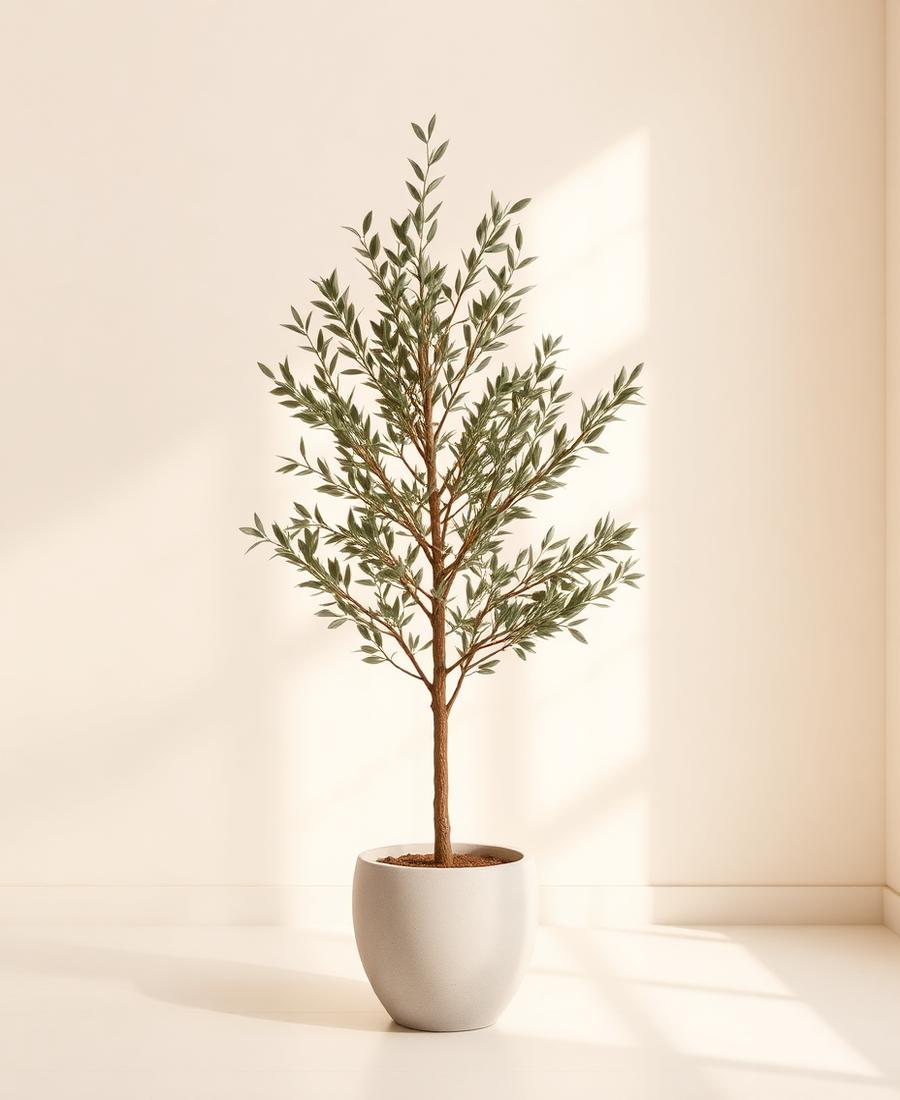
| Close family, a first home or a milestone move | an olive tree, 5.25–8 ft, silk foliage, counted leaves, black pot | $249–$449 | a genuine statement piece, but the black pot and olive's neutral form suit most rooms; ship it directly rather than carrying it |
Splitting the cost of the olive tree among several family members or close friends is a reasonable way to give something larger without any one person carrying the full price, and it arrives as one memorable gift rather than several small ones.
What about a household with pets or young kids?
If you already know the new home has a cat, a dog, or small children, that knowledge should shape the gift, and it actually favours the artificial option in one respect. A number of popular live housewarming plants, including snake plant, dracaena, and fiddle leaf fig, are documented as toxic to cats and dogs if chewed — the artificial versions remove that toxicity risk, though a tabletop piece can still tip or become a chew object, so placement away from where a curious pet or toddler spends most time is still worth a thought. See our pet safety guide for which live species carry documented toxicity and how to place artificial plants sensibly around animals and kids either way.
Frequently asked questions
Is an artificial plant a rude or lazy housewarming gift?
No. It reads as thoughtful when the choice fits the situation — someone who travels, an unknown light exposure, a stated dislike of plant care — and it avoids the actually awkward outcome of a real plant dying in the recipient's new home within a few months. The gift that fits the person's actual life beats the gift that only looks more traditional.
What size of plant should I bring if I have not seen the new place?
Go smaller than you might for your own home. A tabletop or console-height piece, roughly under four feet, fits on whatever surface is available and does not require a corner the recipient may not have planned for yet. Save a floor-standing tree for when you know the room can take it.
Should I ship the plant or bring it to the party myself?
Ship anything larger than a tabletop piece directly to the new address, timed to land shortly before the event. A large tree is genuinely hard to transport and tends to overshadow the gathering when carried in by hand; a small piece is fine to bring along yourself.
Does the pot matter if I am giving it as a gift?
Yes. Most artificial plants ship in a plain nursery pot meant for transit, not display. Transfer the plant into a proper planter before handing it over in person, or let the recipient know a better pot is on the way if you are shipping it straight to them.
What if the recipient is a serious gardener?
Skip the artificial plant. A keen gardener wants the growing itself, not a maintenance-free substitute for it. A real plant, a tool, or a gift card to a local nursery fits that person better than anything faux.
Eververda prices are CAD and current as of 30 August 2026.