

Artificial Plants for Bedrooms: Calm, Low-Maintenance Greenery
29 August 2026
A bedroom asks different questions of an artificial plant than a living room does. The room is smaller, the sightlines are close, and the plant sits within arm's reach of a bed rather than viewed from across a sofa. The size that reads right depends on where it stands relative to the bed: a tall tree beside the headboard should be narrow enough not to crowd the pillow line, a piece in the far corner can be fuller because distance does the framing for you, and a pair flanking a window works best kept low enough not to block the light. Bedside tables and dressers want something smaller still, 17 to 30 inches, that will not tip when a hand reaches for it half-asleep. Colour matters more here than in most rooms: a bedroom generally reads calmer with soft, muted greens and quiet, unfussy pots rather than glossy leaves or bright ceramic. And an artificial plant solves problems a live one cannot in this specific room: no soil to spill on a rug you walk on barefoot, no fungus gnats near where you sleep, no evening watering routine, and, if the base is weighted, nothing that goes over if you knock it in the dark.
What size artificial plant works next to a bed?
Start from the bed, not the room. A queen or king headboard is roughly 5 to 6.5 ft wide and stands 3.5 to 4.5 ft tall, and anything placed directly beside it reads against that scale rather than against the walls.
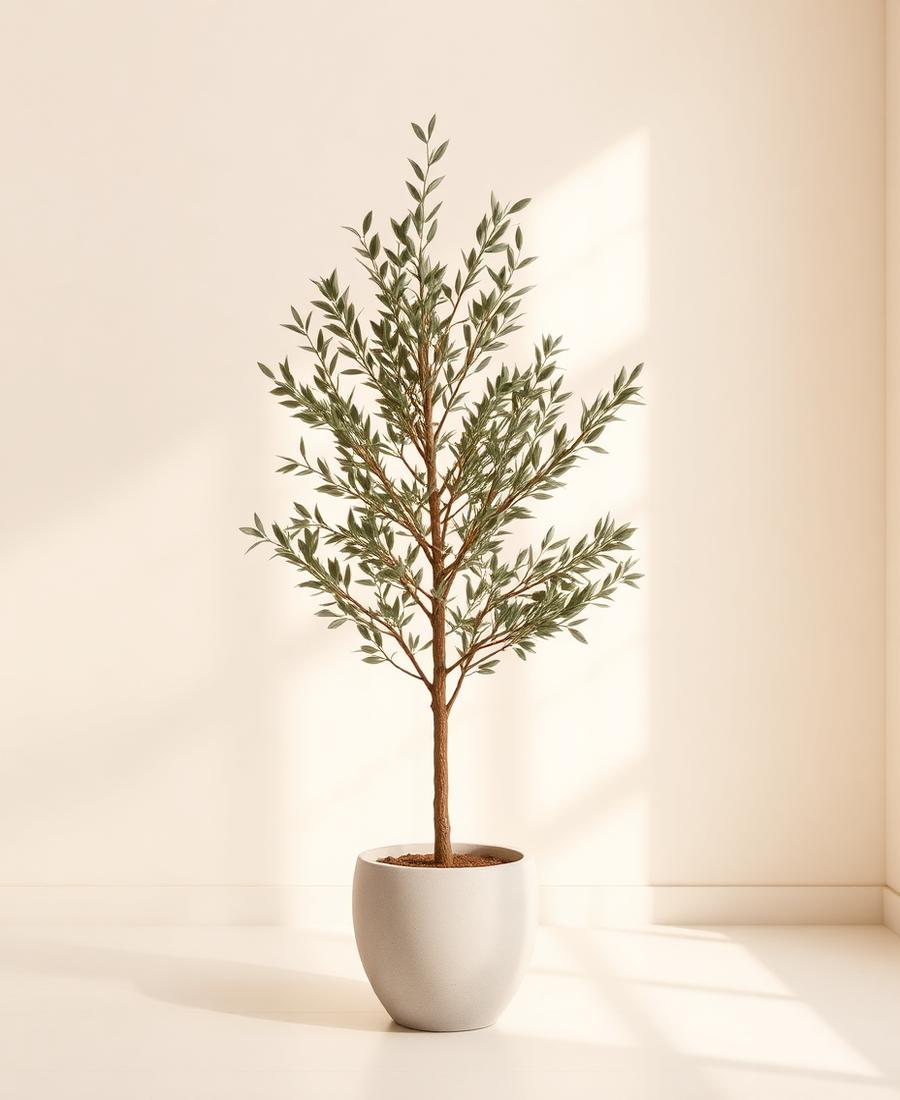
Beside the headboard, keep the canopy narrow. A wide, bushy tree at pillow height crowds the one part of the room meant to feel open. A 4 to 7 ft fiddle leaf fig in a white planter with a weighted base, at $219 to $399 CAD, has the upright, single-trunk shape that stays out of the way at that height. An olive tree, 4 to 6 ft, with PE foliage and stainless-steel branches, at $199 to $329 CAD, does the same job with a looser, more open canopy.
In the far corner, opposite the bed or beside a dresser, you have more room to be generous, because distance from the eye does the visual editing. A fuller tree or a pair reads as a furnished corner rather than a cramped one. This is also where a slightly taller piece earns its keep, since it is not competing with a headboard's sightline.
Flanking a window, choose something that stays below the sill height of the window itself, or a pair that frames rather than blocks the glass. A single piece off-centre from the window usually looks more considered than two identical trees mirrored on each side, which can read as staged. See our general guide to choosing artificial tree size for the room-proportion maths behind this; what changes in a bedroom is that the reference point is the bed and headboard, not the sofa or the ceiling height.
What belongs on a nightstand or dresser?
Nightstand and dresser surfaces call for something small enough not to compete with a lamp or a stack of books, and stable enough to survive a hand reaching for a phone in the dark. A 24 in monstera in a white tabletop pot, at $349 CAD, sits at a scale that works on most dressers without dominating the surface. A 29 in ZZ plant with 72 real-touch leaves in a black pot, at $459 CAD, brings a deeper, quieter green and a slightly taller, more upright shape for a wider dresser top. For a lower, more sculptural piece that suits a nightstand specifically, a 17 in tabletop bonsai pine, at $829 CAD, has a small footprint and a single, considered silhouette rather than a spreading canopy.
On a floor beside a dresser or in a reading nook, a small floor plant fills the gap between tabletop and headboard scale. An artificial snake plant, 3 ft, PEVA leaves, in a cement pot, at $469 CAD, stays under sill height in most bedrooms while adding real presence at floor level.
Why does a calm palette matter more in a bedroom?
A living room or entryway can carry a bolder plant, something glossy or brightly variegated, because the eye moves through those rooms rather than resting in them. A bedroom is the one room built around stillness, and foliage that reads as loud during the day competes with that at night, when a lamp is the only light source and everything in the room reads by silhouette. Soft, matte greens and plain, unpatterned pots hold their shape in low light without pulling focus.
Two of our style guides go deeper on this if a bedroom is part of a wider look. Our guide to styling faux greenery in a Japandi interior covers the muted, restrained palette that suits a calm bedroom directly, including why one well-placed plant reads better than several. Our piece on Japanese-style artificial trees for a zen garden feel indoors goes further into sparse, legible silhouettes such as bonsai and pine, which work particularly well on a nightstand or in a quiet corner where the plant is meant to be looked at, not just filled in around.
What are the practical advantages of an artificial plant in a bedroom specifically?
Some of the case for artificial greenery applies to any room. A few points matter more in a bedroom than almost anywhere else in the house.
There is no soil, so there is nothing to spill on a rug or a floor you cross barefoot. Potting mix near a bed means a small mess is one knocked pot away, and it means fungus gnats, which breed in damp soil, can end up in the one room where a flying insect is least welcome. An artificial plant has no soil for gnats to breed in.
There is no watering routine to remember last thing at night, and no schedule that gets disrupted by a late night or a few days away. A live plant near a bed either gets watered on a fixed rhythm or it starts to show it, and neither is something most people want to manage as part of a bedtime routine.
And if something gets knocked in the dark, a weighted base matters more here than anywhere else in the house, because a bedroom at night is the one room where you are moving without the lights on. A piece such as the fiddle leaf fig above, built with a weighted base, is designed to resist a bump rather than go over. Our full guide to stopping a tall artificial tree from tipping over covers weighted bases, ballast, and wall anchoring for taller pieces in more detail; a bedroom is a good argument for taking that seriously, since a floor plant beside a bed gets knocked more than one standing against a living-room wall.
| Bedroom zone | Typical scale | Example, price CAD |
|---|---|---|
| Nightstand | 17–24 in tabletop | 17 in tabletop bonsai pine, $829; 24 in monstera, $349 |
| Dresser top | 24–29 in tabletop | 29 in ZZ plant, $459 |
| Far corner, more generous | 4–6 ft | 4–6 ft olive, $199–$329; 4–6 ft magnolia, $359–$529 |
| Beside the headboard or flanking a window | 4–7 ft, narrow canopy, weighted base | 4–7 ft fiddle leaf fig, weighted base, $219–$399 |
Do artificial plants help with bedroom allergies?
An artificial plant produces no pollen, because it produces nothing at all, and it has no soil to hold the damp that can support mould growth. Both of those are real advantages over a live plant in a room where you spend a third of your day breathing the air. That said, an artificial plant is not maintenance-free in a way that erases allergy considerations entirely: foliage collects household dust the same as any other surface in the room, from the leaves down to the pot rim, and dust is its own irritant for a lot of people. The fix is regular dusting, not a one-time purchase decision. Our guide to whether artificial plants get dusty, fade, or attract insects covers the realistic cleaning cadence and method by material, which applies in a bedroom exactly as it does anywhere else in the house.
A soft palette pick such as the pink magnolia, 4 to 6 ft, in a tip-resistant weighted pot, at $359 to $529 CAD, brings colour into a bedroom without introducing a live flowering plant's pollen or a damp growing medium near the bed, while still needing the same regular dusting as any other piece in the room.
Frequently asked questions
How tall should an artificial plant be next to a bed?
For a spot directly beside the headboard, look for a narrow-canopy piece in the 4 to 7 ft range so it does not crowd the pillow line at eye level. A far corner can take a fuller tree in the same height range because distance from the bed does the visual editing. Anything closer than an arm's reach from where you sleep is better kept to nightstand scale, 17 to 30 inches.
What is the best low-maintenance artificial plant for a bedroom?
Any artificial plant is low-maintenance in the sense that matters most for a bedroom: no soil, no watering schedule, and no fungus gnats. Beyond that, a piece with a weighted base, such as a fiddle leaf fig with a weighted planter, adds stability if the room is walked through in the dark, and a muted green such as a ZZ plant or olive tree keeps the look calm rather than busy.
Do artificial plants attract dust more than real plants in a bedroom?
No more than any other surface in the room. Artificial foliage collects dust the way a lampshade or a picture frame does, and needs a light dusting every few weeks to stay looking fresh. See our full guide on dust, fade, and insects for the cleaning method by material.
Can I put a tall artificial tree right beside my bed?
Yes, provided it has a weighted or ballasted base and a narrow enough canopy not to crowd the headboard. A tree beside a bed gets bumped more often than one against a living-room wall, so the base matters more here. Our guide to stopping a tree from tipping over covers ballast and anchoring options for taller pieces.
Is an artificial plant a good idea for someone with allergies who sleeps in the room?
An artificial plant produces no pollen and has no soil to hold damp, both genuine advantages over a live plant in a bedroom. It still needs regular dusting, since foliage collects household dust like any other surface, so allergy sensitivity to dust specifically is not eliminated by switching to faux.
Should a bedroom plant match the rest of the house or stand alone?
Either works, but a bedroom generally benefits from a calmer, more muted palette than a living room even within the same overall style. Our Japandi and Japanese-style guides both cover restrained, quiet foliage choices that suit a bedroom's stillness specifically.
Checked August 2026. Eververda prices are CAD and current as of 29 August 2026.