
How to Stop a Tall Artificial Tree From Tipping Over
29 August 2026
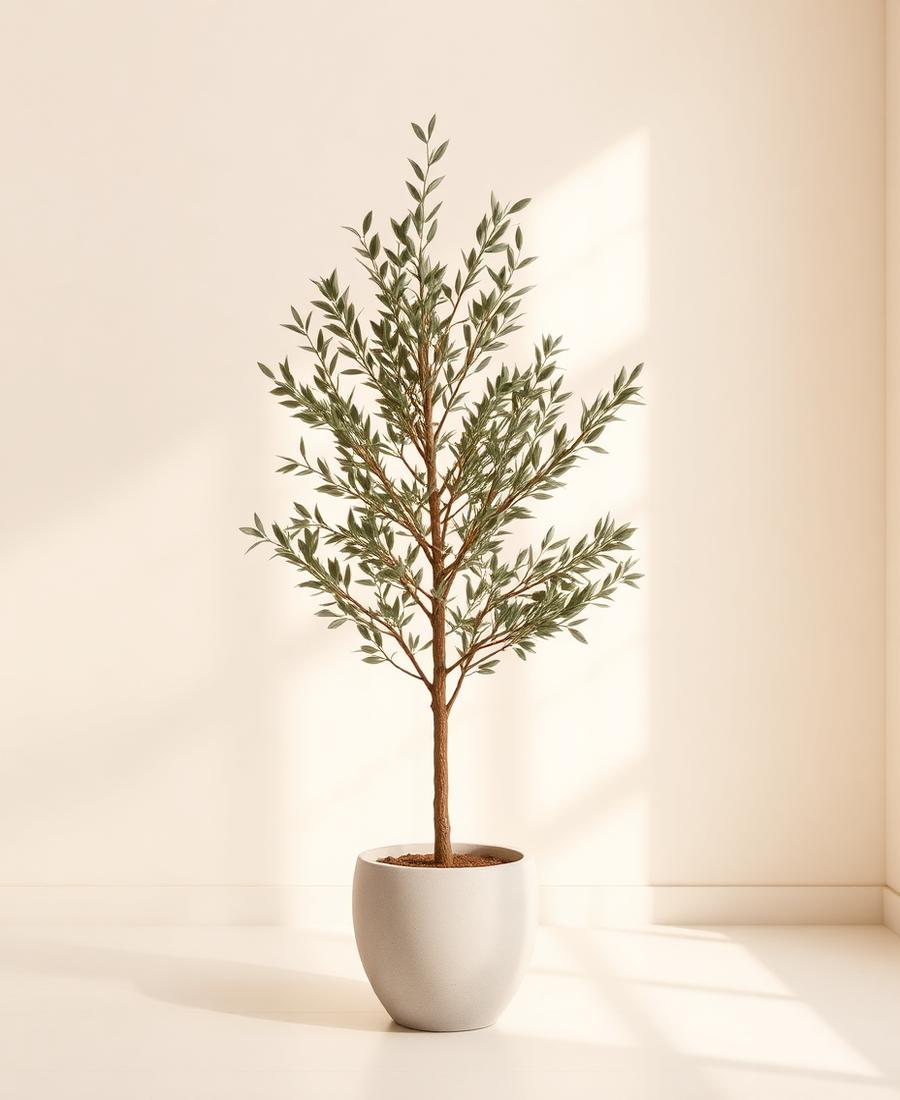
A tall artificial tree tips over for one basic reason: it has all the weight of a real tree's canopy with none of the weight of a real tree's roots. A live 7 ft ficus is anchored by a rootball that can weigh more than the entire above-ground plant; a faux equivalent has a hollow trunk, a foam or PE canopy, and a nursery pot that is mostly empty plastic. The fix, in order of how much stability each step buys, is: buy a tree with a weighted or cement base to begin with, ballast the decorative pot if it did not come weighted, top-dress with heavy stone to pull the centre of mass down, and, for genuinely tall or narrow trees, anchor the trunk to the wall. Most trees under 6 ft in a wide pot only need the first two steps. Anything taller, narrower, or living with cats, toddlers, or dogs benefits from all four.
Why do artificial trees tip over in the first place?
Four things stack against a faux tree's stability, and they are all baked into how the product is built rather than anything the owner did wrong.
There is no rootball. A real tree's roots spread wide and deep, adding mass and friction well below the trunk's base. An artificial tree's "roots" are a plastic footing glued to the bottom of the trunk, with nothing holding it down except its own weight and whatever is in the pot around it.
The nursery pot is light by design. Growers and manufacturers ship trees in the cheapest pot that will hold the trunk upright for transit, usually thin black plastic meant to be dropped inside a decorative cachepot, not to be the tree's only ballast.
The canopy is top-heavy. Silk or PE leaves, wired branches, and any integrated lighting all sit well above the pot. That is where a real tree's canopy sits too, but a real tree offsets it with a rootball; a faux tree does not.
The footprint is tall and narrow. A 6 to 8 ft tree in a 12 to 16 in pot has a very high ratio of height to base width. In basic physics terms, the taller and narrower an object is relative to its base, the less sideways force it takes to push its centre of gravity outside that base and tip it. A gentle bump that a squat, wide planter would shrug off is enough to topple a tall, narrow one.
What is the single most effective fix — buying a weighted base?
Solve this at the point of purchase and every later step becomes a bonus rather than a repair job. Look for a listing that states a weighted, cement-filled, or stone-filled base rather than a bare nursery pot, because that mass is built into the base itself, sits as low as possible, and is sized by the maker to the tree's actual height and canopy weight. A 4 to 6 ft fiddle leaf fig with a weighted black planter runs $319 to $449 CAD, and a 3 to 5 ft cedar topiary with a carbon-steel trunk and a cement base runs $329 to $769 CAD depending on height. Both put the ballast where it belongs before the tree ever reaches the pot it will sit in for years.
If a tree is already in the house and its base is not weighted, the next three steps recover most of that stability after the fact.
How do you ballast a decorative pot after the fact?
This is the highest-value fix for a tree that did not come pre-weighted, and it is invisible once the foliage covers the rim. Drop river rock, pea gravel, or a single flat paving stone into the base of the decorative cachepot before setting the inner nursery pot inside it. The added mass sits at floor level, which is exactly where weight does the most to resist a sideways push, and none of it is visible once the tree is dressed. A 6 ft UV-resistant dracaena ships this way already, with river-rock ballast built into its tapered planter, at $489 CAD — worth a look as a reference for how much rock a planter that size actually needs.
For narrower plants outdoors or on a patio, ground stakes do the same job by pinning the base into the soil rather than relying on the pot's own weight. A pair of 22 in agave plants that anchor on their own ground stakes costs $229 CAD for the set and illustrates the principle: fix the base to something more fixed than the pot itself, rather than trying to out-weigh the canopy.
Can top-dressing lower the centre of gravity?
Yes, and it is worth doing even on a tree that already has a weighted base, because it is one of the few fixes that solves two problems at once. Replacing the bare foam or soil-substrate surface inside the pot with a layer of heavier decorative stone, pebbles, or moss-covered rock adds a small amount of mass at the lowest visible point of the whole assembly. Relative to a 6 to 8 ft canopy, even a layer sitting at pot height is still close to the floor, so it pulls the tree's overall centre of mass down and slightly toward the centre of the base rather than leaving it concentrated in the leaves above.
The same layer is also the standard styling trick for making a faux tree look less like a display prop and more like a planted one — covering the bare substrate is one of the first things our guide to making artificial plants look real recommends, for realism rather than stability. Doing it for one reason gets you the other for free.
When is it worth anchoring a tree to the wall?
Reserve this for trees that are genuinely tall relative to their base — anything at or above eye level in a pot under about 16 in across — or that stand somewhere they regularly get knocked: a doorway with a draft, a hallway, a spot a delivery trolley or vacuum passes. A discreet screw eye or bracket into a wall stud, connected to the trunk in its upper third with clear fishing line or a plant tie, stops the tree tipping past the point a weighted base alone can resist, without being visible from more than a step away.
This is the same underlying principle behind the anti-tip hardware the US Consumer Product Safety Commission recommends for tall furniture through its Anchor It campaign — securing a tall, top-heavy object to a wall stud rather than relying on its own base to resist a push (CPSC, anchorit.gov, checked August 2026). Furniture and trees fail the same way for the same reason: height and top weight without anything holding the base down.
What household risks make tipping more likely?
The physics above sets the baseline risk; what actually knocks a tree over day to day is usually one of a short list. Cats treat a tall canopy as something to climb or swat at, and a claw hooked into a branch partway up applies exactly the kind of high, off-centre force a narrow base cannot resist. Toddlers pull on the nearest low branch to steady themselves. A dog's tail sweeping past at pot height is a smaller, repeated version of the same problem, and vacuum cleaners or delivery trolleys bump pots directly. A doorway that gets a gust every time it opens works on a tall canopy the way outdoor wind works on a patio plant, just less often. None of these are solved by picking a heavier tree alone; they are solved by combining a low, wide, weighted base with a wall anchor wherever one of these is a regular pattern rather than a one-off. For cats specifically, the safety side of the equation is covered in our guide to artificial plants and pet safety.
How is this handled at commercial scale?
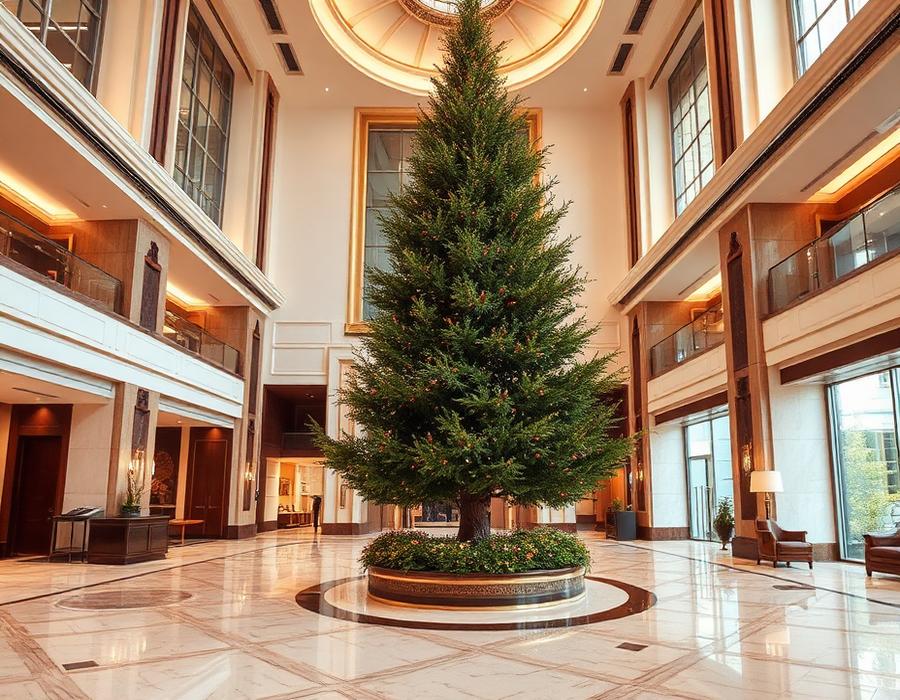
In a lobby, restaurant, or retail floor, a tipped tree is a walkway hazard and a liability question, not just a mess, so the same physics gets solved with heavier engineering rather than a bag of pea gravel. Public-space installations typically specify an engineered base sized to the tree's height and canopy weight, with a low-profile footprint built to survive foot traffic and cleaning equipment brushing past it, and taller pieces are anchored into the floor or an architectural planter rather than left free-standing. Sizing a base for anything in the 8 ft-plus range is its own subject, covered in our guide to giant artificial trees in Canada.
| Fix | Where the weight goes | Best for | Effort |
|---|---|---|---|
| Weighted base at purchase | Built into the pot's base | Any tall or top-heavy tree, decided before buying | None — pick the right listing |
| Ballast the cachepot | River rock, pea gravel, or a paving stone under the inner pot | Trees already home in a light decorative pot | Low — one-time, hidden by foliage |
| Top-dress the surface | Heavy stone or pebble layer over the substrate | Any tree, doubles as styling for realism | Low — cosmetic layer |
| Wall anchor | Trunk tied to a wall stud in its upper third | Trees at or above eye level, narrow pots, high-traffic spots | Moderate — one bracket and a tie |
Frequently asked questions
Does a heavier pot alone stop a tall artificial tree from tipping?
A heavier pot helps but is not always enough on its own once a tree gets tall and narrow enough, or once a cat, toddler, or dog is a regular presence near it. Combine a weighted or ballasted base with top-dressing, and add a wall anchor for anything at or above eye level in a pot under about 16 in across.
What can I use to weigh down an artificial tree pot?
River rock, pea gravel, or a single flat paving stone dropped into the base of the decorative cachepot before the inner nursery pot goes in, all sitting below the foliage line so nothing shows. A ready-ballasted option, such as a dracaena that ships with river rock already built into its planter, skips this step entirely.
Is it safe to anchor an artificial tree to the wall?
Yes, using a discreet screw eye or bracket into a wall stud, tied to the trunk in its upper third with clear fishing line or a plant tie. It is the same anti-tip principle the US Consumer Product Safety Commission recommends for tall furniture, applied to a tree instead of a dresser.
Do cats make artificial trees more likely to tip over?
Yes. A cat climbing or swatting partway up the trunk applies force high on a narrow base, which is exactly the kind of push a light nursery pot cannot resist. A ballasted or weighted base plus a wall anchor for taller trees addresses the tipping risk directly.
Do all artificial trees need a wall anchor?
No. A tree under about 6 ft in a wide, weighted pot is usually stable enough with ballast and top-dressing alone. Reserve wall anchoring for trees at or above eye level, trees in narrow pots, or any tree standing somewhere it regularly gets bumped, such as a doorway or a hallway.
Checked August 2026. Eververda prices are CAD and current as of 29 August 2026; the CPSC Anchor It guidance was checked at anchorit.gov in August 2026.