
Artificial Plants for Airbnb and Short-Term Rentals: What Survives Guests
29 August 2026
A short-term rental sits empty for days or weeks between guests, and nobody on a cleaning schedule is coming by to water a fiddle leaf fig on a Tuesday. That fact rules out most live plants for a listing that turns over on booking-platform timing, not a homeowner's routine. The fix is not to skip greenery, since a bare corner photographs flat and a styled one reads as cared-for, but to choose pieces built for the abuse a rental takes: rolling suitcases, a vacuum on a tight turnover window, a cleaner with no time to fluff foliage, and, in a lot of Canadian cottage and chalet properties, months of an unheated off-season. This guide covers what survives that cycle, where to put it, and what a reasonable budget looks like for a one-bedroom versus a whole cottage.
Why do live plants fail in a short-term rental?
A live plant needs a consistent person and a consistent schedule, and a rental structurally has neither. A homeowner waters on instinct; a property manager runs a fixed cleaning window between checkout and check-in, and watering plants is not on that checklist unless someone specifically adds it and keeps doing it, indefinitely, across every turnover. Vacancy gaps make it worse: a plant does not pause its water needs to match the booking calendar, and a slow or off-season stretch is exactly when nobody is on site to notice a wilting leaf. The result is usually the same: a plant that looked good on move-in day is crisp, yellowed, or dead by the third or fourth changeover, and now it is a liability in photos and debris for the next cleaner.
Does greenery in the photos actually matter, or is it just decoration?
Be skeptical of anyone who claims a specific booking-rate lift from adding a plant to a listing; that number does not exist in any source we can verify, and we are not going to invent one. What is verifiable is Airbnb's own guidance to hosts. Its Resource Center advice on listing photos, updated 13 October 2025, tells hosts to highlight the space "at its best"; its guidance on standing out, updated 8 May 2025, tells hosts preparing for a shoot to "pull back window coverings, and remove clutter" (both checked 29 August 2026). Neither page names plants, but both describe the target a plant helps hit: a room that reads as finished rather than empty or cluttered. A dead corner photographs as a dead corner; a living-room shot with one well-placed tree or greenery framing a balcony door reads as furnished. That is ordinary staging logic, not a manufactured statistic, and it is honest about the difference.
What actually survives guests and a turnover clean?
Three rules cover most of it. First, weighted bases only: a plant that tips when a suitcase wheel clips the pot is one you will be replacing every season, and a stone- or cement-filled base resists that the way a light plastic pot never will. Second, wipeable material over anything that needs restyling: moulded PE and PEVA foliage takes a damp-cloth wipe in under a minute and looks the same before and after, while silk creases in transit and needs actual fluffing, which is exactly the step a short turnover skips. Third, nothing with loose fill — decorative pebbles, bark chips, or sheet moss get vacuumed up, tracked into a suitcase, or scattered when a piece gets bumped, and a cleaner on a fixed window will not hand-sort gravel back into a pot. The same logic rules out fragile silk in a doorway or hallway pinch point, where a passing bag catches loose leaves first. See our guide to how long artificial plants actually last for more on how materials age under regular handling.
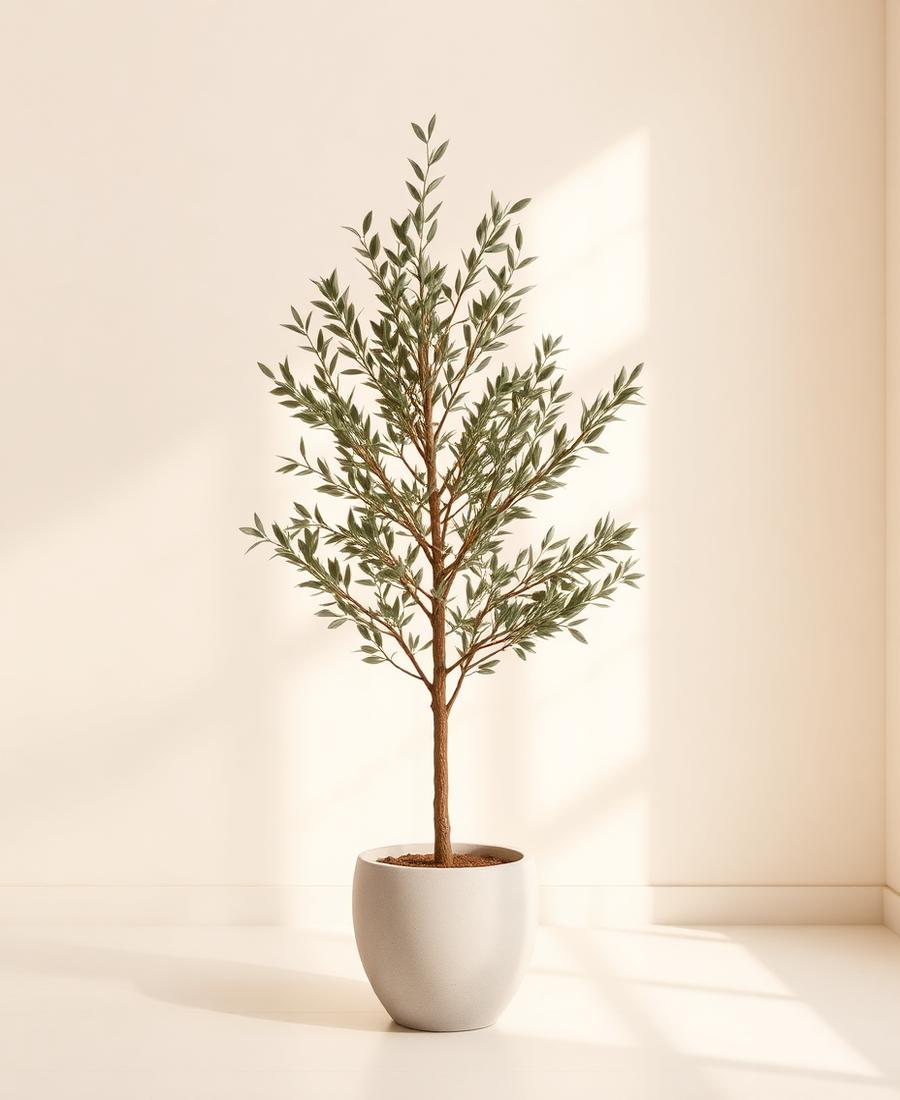
A weighted-base 4 to 6 ft fiddle leaf fig in a black planter, $319 to $449 CAD, holds a corner without re-anchoring after every checkout. For moulded, wipeable PE foliage instead of silk, an olive tree with PE foliage and stainless-steel branches, 4 to 6 ft, runs $199 to $329 CAD.
What should you tell the cleaner?
Almost nothing, if the piece is chosen right. A cleaner works a fixed slot between checkout and the next check-in and is not going to fluff foliage or reposition loose stems, so the goal is a plant that looks correct with zero styling effort. Where a note helps is one line on the checklist for pieces that do move — "straighten the plant by the window if knocked" is an instruction a cleaner can execute in five seconds; "restyle the arrangement" is not. Anything needing more than that one line will not get done consistently across a rotating crew. For the wipe-down itself, our guide to cleaning artificial trees and plants covers the method by material, which matters more here since a rental gets touched by more hands per year than most living rooms.
Where should the plant go so it earns its place in the photos?
Three spots do most of the work: a corner of the main living area, in the frame of the widest listing photo; a single piece beside the bed head, softening an otherwise flat headboard-and-wall shot; and, on a unit with a balcony or patio, one weather-tolerant piece framing that outdoor shot, turning a plain railing view into a usable hero image. What does not belong is a plant in a walkway. A small unit has limited floor area, and a piece that looks good in a photo but sits in the path between the door and the kitchen becomes the thing a guest trips over on a first night in an unfamiliar space. Confirm the walking path is clear before finalizing placement, not after.
What about pet-friendly and family listings?
A pet-friendly listing adds one filter: whatever you place has to tolerate a curious dog or cat without becoming a hazard if chewed, which rules out real plants in most cases. Our guide to artificial plants and pet safety covers sizing and placement. A family listing raises the same loose-fill concern above, plus height — keep detachable stems or berries out of a toddler's reach, the same way you would babyproof any unfamiliar room.
What survives an unheated cottage or ski chalet over the off-season?
A live plant cannot survive a Canadian cottage or chalet that sits at or below freezing for weeks between winter bookings; there is no watering schedule that fixes a frozen root ball. This is where artificial foliage stops being a convenience choice and becomes the only option that works at all. Cold does not damage moulded PE or PVC foliage the way it kills a living plant, so a piece set up in September can sit through an unheated January and look the same at the first spring booking, no seasonal removal required. The one caution is direct UV exposure through south-facing glass over a long unheated stretch, which fades any material faster than steady indoor light; where that is a concern, choose UV-resistant foliage for the sunniest window.
What does it cost to kit out a rental, and does the number change with property size?
It scales with room count more than with anything else. A one-bedroom or studio unit typically needs two pieces to do the job described above: one anchor piece for the living area and one smaller piece for the bedroom or a balcony accent. A full cottage or chalet with a main living area, two or more bedrooms, and a porch or deck needs proportionally more, plus at least one weather-tolerant piece for the outdoor shot.
| Property type | Typical pieces | Approximate total (CAD) |
|---|---|---|
| Studio or one-bedroom unit | 1 living-area anchor tree, 1 smaller accent piece | roughly $400–$700 |
| Two-bedroom condo or townhouse | 1 living-area tree, 1–2 bedroom pieces, 1 balcony accent | roughly $700–$1,100 |
| Whole cottage or ski chalet | 2–3 room pieces plus a porch or deck panel | roughly $1,000–$1,750 |
For a studio or one-bedroom, a 4 ft fiddle leaf fig in a white planter at $219 CAD works as the compact anchor, paired with a 7.5 ft real-touch monstera at $266.99 CAD for a second corner, or the same price in an outdoor-rated PE Boston fern built for balcony use if the unit has one. Scaling up to a full cottage, add an areca palm, 4 to 6 ft, at $289 to $419 CAD for a second bedroom, and for the porch or deck rail, a boxwood fence panel at $127.99 CAD or an ivy privacy screen on a willow trellis at $225.99 CAD frames an outdoor photo without a potted tree exposed to weather. For tight units, see our guide to artificial plants for small apartments and condos, and for ensuite staging, artificial plants for bathrooms covers the humidity-tolerant picks.
Frequently asked questions
Can I just use real plants and have the cleaner water them?
You can ask, but it rarely holds up across a full year of turnovers. Cleaning staff work a fixed window per visit and often rotate between properties, so a watering task riding on one person's memory tends to lapse within a few months, especially over a slow booking stretch. If a listing genuinely needs live plants, budget a separate plant-care visit on its own schedule rather than folding it into the cleaning checklist.
Will a weighted-base tree tip if a guest bumps it?
A properly weighted base resists a bump or a passing suitcase far better than a light plastic pot, though no base makes a tree immovable against a determined shove. Placement still matters: keep any floor piece out of the direct path between the door and high-traffic areas like the kitchen, so a knock stays a rare event rather than a nightly one.
Do artificial plants need any maintenance between guest turnovers?
Very little. Moulded PE foliage holds up to months of no attention and just needs an occasional damp-cloth wipe to clear dust, which a cleaner can do in under a minute during a normal pass. Silk-heavy pieces need more frequent attention to stay looking styled, which is why this guide steers rental use toward PE and other wipeable materials instead.
Is a balcony plant worth it or is that just for the photo?
It is mostly for the listing photo, and that is a legitimate reason on its own, since a balcony or patio shot is frequently one of a listing's featured images. Use a piece rated for outdoor or covered-outdoor use rather than an indoor-only line, since sun and temperature swings on a balcony differ from an interior room.
What if the property has no heat at all in winter?
Artificial foliage is unaffected by cold; the material does not freeze or die back the way a live plant would. The only real risk in an unheated space is fading from prolonged direct sun through unshaded glass, which a UV-resistant product line handles better than a standard indoor line over a multi-year off-season cycle.
External facts on Airbnb's own host guidance were checked against the Airbnb Resource Center as of 29 August 2026 (pages last updated 13 October 2025 and 8 May 2025 respectively). Eververda product prices are CAD and current as of 29 August 2026.