
Decorating With Artificial Plants Through the Seasons
29 August 2026
Short answer: a Canadian home does not need to redecorate four times a year to look seasonally current. A small permanent core, left in place all year, plus two or three pieces that rotate on a genuine Canadian calendar, covers the year for less money and effort than swapping everything out each season. This guide walks that calendar season by season with real pieces and CAD prices, then covers storage and the honest option of skipping rotation altogether. For the same idea applied to a restaurant or café, see our hospitality seasonal decor guide instead; this piece is about a household.
What does a year-round artificial-plant calendar look like for a Canadian home?
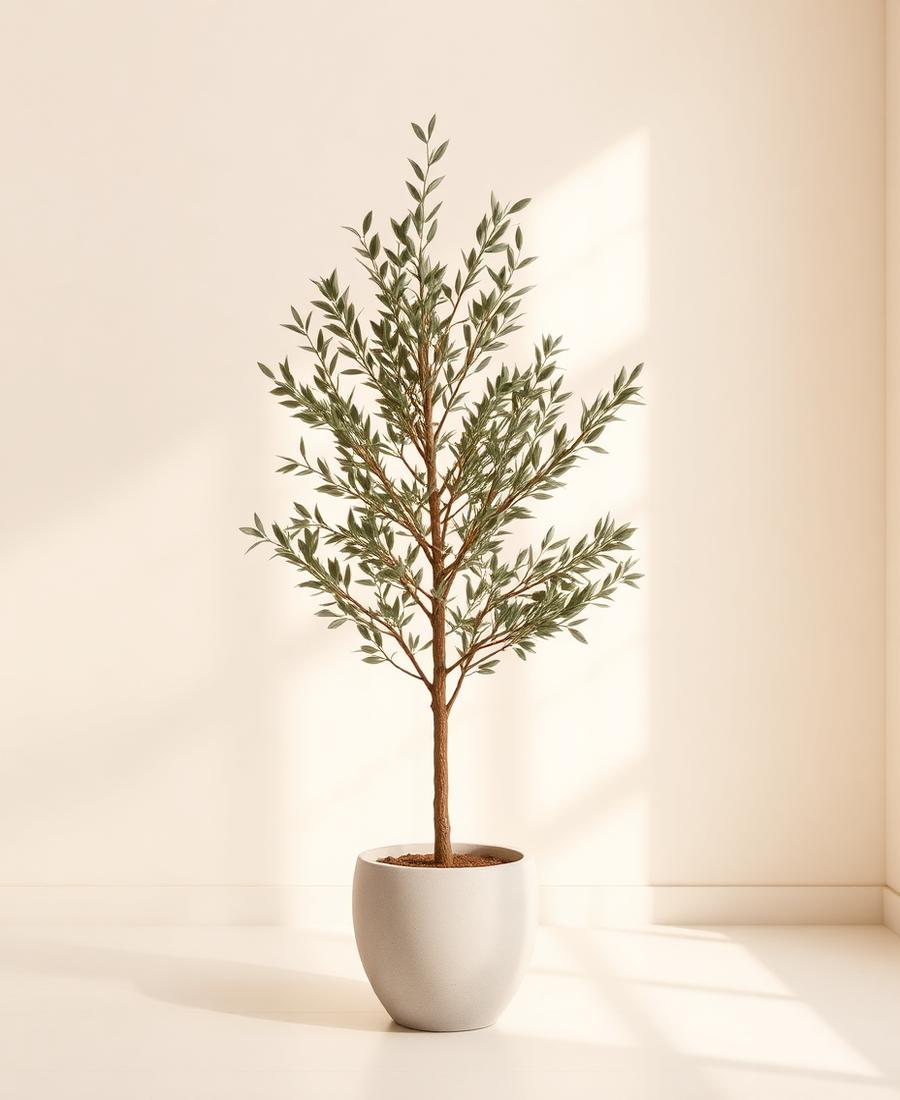
The shape of the year is the same in most Canadian homes, though exact swap dates shift with local climate. A permanent piece, an olive tree or a fiddle leaf fig, anchors a living room or entryway all twelve months, while two or three seasonal accents rotate through a console table, a mantel, a covered porch.
| Window | What it looks like | Example piece |
|---|---|---|
| February–March | Blossom indoors while it is still winter outside | Cherry blossom, 5–6 ft, white or pink, $329 to $419 CAD |
| April–May | Blossom continues; UV-rated pieces move back to covered porches | Willow-trellis ivy screen, UV-resistant, $225.99 CAD |
| June–August | Patio and balcony season, sun-tolerant pieces only outdoors | Palm, 5–6 ft, UV-resistant fronds, $219 to $289 CAD |
| September–October | Autumn colour that never browns | Red maple, indoor display, from $827.99 CAD |
| November–early January | Holiday greenery beyond the tree | see holiday section below |
The permanent core does not appear in that table because it never leaves. A 5.25 to 7 ft olive tree with a natural wood trunk runs $249 to $419 CAD, and a 4 to 7 ft fiddle leaf fig in a white planter with a weighted base runs $219 to $399 CAD; either works as the year-round anchor the seasonal pieces rotate around.
Why is February the hardest month for a Canadian living room?
By February, the holiday greenery has come down, the light is still weak and grey across most of the country, and real spring is still weeks away almost everywhere. It is the stretch when a home most needs something that reads as alive, and the stretch when nothing outside can help: the garden is dormant or under snow, and cut flowers are expensive and short-lived through the coldest months.
Blossom solves this better than plain green does, because blossom is unmistakably a spring signal rather than a generic houseplant. A 5 to 6 ft cherry blossom tree in white or pink, at $329 to $419 CAD, reads as spring the moment it is in the room, regardless of what the thermometer says outside. Placed at a landing, a console table or a bright corner away from a heat source, it is the one seasonal piece that earns its keep in the coldest, greyest month rather than the easy ones.
When is it safe to move pieces back onto a porch in spring?
Not the first mild weekend. Spring in Canada is a freeze-thaw stretch before it is a warm one: water works its way into pot seams and cement bases and expands each time the temperature crosses zero, which it does repeatedly through a Canadian spring. Moving a piece outside too early trades a mild afternoon for a cracked planter a week later.
Wait until your own region's freeze-thaw cycle has genuinely settled, not the first warm day, and move back only pieces the manufacturer states are UV-resistant or outdoor-rated. Our full breakdown of what survives a Canadian winter outdoors, including which materials handle cold and freeze-thaw and which do not, is in Can Artificial Plants Stay Outside in a Canadian Winter? A piece built for it from the start, like the willow-trellis ivy privacy screen at $225.99 CAD, is a reasonable first thing back on a covered porch railing, since it carries a stated UV-resistant rating rather than an assumed one.
What changes on the patio or balcony once summer patio season starts?
Summer is the one season where indoor greenery has real competition: a real garden, a planted patio pot, hanging baskets. That is fine. A seasonal artificial piece does not need to replace real plants outdoors; its job is the spots real plants cannot easily reach, a covered corner, a shaded balcony rail, an entry that gets no watering attention on a travel week.
The honesty point matters more here than in any other season, because summer sun is the most testing condition an outdoor piece faces all year. Only pieces the manufacturer actually states are UV-resistant belong in direct sun for a full Canadian summer; a 5 to 6 ft palm with UV-resistant fronds, at $219 to $289 CAD, is stated as such. A palm without that rating belongs under an awning or indoors, not in full sun on the assumption that "outdoor-looking" means "outdoor-rated." Balcony placement adds a second variable beyond sun: height multiplies wind, which is a safety question before it is a styling one. Our guide to artificial plants for balconies and terraces covers which pieces are actually rated for an exposed rail and how to secure them.
How do you style artificial maple for a Canadian autumn?
Maple is the autumn move most homes skip, and it is worth not skipping. A living red maple gives two or three weeks of peak colour before the leaves drop; an artificial one holds that peak the whole season it is out, then boxes away again once the room moves on. A red maple for indoor landscape display, from $827.99 CAD, reads as a deliberate autumn choice in a front hall or living room corner rather than a summer plant left up too long.
The one rule that keeps a seasonal specimen from looking off is committing to one season story per room. An autumn-red maple standing next to a summer-green fiddle leaf fig in the same sightline reads as a mismatch, even to someone who could not say why. Keep the rest of the room's greenery neutral, evergreen tones, bare or warm-toned planters, while the maple is out. The fuller version of this rule, plus willow, birch and ginkgo as the other specimen deciduous options, is in our specimen deciduous species guide.
What belongs at home for the holidays beyond the Christmas tree?
The tree is the centrepiece, but a household holiday scheme that stops there looks unfinished next to one that also dresses a mantel, a stair rail or a doorway. Garland and vine pieces, draped by hand or fixed once as a trellis-style screen, cover that ground without a second tree-sized purchase. Our practical buying and styling guide to garlands, vines and ivy covers the formats, how much a typical banister or mantel actually needs, and how to fix it so it stays up through the season.
This is about a household's own holiday decorating, not a business's. Specifying a lobby-scale or storefront tree instead is a different job: our commercial Christmas tree buying guide covers sizing and cost, and our business Christmas installation timeline maps the order-to-teardown calendar a commercial rollout runs on.
Is a permanent core plus seasonal swaps actually cheaper than redecorating four times a year?
Yes, and the saving compounds every year the pieces get reused. A permanent core, one olive tree or fiddle leaf fig at $219 to $419 CAD, gets bought once and stays in place through every season change; it absorbs day-to-day wear and becomes what a household's eye gets used to seeing in that spot. The seasonal kit sitting alongside it is deliberately small, two or three accent pieces sized to the same console table or porch corner each time, reused year after year rather than discarded and rebought. That is the actual saving: not a lower price per piece, but zero repeat purchases.
It also looks more deliberate. A room with one thing changed, the blossom tree, the maple, the palm, reads as considered; a room restyled on every surface reads as busy rather than seasonal.
How do you store seasonal pieces between rotations?
The short version: clean and completely dry before boxing, stored upright with foliage folded the way it shipped, nothing stacked on top, and the original carton or a rigid box rather than a soft bag under weight. Cold does not damage foliage in storage; damp does, and a piece boxed even slightly wet stays that way for months in a closed container. Silk and blossom foliage loses its shape under sustained pressure and does not spring back the way a moulded PE leaf does, so a cherry blossom tree specifically should never have anything stacked on its box. The full method is in How to Store Artificial Trees and Plants Without Ruining Them.
Do you need a seasonal rotation at all?
No. A good year-round scheme, one well-chosen permanent piece and nothing else, is a perfectly respectable answer, and for many households it is the right one. Seasonal rotation suits a household that enjoys refreshing a mantel through the year and has room to store extra pieces the other nine or ten months. It does not suit a household that would rather buy one good tree and be done thinking about it. Both are legitimate; the permanent core above works either way.
Frequently asked questions
How many seasonal pieces does a home actually need in rotation?
Two or three is enough for most households: one late-winter or spring piece, one summer outdoor-rated piece, and one autumn piece. A permanent core, an olive tree or fiddle leaf fig, sits underneath the rotation year-round rather than counting as a fourth seasonal buy.
Can artificial plants stay on an unheated porch through a Canadian winter?
Only pieces the manufacturer states are UV-resistant or outdoor-rated, and even those do better on a covered porch than an exposed one, since freeze-thaw and wind are separate risks from sun. See our winter outdoors guide for what actually survives.
What is the cheapest way to add seasonal colour without buying something new every year?
Reuse the same two or three seasonal pieces year after year rather than buying fresh decor each season. A cherry blossom tree at $329 to $419 CAD or a maple from $827.99 CAD, stored properly between rotations, costs nothing to bring back out the following year.
Does an artificial autumn maple need to match the rest of the room's greenery?
It helps to keep nearby foliage neutral, evergreen tones or bare, warm-toned planters, while an autumn-red maple is out, rather than mixing it with a summer-green piece close by. This is a styling preference, not a rule that affects how the maple looks on its own.
Where should seasonal pieces be stored for the rest of the year?
Somewhere dry and temperature-stable rather than damp, since damp causes more storage damage than cold does. An unheated but dry garage, closet or basement works; an unheated shed that swings between cold nights and warmer days invites condensation.
Is it acceptable to just keep one artificial tree year-round instead of rotating seasonal pieces?
Yes. A single well-chosen permanent piece is a complete answer on its own and needs no seasonal additions. Seasonal rotation is an optional layer for households that enjoy the extra styling, not a requirement for a home to look finished.
Eververda prices are CAD and current as of 29 August 2026. Seasonal outdoor, balcony and storage guidance follows Eververda's own published research on those topics, linked throughout, checked 29 August 2026.