
RH and West Elm Faux Tree Dupes: What You Get for the Money
22 August 2026
RH dupes and West Elm dupes are usually the same search wearing different clothes. Someone has seen a large faux tree in a catalogue, found the price, and wants to know what the money is for. The two brands happen to make the cleanest head-to-head in the category, because they sit at opposite ends of the same catalogue tier, and the gap between their price tags is explained almost entirely by four construction details. This page is that head-to-head.
Prices are as published on each brand's own page when checked in August 2026, and Canadian and US pricing differ. This article keeps to RH and West Elm; the complete market ladder, from Amazon bestsellers through Crate and Barrel, Pottery Barn and McGee & Co, lives in one place, why faux trees cost $80 or $900, with every rung priced.
Eververda listings publish those four details too. Every Eververda product page carries a specification table holding what the manufacturer documented, and where a value was never documented it reads "Not specified" rather than being guessed. In October 2026, 375 such fields across 152 products were rewritten so an unknown reads as an unknown.
What do RH and West Elm faux trees actually cost?
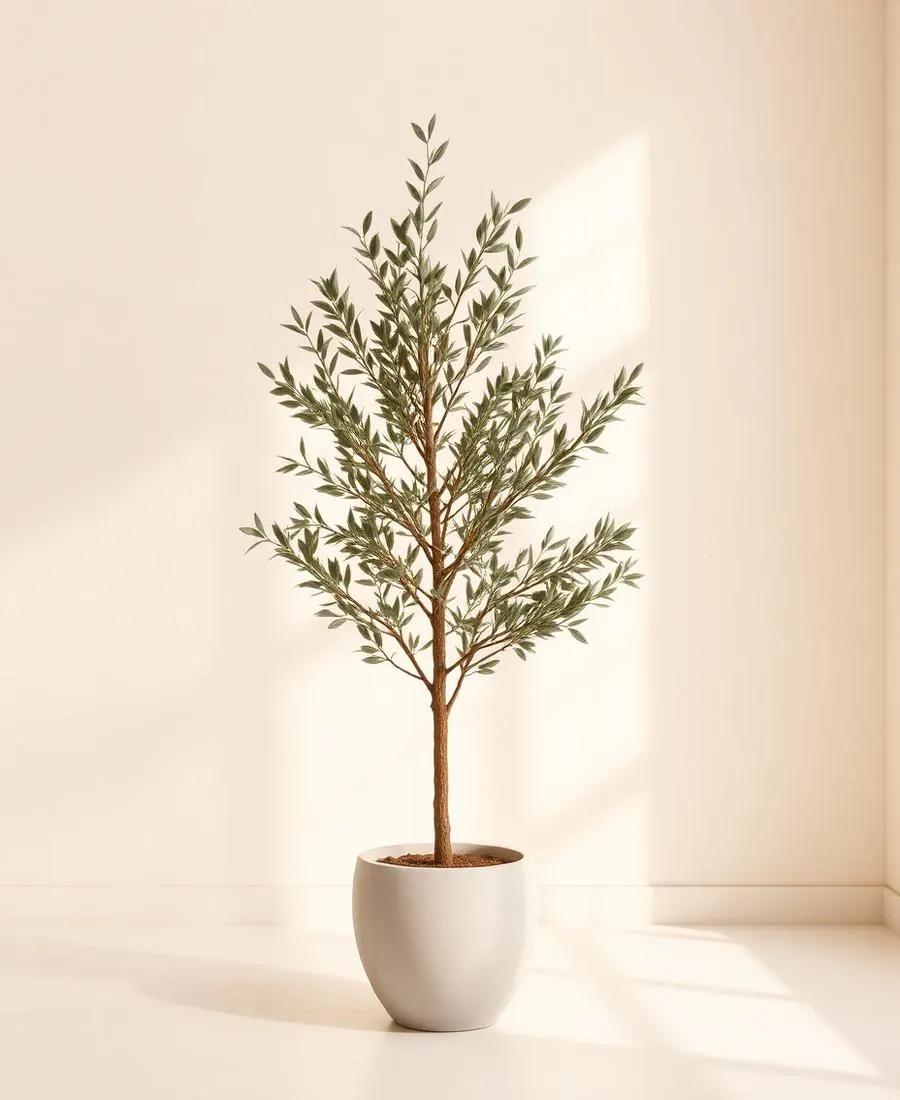
When checked in August 2026, RH listed a faux olive at "SAVE 40% Starting at $929 Member Sale /$1,565 Regular". West Elm's Faux Potted Olive Tree ran $299 to $648 depending on size.
Read those two lines together and the first lesson of this comparison appears before any construction talk: "catalogue brand" is not one price point. Even on member sale, on the August 2026 prices, RH's starting figure is roughly three times West Elm's, and RH's regular price is more than double West Elm's largest size. These are not two versions of the same product with different logos; they are the floor and the ceiling of a whole tier.
What explains the gap between $299 and $929?
Four construction details, and only four. Everything beyond them is brand position.
| What changes | At the West Elm end of the tier | At the RH end of the tier | What an Eververda listing publishes | Does it matter? |
|---|---|---|---|---|
| Trunk | Moulded plastic over a wire or metal core | Fibreglass over steel, or real timber | The manufacturer's trunk material, fibreglass over galvanised steel and real timber included, or Not specified | Yes. The biggest single difference at close range |
| Foliage density | Lighter canopy, gaps possible | Dense, layered, no see-through patches | A leaf and fruit count per size on some pieces, Not specified where the manufacturer gives no figure | Yes. This is what "looks real" actually means |
| Canopy width | Narrower, often unlisted | Wide enough to fill a corner | Published where the manufacturer documents it, Not specified where not | Yes, and it is the spec most often omitted |
| Pot | Plainer vessel | Ceramic, cement or woven planter | Box contents per listing | Yes, and it is expensive to ship |
| Leaf material | Plastic and polyfoam | Plastic and polyfoam | Published per listing where the manufacturer documents it, Not specified where not | No. It does not change |
The last row is the one to sit with. Nowhere in this market does leaf material move with price: the materials lists retailers publish converge on the same plastic-and-foam family from the mid tier to the very top, and the hub article linked above puts the published lists side by side so you can read the convergence yourself. When you pay $929 instead of $299, on the August 2026 prices, you are paying for the four rows above it, plus RH's position, and for nothing that happens inside the leaf.
Are the expensive trees a rip-off then?
No, and it is worth being precise here rather than cynical. A fibreglass trunk over a steel core genuinely costs more to make than plastic over wire, and it is the reason a 13 ft tree can stand without guy wires. A dense canopy uses more leaf, and more leaf costs more. A cement or ceramic planter is heavy, and heavy things cost real money to ship across a continent. Those are honest costs, and at the RH end of the tier you are getting some real quantity of them.
What you should not assume is that a higher price guarantees them. One tier down from RH, a designer reviewing a $718 faux olive on the seller's own site, read in August 2026, gave it four stars while observing that fuller-looking trees were available for less; the full story of that review is in our McGee & Co dupes article. Fullness, the quality that does the most visual work, is buyable at several price points. That is precisely why the four details beat the logo as a shopping method.
What should I check before buying a fake tree anywhere?
Start under the photograph. Some retailers style their trees in planters that ship separately, and the honest ones print a line on the page saying so. Learning to find that line is the highest-value habit in this category; the best worked example of it is Pottery Barn's page, which we go through in the Pottery Barn olive tree guide.
Then check, in this order:
- Trunk material. If the listing does not say, assume plastic over wire and price accordingly.
- Canopy width in inches. If it is not published, ask. Two 8 ft trees can differ by two feet of spread.
- What is in the box. Tree only, tree plus plain pot, or tree plus decorative planter.
- Real height including the pot. A tree specified to the top of the canopy will exceed that number once it is set into a base.
- Review count and age. A tree with hundreds of reviews has a year of real living rooms reporting back; a tree with a handful has a photograph.
How Eververda's range compares
Every Eververda listing publishes the manufacturer's trunk material, height, listed placement and box contents where the manufacturer documents them, and marks anything unknown as Not specified: the same four numbers this article told you to demand from RH and West Elm. Artificial trees and plants are the whole of our catalogue rather than one category inside a general home range, spanning residential sizes through commercial-scale specimens in one place.
Our large artificial trees and 10 ft artificial trees are built for the specification end of the market: fibreglass over galvanised steel, real timber trunk options, heights quoted in both feet and metres because a 4 m tree is a two-person install with a clear delivery route. As a concrete example of that end, our 2 m cedar pine bonsai lists at $1,246.99 CAD, and several commercial builds run well beyond it. Commercial-scale pieces are quoted with freight, crating, lead time and site access planned per order.
If your budget is a West Elm budget, the other end of our range is the relevant one, and it undercuts West Elm's $299 entry point as checked in August 2026 at the smaller sizes: an olive on a genuine wood trunk at 5.25 to 7 ft is $249 to $419 CAD, and a PE-foliage olive on stainless-steel branches, 4 to 6 ft, is $199 to $329 CAD. Note that a wood trunk under $300 is the kind of spec-versus-price fact this whole article is about.
To browse by room rather than size, start at indoor trees.
Eververda sells the products described in this section.
Where a piece carries UV-treated foliage, the listing says so, because Eververda publishes a UV claim only where the documentation supports one. UV treatment slows fading rather than stopping it, on any brand's tree.
The short version
Do not shop RH and West Elm dupes by hunting a cheaper logo. Write down four numbers for the tree you liked, trunk material, canopy width, foliage density and included pot, then find any tree at any price that matches all four. A wood-trunk tree at $249 CAD like ours is one place to look, because those four numbers are printed on the listing instead of left to the photograph. At 12 ft, nothing lighter than a fibreglass-over-steel build stands up, whatever the logo. The four numbers tell you which one you are in. The logo never does.
Frequently asked questions
Why is the RH faux olive tree so expensive?
RH sits at the very top of the consumer catalogue tier, listed in August 2026 at $929 on member sale against a $1,565 regular price. What that buys, where it is buying anything, is trunk construction, canopy density, canopy width and a serious planter, the four details that genuinely cost money. The leaf material is the same plastic-and-foam family the rest of the market publishes.
Is West Elm a good place to buy a faux tree?
It is the accessible end of the catalogue tier, at $299 to $648 for the Faux Potted Olive Tree depending on size when checked in August 2026. Judge any specific listing on the four construction details rather than the brand: trunk material, canopy density, canopy width and what pot ships. Where those are unpublished, ask before ordering, because they vary more than the logo suggests.
Do RH and West Elm use better leaf materials than cheaper brands?
There is no published evidence of that. Across the market, retailers' own materials lists converge on plastic and foam regardless of price, and leaf material is the one row of our comparison that does not change between the $299 end and the $929 end on the August 2026 prices. Price differences live in the trunk, the density, the width and the pot.
When is a $900-plus faux tree actually necessary?
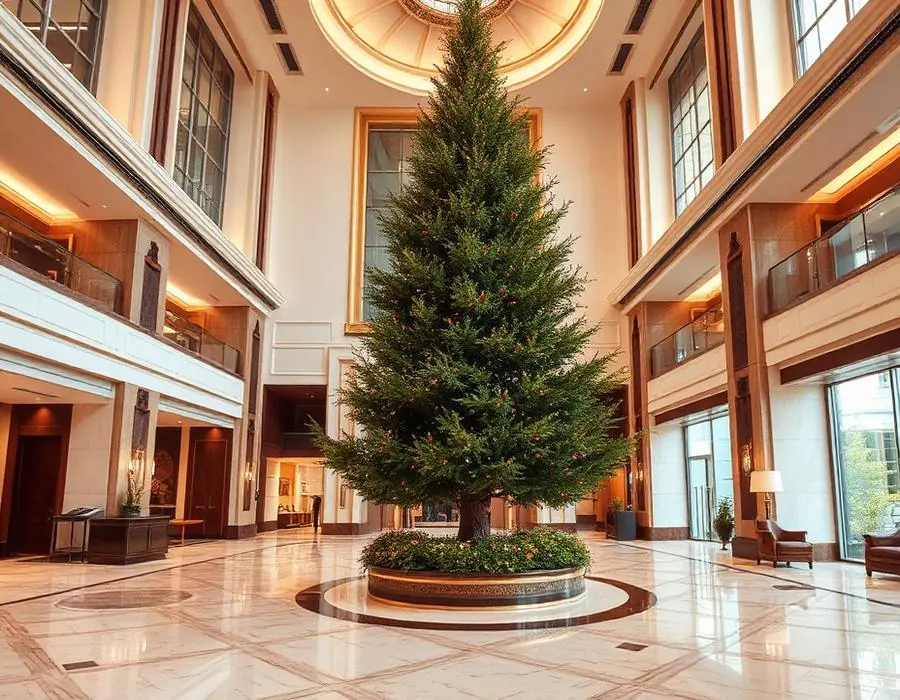
Mainly at height and at close range, on the catalogue prices checked in August 2026. Around 13 ft, a tree needs a steel core to stand without guy wires, and fibreglass-over-steel construction stops being a luxury. If people will stand within arm's reach in a lobby or entrance, a fibreglass or real timber trunk is the difference that survives inspection. Across a normal living room, a dense canopy at a far lower price does the job.
What is the cheapest way to get the RH look?
Match the four numbers, not the brand. Find the trunk material, canopy width, foliage density and pot of the RH tree you liked, then search for those specifications at lower tiers. As one data point, a faux olive on a genuine wood trunk runs $249 to $419 CAD in our range, under West Elm's entry price and a fraction of RH's.
Competitor prices are USD list prices as published when checked in August 2026. Eververda prices are CAD and current as of 28 August 2026.
Products in this article
- Tall Artificial Cedar Pine Bonsai Tree Green 2 m (6.56 ft)$1,246.99 CAD, quoted
- Artificial Olive Tree, 5.25 to 7 ft, Natural Wood Trunk$249 CAD to $419 CAD, quoted
- Artificial Olive Tree, 4 to 6 ft, PE Foliage, Stainless Steel Branches$229 CAD to $289 CAD, quoted