
Real vs Artificial Olive Tree in Canada: The Five-Year Cost
29 August 2026
A live olive tree is a genuinely appealing thing. It grows, changes with the seasons, and the right cultivar can even fruit; if you have a bright south-facing window and enjoy looking after plants, nothing artificial replaces that. We sell artificial olive trees, so read our arithmetic with that declared interest — every number below is sourced and every calculation shown in full.
What does a live olive tree cost to buy in Canada?
Less than you might think at the small end, more at the statement end. Verified Canadian prices, checked 29 August 2026: MyGreenscape sells a small olive in a 4-inch pot for $18 CAD; Promise Supply in Toronto lists an Arbequina at 1.5 to 2 ft for $45.00 CAD; JOMO Studio's size ladder runs from $18.00 for a 4-inch pot to $400.00 for a 6-ft-plus tree; and Sheridan Nurseries lists a #15 container olive at $599.99 CAD. So a living-room-scale live olive — the size an artificial tree usually stands in for — sits around $400 to $599.99.
What care does it actually need indoors?
Light is the hard constraint. Promise Supply's Canadian care guide calls for at least 6 hours of direct sunlight in a south-facing window; Ask Extension, the US Cooperative Extension service, likewise says a minimum of 6 hours is needed and, where natural light falls short, recommends a grow light run about 12 hours a day on a timer. Most Canadian rooms in January fall short, which makes a grow light standard equipment: Home Depot Canada's full-spectrum LED units run $41.59 to $169.74 CAD.
Watering is a rhythm rather than a chore: every 3 to 5 days in spring and summer, every 7 to 10 days in winter, when the top two inches of soil are dry, per Promise Supply. Léon & George's guide is blunt about the main risk — "overwatering is the most common cause of trouble" — with insufficient light, which causes weak growth and leaf drop, as the other leading cause of failure. Some leaf drop right after purchase is normal: Ask Extension attributes it to differences in light and temperature from the nursery.
Temperature has a floor: Curb Wise's Ontario guide says to keep winter indoor temperatures above 10°C, and Promise Supply says the tree can't handle below-freezing weather and should come inside a few weeks before the first autumn frost — though summering it outside once temperatures hold above 15°C "may be the best thing you can do for it". Feeding uses fruit-and-citrus fertilizer spikes, nine-packs at $10.98 to $15.99 CAD, and an eventual repot means a planter ($59.98 to $129 CAD at Home Depot Canada) plus indoor potting mix ($24.99 CAD).
One expectation to set: the New York Botanical Garden's reference service states that container olives need winter temperatures held in the 40 to 50°F range, with at least two months below 50°F, to generate flowering and fruit. A centrally heated Canadian living room never gets that cold, so plan on a handsome silvery tree, not a harvest.
Can you grow one outdoors in Canada?
The sourced facts, side by side. The New York Botanical Garden says the common olive "is not winter hardy in zone 4 and prospers only in a dry, Mediterranean-like climate in zones 8 to 10". Gardening Know How puts olives at zones 9 to 11, notes damage begins around −5°C, and names Arbequina, Ascolana, Mission and Sevillano as the most cold-hardy cultivars — ones to move indoors and protect when cold sets in. Triple Tree Nurseryland, a Canadian retailer, lists its olive at hardiness zone 8. And Natural Resources Canada maps the country's warmest zone, 9, to the warmer parts of Vancouver Island, where "certain palms and citrus varieties" can grow. Put those facts next to each other and the map draws itself: a gardener in the mildest corners of Vancouver Island can genuinely attempt an olive outdoors, while everyone else grows a container tree that summers on the patio and winters inside. (The outdoor question for artificial trees has its own answer — see can you put artificial trees outside.)
What do five years actually add up to?
The worked example, at statement height, every line a verified price. Two stated assumptions: one nine-spike fertilizer pack per year, and one repot in five years. Electricity for a 12-hour daily grow light is real, but we found no verified Canadian figure, so it's left out — the live-tree total is understated, if anything.
| Item | Live olive, worked example | Artificial olive, worked example |
|---|---|---|
| The tree | Sheridan Nurseries #15 container: $599.99 | Eververda 5.25–7 ft olive, natural wood trunk: $249–$419, one purchase |
| Grow light | $41.59 (entry-level full-spectrum LED, Home Depot Canada; larger units to $169.74) | $0 — no light needed |
| Fertilizer, five years | $15.99 × 5 = $79.95 (Jobe's nine-spike pack at Grow Daddy Canada; packs found from $10.98) | $0 — never needs feeding |
| One repot (planter + soil) | $59.98 + $24.99 = $84.97 | $0 — never needs repotting |
| Five-year total | $806.50 | $249–$419 |
The live-side addition in full: $599.99 + $41.59 + $79.95 + $59.98 + $24.99 = $806.50. The artificial side is one number because that's the point: our 5.25 to 7 ft olive with a natural wood trunk is $249 to $419 CAD on the day you buy it and nothing after.
The budget route is fairer to the live tree. Start with Promise Supply's $45.00 Arbequina and the same kit: $45.00 + $41.59 + $79.95 + $59.98 + $24.99 = $251.51 over five years — squarely in artificial-tree territory. The caveat is size and time: that's a 1.5 to 2 ft young tree in year one, not a 6 ft presence the day the box arrives.
What are the artificial side's own realities?
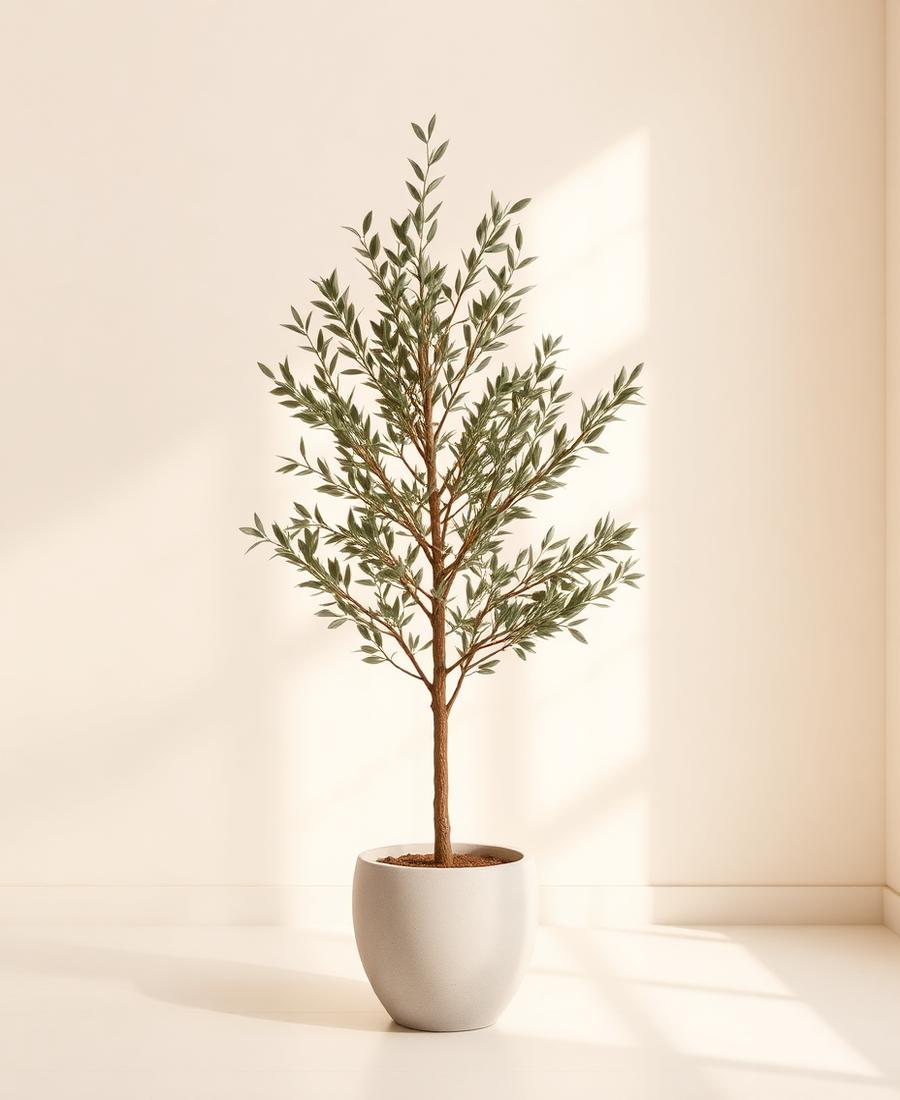
Fairness cuts both ways. An artificial olive will never grow, change or surprise you; the shape you buy is the shape you keep. It needs dusting a few times a year. And on sun exposure, our published position is the honest one: UV protection slows rather than stops fading, so even a UV-treated tree shouldn't live in harsh all-day direct sun — which, neatly, is the one light a live olive demands and an artificial one doesn't want. What you're buying is the form without the inputs. Our silk-foliage olive with counted leaves and fruit ($249 to $449 CAD) publishes its heights, materials and foliage counts, holds its shape in a north-facing room where a live olive would sulk, and costs nothing to run. What makes an artificial tree look real covers the construction details worth checking on any tree, ours included.
So which should you choose?
Choose the live tree if you have six hours of direct sun or are happy running a grow light on a timer, if the watering rhythm sounds like a pleasure rather than a job, or if you live somewhere it can spend real time outdoors — the mild edges of coastal BC most of all. Choose the artificial tree if you want the olive's form in a room the sun doesn't reach, at a known one-time cost — $249 to $419 CAD for our natural-wood-trunk example. And the two mix well: a $45.00 seedling in the sunny window and a full-height artificial tree in the dim corner is a perfectly rational household.
Frequently asked questions
Will an indoor olive tree in Canada ever produce olives?
Almost certainly not in a heated home. The New York Botanical Garden's reference service states that container olives need winter temperatures held in the 40 to 50°F range, with at least two months below 50°F, before they will flower and fruit — conditions a centrally heated Canadian house never provides.
Can I plant an olive tree in my garden in Canada?
Only in the country's very mildest spots. Sources place olives at hardiness zones 8 to 10 (New York Botanical Garden) or 9 to 11 (Gardening Know How), with damage starting around −5°C, and Natural Resources Canada maps Canada's warmest zone, 9, to the warmer parts of Vancouver Island. Elsewhere, growers keep olives in containers, summering them outside and overwintering them indoors above 10°C.
What does a live olive tree cost per year after you buy it?
From the verified components: about $16 a year in fertilizer (a nine-spike pack runs $10.98 to $15.99 CAD), a one-time grow light at $41.59 to $169.74 CAD if your window can't deliver six hours of direct sun, and an occasional repot at about $84.97 for planter plus soil. Electricity for a 12-hour daily grow light comes on top; no verified figure was found.
Is a real olive tree cheaper than an artificial one?
It depends where you start. A $45.00 seedling plus grow light, fertilizer and one repot totals $251.51 over five years — comparable to an artificial tree, though it starts at 1.5 to 2 ft. A statement-height live tree at $599.99 with the same kit totals $806.50, against $249 to $419 CAD for our full-height natural-wood-trunk artificial olive as a one-time purchase.
Why is my new olive tree dropping leaves?
Usually adjustment, not failure. Ask Extension attributes leaf drop after purchase to differences in light and temperature from the nursery rather than a care error. Beyond that settling-in period, the cited causes are overwatering — "the most common cause of trouble" per Léon & George — insufficient light, and drought.
For what every size of artificial olive costs across Canadian sellers, see our size-by-size olive pricing guide. For a budget framework built around your room rather than the species, see how much a decorative indoor tree should cost. And if the comparison in your head is with a designer tree, our Pottery Barn olive comparison runs those numbers directly.
Competitor and component prices were checked on 28–29 August 2026 and are quoted as displayed at the source. Eververda prices are CAD and current as of 30 August 2026.