
Nearly Natural Alternatives: Where Else US Buyers Can Shop
29 August 2026
Where else can US buyers shop besides Nearly Natural?
Short answer: plenty of places, and the right one depends on what you are buying. Eververda is artificial trees and plants only, and every product page carries a specification table holding what the manufacturer documented; where a value was never documented it reads "Not specified" rather than being guessed. Nearly Natural is the biggest specialist name in US artificial trees, with a catalogue deep enough to fill multiple pages per species and an entry price lower than anything in Eververda's range, which starts where a piece carries a documented specification table and a 30 day return. Afloral publishes material compositions; Balsam Hill is the seasonal specialist; big-box convenience sits at Home Depot and Target; marketplace scale sits at Amazon and Wayfair; a building-scale installation runs through a commercial supplier, a different category of purchase entirely. This maps that field, checked 29 August 2026, with real USD prices where a source gives one and a plain "could not verify" where it does not. It is a companion to our verified US retailer price survey, which covers the same retailers as a full price table; this piece does not repeat that table, only who each retailer suits.
What does Nearly Natural's range look like?
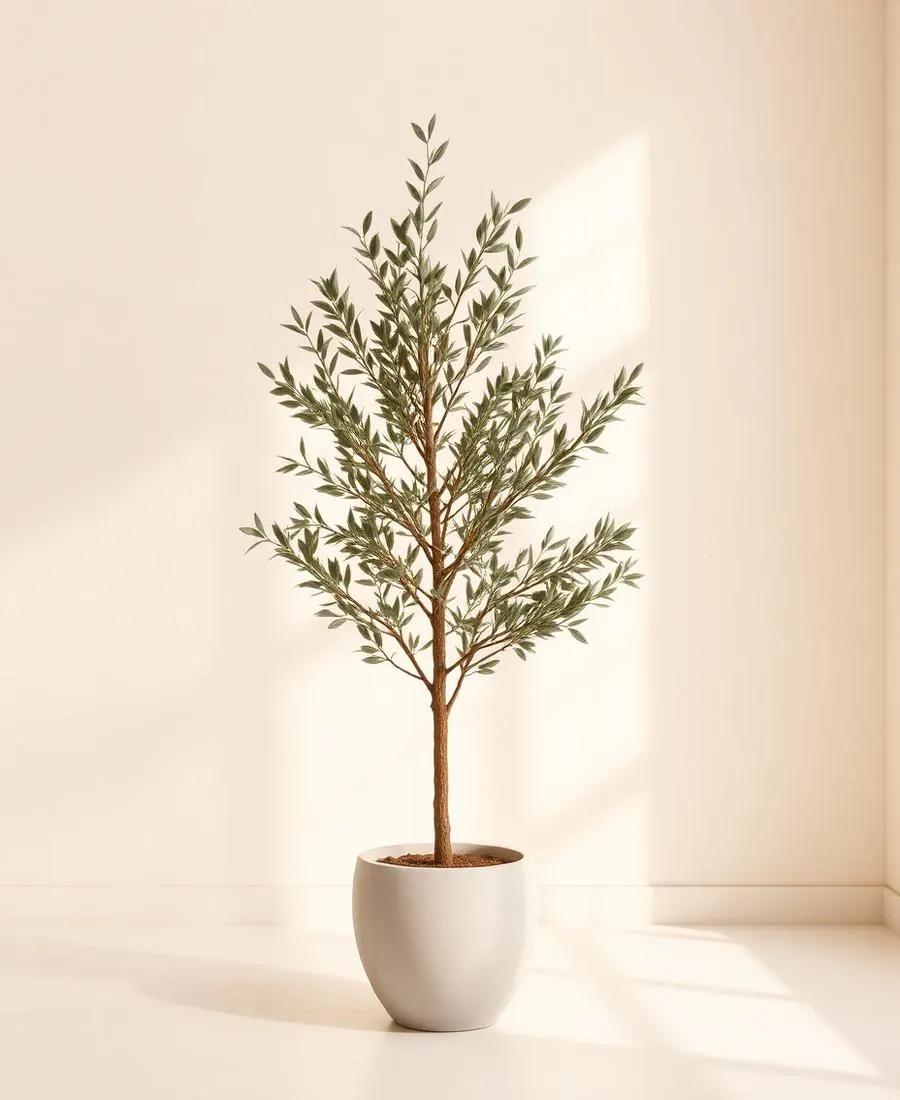
Nearly Natural's faux olive tree collection alone showed at least 14 distinct models on first load when checked 28 August 2026, with a "Load More" control indicating more beyond that. Its price floor is low: a 3 ft olive tree with a natural trunk was on sale for $27.99 USD (regular $49.99), and an 8 ft tree was $251.99 USD, both checked 28 August 2026. That floor is below anything in Eververda's range, where every piece carries a documented specification table, free tracked US shipping for residential pieces and a 30 day return. Nearly Natural also runs branded storefronts on Wayfair, Walmart and Amazon (checked 28 August 2026), putting the same designs in front of shoppers already browsing those marketplaces.
The gaps are worth stating too. Product pages describe trees as "crafted from high-quality materials" without naming a fabric or plastic, so foliage cannot be compared against a competitor's spec sheet. Its shipping page says: "We ship to the 48 contiguous United States. At the moment, we do not ship to P.O Boxes," with returns valid only "for orders shipped within continental USA and purchased directly from nearlynatural.com" (checked 28 August 2026): a 30-day window, geographically narrow.
Which retailer suits a design-led buyer who wants published materials?
Afloral's listings publish an exact composition: a 47.25 in potted olive tree at $148.00 USD is broken down as "60% polyester, 25% plastic, 10% wire, 5% plaster of paris" (checked 29 August 2026), more disclosure than most competitors offer. Its return window is 30 days from delivery, with "Shipping & Handling charges will not be refunded" and "Return labels can only be provided for Continental US orders at this time" (checked 29 August 2026): the same continental-US limitation that recurs across this field.
Eververda publishes a per-size leaf and fruit count on its silk olive listings, which no retailer surveyed here publishes at all, and marks anything the manufacturer does not document as Not specified.
Afloral also publishes composition percentages, which Eververda does not.
Crate & Barrel also discloses materials: its Faux Olive Tree in Pot, sold in 5, 7 and 9 ft sizes, is $249.00 USD for the 5 ft version, polyester, plastic, foam and wire foliage in a cement-filled planter (checked 29 August 2026). West Elm and Pottery Barn sit in the same bracket on price but disclose less: West Elm's 5 ft Faux Potted Olive Tree at $229 USD publishes no composition, and Pottery Barn's clearance terracotta olive tree at $88.97 USD (was $179), as displayed 29 August 2026, used generic "high-quality materials" language, with a second olive SKU on the same site showing "No Longer Available". Listings churn faster than specialist catalogues (both checked 29 August 2026).
Which retailer suits a seasonal Christmas-tree buyer?
Balsam Hill is the seasonal specialist, sitting outside the year-round comparison because Christmas trees are a different decision entirely: lit or unlit, needle type, and off-season storage matter more than foliage realism alone. A Balsam Hill Fraser Fir, priced through its Williams-Sonoma listing, runs $1,449 to $3,199 USD across height and lighting options (checked 29 August 2026); balsamhill.com's own page runs on a price configurator that does not expose a static figure to a fetch, so that range is the verifiable one. The band sits well above the year-round trees elsewhere here, which is expected: a premium lit Christmas tree and an unlit accent olive tree are not the same purchase.
Which retailer suits a budget or big-box buyer?
Home Depot and Target are the convenience options. Home Depot's DR.Planzen 6 ft olive tree with a white planter was $87.38 USD (was $103.98), silk leaves on flexible metal wire over a cement-filled plastic base. That listing was gone on a re-check of homedepot.com on 12 October 2026, when the cheapest DR.Planzen olive was about $47.99 USD for a 5 ft tree and the next cheapest was $51.27, approximate because Home Depot states that local store prices may vary from those displayed. Target's 90 in olive tree, part of its Threshold line with Studio McGee, was $250.00 USD, polyester, 93 in by 32 in by 30 in (both checked 29 August 2026). Neither publishes a leaf count or material percentage the way Afloral does.
Eververda's listings carry a specification table on every product, and a per-size leaf and fruit count on its silk olives, which neither big-box retailer publishes.
Amazon and Wayfair are the marketplace options. Wayfair's Rustic Reach Large Artificial Olive Tree at 94.5 in was $568.87 USD (was $604.13), the highest verified year-round price found (checked 29 August 2026). Amazon lists dozens of third-party olive-tree sellers (brands such as Bellacat, TDIAOL and Kazeila turned up for 6 ft models), but this survey could not verify a price at source; pages returned a robots.txt block on every fetch, checked 29 August 2026. That is not a claim Amazon prices are bad, only unconfirmed here; on a marketplace where materials and returns vary by seller, the listing matters more than the platform.
Where do trade and commercial suppliers fit in?
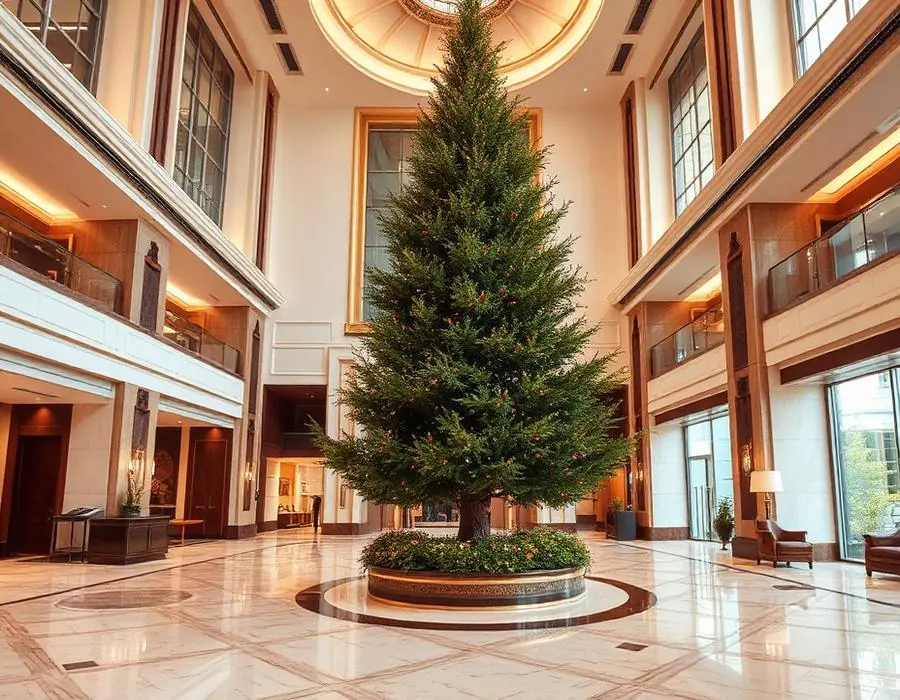
For a building-scale installation (a hotel lobby, an airport concourse, an office atrium), Eververda quotes commercial-scale pieces with freight, crating, lead time and site access planned per order, and trade suppliers also work in this category. Commercial Silk, checked 29 August 2026, describes itself as designing and manufacturing "plants, trees, and integrated greenery" for architectural and hospitality spaces, listing clients including the Ritz-Carlton, Four Seasons, Waldorf Astoria, Universal Studios and LaGuardia Airport, and sells through a request-a-catalogue, direct-contact model. New Growth Designs, also checked 29 August 2026, says: "We sell exclusively to the trade. To access pricing and place orders, please apply for a wholesale account," pairing that with an Enduraleaf line of UV-resistant outdoor foliage carrying a published 5-year warranty and a drop-ship option. Neither publishes retail prices, and neither compares to a $250 accent tree: the products and the buyer are different.
What should a US buyer compare across any of these sources?
Whichever route fits, run the same checks before paying:
| Criterion | What this survey found, when checked 29 August 2026 |
|---|---|
| Materials as published | Afloral (60% polyester, 25% plastic, 10% wire, 5% plaster of paris); Crate & Barrel and Home Depot name a material; Nearly Natural, West Elm, Pottery Barn use generic language; Eververda publishes the manufacturer's foliage material and trunk construction per listing and marks anything undocumented Not specified rather than filling it in |
| Leaf/fruit counts | Not published on any retailer listing checked here: a stronger fullness signal than photos, which can be styled denser than what ships. Eververda publishes a per-size leaf and fruit count on its silk olive listings |
| Trunk construction | Home Depot and Crate & Barrel note wire branch construction; most others do not specify natural versus moulded |
| Base weight | Home Depot, Crate & Barrel and Pottery Barn confirm a cement- or sand-filled base, needed above 5 ft |
| Return window | Nearly Natural and Afloral: 30 days, continental US only; Afloral's shipping cost is non-refundable. Eververda: 30 days to return and 48 hours to report shipping damage, with repair, replacement or refund at its cost on anything damaged, defective or incorrect |
| Freight on large trees | Not specified per listing here; assume freight rather than parcel above roughly 7 ft. Eververda's residential pieces ship free and tracked to US addresses at any order value, in 2 to 10 business days, with installation-scale pieces quoted individually |
For what PE, PVC and silk actually mean, see our materials guide; for what separates a convincing tree from an obviously fake one beyond the spec sheet, see what makes an artificial tree look real.
Where does a Canadian specialist fit for a US buyer?
What differs from most retailers surveyed here is that the spec sits on the listing itself: foliage material, trunk construction and, where relevant, leaf or fruit counts, rather than "high-quality materials" as a catch-all. Where a spec is undocumented, we say so rather than guessing. This is our own section, labelled as such: Eververda sells the products described here. Eververda is a Canadian retailer; US visitors now see pricing in USD at checkout, and that checkout figure is the live number, not a hand conversion. It is not restated here as a CAD price wearing a USD label. What can be described accurately is our range by tier. Our residential olive line runs from an entry tier around $229 to $289 CAD for a 4 to 6 ft PE-foliage tree with stainless-steel branches, up through mid-tier silk-foliage versions with counted leaves and fruit, to statement pieces like a 9.8 to 18 ft glass-fiber coconut palm built for commercial use at $2,787.99 to $6,291.99 CAD. For an installation-scale tree, our 15 ft UV-protected fiberglass olive tree is quote-priced rather than fixed, the same way the trade suppliers above work.
Residential pieces ship free to US addresses with tracking, priced in USD at checkout, and delivery typically takes 2 to 10 business days from order. For the largest end of our range, see giant artificial trees; for the Nearly Natural comparison from the Canadian side, including a third specialist named Artiplanto, see Nearly Natural vs Artiplanto, not repeated here.
Frequently asked questions
What is the most affordable alternative to Nearly Natural?
Home Depot's DR.Planzen 6 ft artificial olive tree at $87.38 USD and Pottery Barn's clearance terracotta olive tree at $88.97 USD were the lowest verified prices in this survey, both checked 29 August 2026. On a re-check of homedepot.com on 12 October 2026 that listing was gone: the cheapest DR.Planzen olive was about $47.99 for a 5 ft tree, with the next cheapest at $51.27. Home Depot states that local store prices may vary from those displayed, and the read was served a Niagara Falls store context, so treat those figures as approximate and dated rather than fixed national prices. Pottery Barn's listing used generic "high-quality materials" language, while Home Depot's named silk leaves on flexible metal wire; neither published a full composition breakdown the way Afloral does, which is worth weighing against the lower price.
Eververda's listings carry a specification table on every product, and where a value was never documented it reads "Not specified" rather than being guessed.
Where should a business buy a large-scale artificial tree for a lobby or storefront?
Eververda quotes commercial-scale pieces with freight, crating, lead time and site access planned per order. Trade and commercial suppliers also serve this category: Commercial Silk and New Growth Designs, both checked 29 August 2026, sell to hospitality, architecture and design clients through direct contact or a wholesale account rather than a public price list, and neither is a retail comparison point against a $250 accent tree.
Does Eververda ship to the United States, and in what currency?
Yes. Residential pieces ship free to addresses in the United States, priced in USD at checkout, with tracking on every order and delivery typically in 2 to 10 business days from order. Commercial pieces are quoted individually.
Is Balsam Hill worth comparing against a year-round artificial tree retailer?
Only for a seasonal purchase. Balsam Hill's Fraser Fir runs $1,449 to $3,199 USD depending on height and lighting, checked 29 August 2026 via its Williams-Sonoma listing, which is a premium-Christmas-tree price band, not a like-for-like comparison with an unlit year-round accent tree from the other retailers in this piece.
Nearly Natural facts were checked 28 August 2026 at nearlynatural.com. Afloral, Balsam Hill, Pottery Barn, West Elm, Crate & Barrel, Target, Home Depot, Wayfair, Amazon, Commercial Silk and New Growth Designs were checked 29 August 2026 at each site (Amazon blocked automated access). Eververda prices referenced are CAD, current as of 24 October 2026; USD pricing for US visitors is the figure shown at checkout, not restated here.
Products in this article
- Army Green Artificial Coconut Palm Tree 9.8 ft Glass Fiber$2,787.99 CAD to $6,291.99 CAD
- 15 ft Fiberglass Olive Tree UV Protected Hotel Lobby$6,990.99 CAD