
How to Make Artificial Plants Look Real: What Actually Works
29 August 2026
Eververda sells artificial trees, so read this knowing that. It is the advice we give our customers, because how convincing an artificial plant looks is mostly decided after the box arrives. What separates a well-made tree from a cheap one is covered in our honest answer on whether artificial plants are tacky, and the specifications to check before buying are in what makes an artificial tree look real. This is the third step: the box is on your floor, and the next hour decides how the tree reads.
Why does an artificial tree look fake straight out of the box?
Because it was packed to survive a courier, not to look like a tree. Every artificial tree ships compressed: branches folded against the trunk, leaves pressed together in a plastic sleeve. Stood up in that state it looks like a closed umbrella, and plenty of people stop there and decide the tree was a disappointment. Nothing is wrong with it; it has not been opened yet, in the real sense. The fix costs nothing and takes about twenty minutes.
How do you shape artificial branches so they look real?
The stems of a decent artificial tree are wired, and the wire is there for you. Wired branches exist to be bent, and a tree that has never been bent still looks like the diagram of a tree rather than the tree itself.
Work outward from the trunk. Bend each main branch down and away, fan the sub-branches so no two sit at the same angle, then separate leaves so none lie flat against a neighbour. The step most people miss is depth: push some branches toward the room and some back, so the canopy occupies three dimensions instead of one plane. Resist the urge to make it tidy. Real trees are not symmetrical, and asymmetry is precisely what reads as alive. If the finished tree looks slightly uneven, you have done it right.
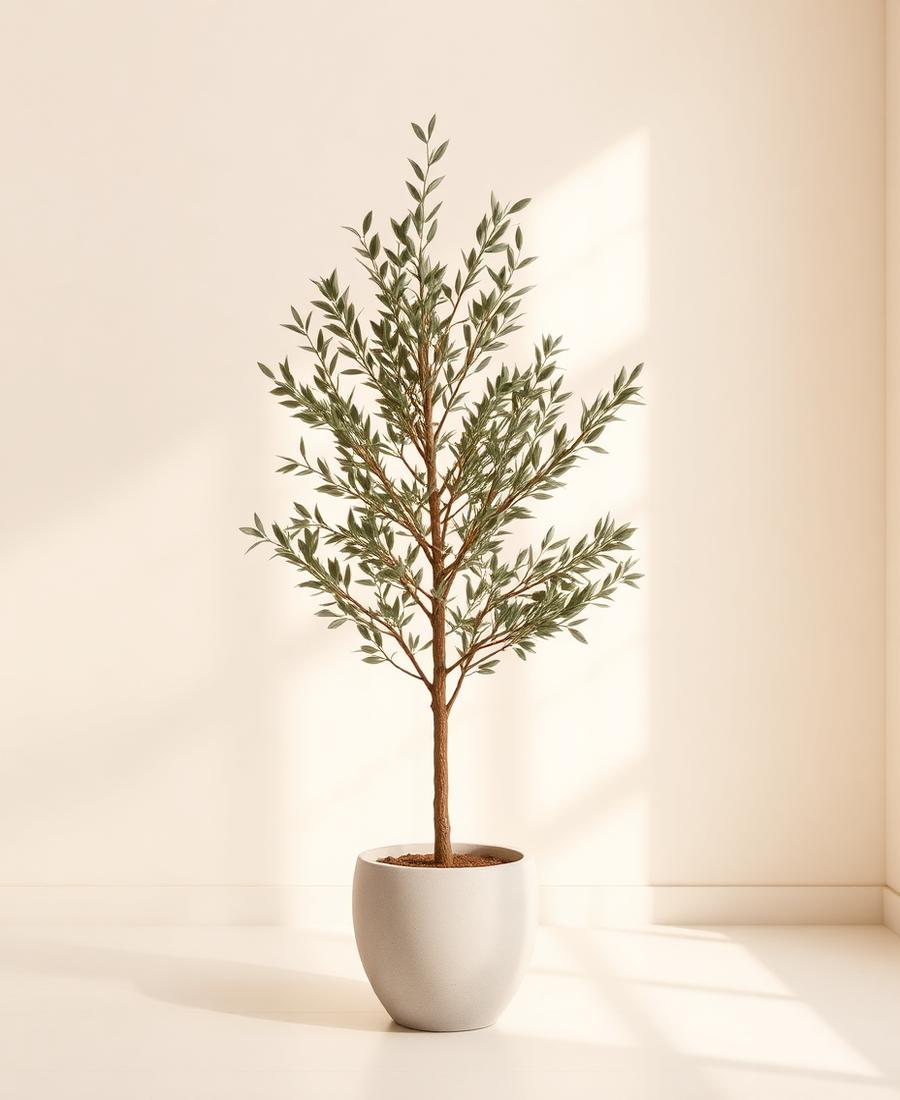
Branch construction decides how well the shape holds. Stems with a firm metal core keep the position you set instead of drifting back; our 4 to 6 ft olive with stainless-steel branches is built exactly for this and runs $199 to $329 CAD. Once set, it stays set.
Should you put an artificial plant in a different pot?
Almost always, yes. Most artificial trees ship in a black plastic nursery pot, the cheapest component on the product. You do not repot anything. You drop the entire nursery pot, tree and all, inside a real planter: ceramic, concrete, terracotta or a woven basket. The nursery pot disappears and the object stops looking like it arrived in a box.
Check the nursery pot's diameter against the planter opening before buying, and choose a depth that leaves the inner rim slightly below the outer one. If you would rather skip the swap, buy a tree that ships finished: the 4 to 7 ft fiddle leaf fig in a white planter comes with a weighted base and runs $219 to $399 CAD, ready to stand where it lands.
What should you cover the base with?
Whatever pot you use, the top surface is the giveaway zone. A visible plastic base plate undoes the work the foliage does above it. Top the planter with a loose natural material: preserved moss is the standard choice, bark suits trees, smooth stones suit anything architectural. Lay it loosely and a little unevenly; real soil surfaces are not uniform either. A few dollars of material, and it finishes the object.
Where should you put an artificial plant in a room?
Where a real plant would plausibly live. The eye runs a quiet plausibility check on every plant, and a tree thriving with no light source in sight fails it even when the foliage is excellent. Near a window is the believable default, with one caution from our own published guidance: keep it out of harsh all-day direct sun, because sunlight slowly costs any artificial foliage its colour. A bright spot beside the window serves both believability and longevity.
The other placement trick is company. An artificial tree standing beside real plants borrows their credibility, because the textures mix and nobody audits one plant in a group. Use the artificial tree where a living one could not survive, and let real plants fill the bright spots.
How do you style artificial plants together?
Group in odd numbers and vary the heights. A matched pair reads as staging; three plants at three heights read as a collection that accumulated naturally. Set the tallest at the back and vary the planters rather than matching them. Keep the grouping to one zone: one deliberate cluster and one large standalone tree do more than six scattered pots, and they are easier to keep dusted, the one recurring job artificial plants have. A soft cloth over the leaves every few weeks keeps them light-catching.
How do you get shipping creases out of artificial leaves?
Silk foliage comes out of its sleeve with fold lines pressed into the leaves, and leaving them there is the most common styling mistake: a creased leaf catches light along the fold and flags itself as fabric. The fix is gentle heat and patience: a garment steamer passed near the foliage relaxes the fabric so leaves can be smoothed by hand, and letting the tree stand for a day or two in a warm room softens most creasing on its own. Start with the branches at eye level, since those are the ones people see. Fabric foliage rewards this most: the 5.25 to 8 ft silk olive, which lists its leaves and fruit as counted numbers and runs $249 to $449 CAD, arrives with canopy density in place, so relaxing and shaping the foliage is the only work left.
What does the first hour look like, in order?
| Fresh out of the box | The ten-minute fix |
|---|---|
| Branches folded flat, canopy like a closed umbrella | Bend main branches down and out, fan sub-branches, push some forward and some back |
| Canopy perfectly symmetrical | Make it deliberately uneven; asymmetry reads as alive |
| Black plastic nursery pot on show | Drop the whole nursery pot into a ceramic, concrete or woven planter, rim slightly below the planter's rim |
| Plastic base plate visible in the pot | Top with preserved moss, bark or stones, laid loosely |
| Fold lines pressed into silk leaves | Steam gently or let the tree stand in a warm room, then smooth leaves by hand |
| Standing wherever there was floor space | Move to believable light near a window, out of harsh all-day sun, ideally beside real plants |
Frequently asked questions
Can you bend the branches on an artificial tree without breaking them?
Yes. The stems of a decent artificial tree are wired specifically so they can be bent and re-bent, and handling them firmly is the point of the design. Work outward from the trunk, main branches first. Branches with a firm metal core, such as stainless steel, hold the position you set rather than drifting back.
Do artificial plants need to be repotted?
No, not in the gardening sense. The whole nursery pot goes inside a real planter, tree and all, with nothing removed. Choose a planter whose opening fits the nursery pot's diameter and whose depth leaves the inner rim slightly below the outer one, then cover the top with moss, bark or stones so no plastic shows.
What do you put on top of the soil of a fake plant?
A loose natural topping that hides the plastic base plate. Preserved moss is the standard finish, bark suits trees, and smooth stones suit anything architectural. Lay it unevenly rather than flat, because real soil surfaces are not uniform and the eye notices. It costs a few dollars and finishes the object.
How long does it take to make an artificial tree look realistic?
About twenty minutes of shaping, plus the pot swap and base topping, so budget an hour for the whole job on a large tree. None of it needs skill. Shaping the branches out of their shipped symmetry changes the object most, and skipping it is the most common reason a well-made tree disappoints.
Why do fake plant leaves look creased or too flat?
Shipping. Silk foliage travels pressed inside a plastic sleeve and comes out with fold lines that catch the light and read as fabric. Gentle heat relaxes them: pass a garment steamer near the leaves, or let the tree stand in a warm room for a day or two, then smooth the leaves by hand, starting at eye level.
For what separates a good artificial tree from a cheap one in the first place, read are artificial plants tacky; for the specifications to check before you order, read what makes an artificial tree look real. Get those right, and this hour is all that stands between the box and a tree people have to touch to doubt.
Eververda prices are CAD and current as of 29 August 2026.