
Artificial Christmas Trees: Outdoor Use, Materials, Assembly and Storage
12 October 2026
Most artificial Christmas tree advice is a list of brands. That is the least useful form the answer can take, because the same maker sells a dense tree and a thin one, and the specifications that decide realism, outdoor safety and assembly time are printed on the box rather than attached to the badge. Here is what each of those specifications actually does.
Can an artificial Christmas tree be used outside?
Only if three separate things are rated for it, and the one that catches people out is the lights rather than the tree.
The lights are an electrical question, not a durability one. A pre-lit tree sold for indoor use almost always carries a light string rated indoor-only. Running one outdoors, where rain or snow can reach the connectors, is a shock and fire risk rather than simply a shorter life. If a tree is going outside, the lights on it have to be rated for outdoor or wet locations and fed from a protected outdoor circuit. An unlit tree with separately bought outdoor-rated lights is the safer build, and often the cheaper one.
The frame decides whether it survives wind. A cone is a large sail on a small footprint. A folding tripod stand is designed for a carpet, not for a gust. Trees built for outdoor use sit on a weighted or staked base, or on an iron frame that can be anchored. If a tree cannot be physically fixed down, it will not stay up through a winter storm no matter what the foliage is rated for.
Cold makes PVC brittle. Cut-strip PVC needles stiffen and crack in freezing temperatures, especially where they are crimped onto the wire. PE moulded tips handle cold better. This is why a tree that lives outdoors through a real winter should be PE on every visible branch, not PE tips over a PVC interior.
Lifespan outdoors is covered properly in how long artificial plants last, and the general outdoor question in can you put artificial trees outside.
What is the most realistic artificial Christmas tree material?
Moulded polyethylene, usually written PE, on every branch you can see. The reason is how each material is made.
PE is injected into a mould taken from a real branch, so a needle cluster comes out as one solid three-dimensional piece with real depth and a rounded edge. PVC is pressed into thin sheets, cut into narrow strips and twisted onto wire, so a PVC needle is flat, uniform and bright in a way no real conifer needle is.
The detail that matters, and that most listings bury: almost every mid-range tree is both. Makers put PE on the outer tips where your eye lands and fill the interior with cheaper PVC. That is a legitimate way to build to a price, and it looks fine. What you are comparing between two trees at the same height is the proportion, so look for a published PE percentage or PE tip count, and treat a tree that only says "mixed needle" as mostly PVC.
Two further realism markers. Needle length should vary within the tree, because a real conifer carries different growth at the leader than at the lower skirt. And the green should not be one green: better trees mould two or three shades and mix them, which is the same principle that separates a convincing artificial plant from a flat one, covered in which fake plant looks most real.
What does the tip count or T number mean?
Tip count is the number of individual needle clusters on the tree, and it is the single clearest density figure in the category. A 7.5 ft tree might carry anywhere from roughly 1,000 tips to over 3,000, and the difference is immediately visible: a low tip count shows the pole and the wire through the middle, and no amount of branch arranging fills it, because the material is simply not there.
Tip count is only comparable between trees of the same height and the same profile. A slim or pencil tree will always carry fewer tips than a full tree of the same height, and that is correct rather than a defect. Compare like with like, and treat a seller that publishes a tip count at all as a good sign, because thin trees rarely advertise the number.
What is the easiest artificial Christmas tree to assemble?
A hinged tree in three sections. The hinge mechanism, not the brand, is what decides whether setup takes fifteen minutes or an hour.
Hinged branches arrive permanently attached to the centre pole and folded upward. You drop each section onto the one below and swing the branches down. Nothing to sort, nothing to lose.
Hook-on branches arrive as a pile of loose branches, usually colour-coded by row, that you insert one at a time into rings on the pole. On a 9 ft tree that is several hundred individual insertions, and any branch that goes missing between seasons leaves a visible hole.
Two more things that cut setup time: sections that connect their own lights through the pole, so there is no string to thread, and a stand that bolts rather than clamps. Budget around twenty minutes of shaping afterwards whatever you buy, because every tree ships compressed and looks thin until the branches are opened out and given varied angles.
What should you look for in a pre-lit tree?
Three things, none of which is the bulb count.
Whether one dead bulb takes out a run. Older series-wired strings go dark in whole sections when a single bulb fails. Strings where each bulb is independently wired keep working around a failure, which on a tree you cannot rewire is the difference between a repair and a replacement.
Whether the sections plug into each other rather than running one continuous string the length of the tree. Sectional wiring means a fault is contained to one third of the tree.
The warranty on the lights specifically. It is routinely shorter than the warranty on the tree, often by years, and on a pre-lit tree the lights are the part that fails first. A tree with a ten-year frame warranty and a two-year light warranty is telling you exactly what its maker expects to happen.
This is also the honest case for buying unlit. An unlit tree plus your own lights costs less, lets you choose colour temperature, and makes a light failure a ten-minute fix instead of the end of the tree.
What is the best way to store an artificial Christmas tree?
Compression and heat are what damage it, in that order. Neither is obvious at the time.
Do not crush the tips. Fold branches upward toward the pole rather than pressing them flat, and store the tree in a bag or box sized for it. A tree forced into a smaller box than it came in creases the tips permanently, and creased PE does not spring back after a year under pressure.
Choose a cold space over a hot one. An unheated garage or basement is better than an attic. Cold does not harm the materials in storage, while repeated summer heat in a roof space softens and distorts plastic needles and degrades light insulation.
Coil the lights loosely on a pre-lit tree and avoid tight bends at the connectors, which is where strings break.
Label the sections as they come apart, and photograph the assembled tree before you dismantle it. Next December the photograph is worth more than the instructions you no longer have.
What we carry
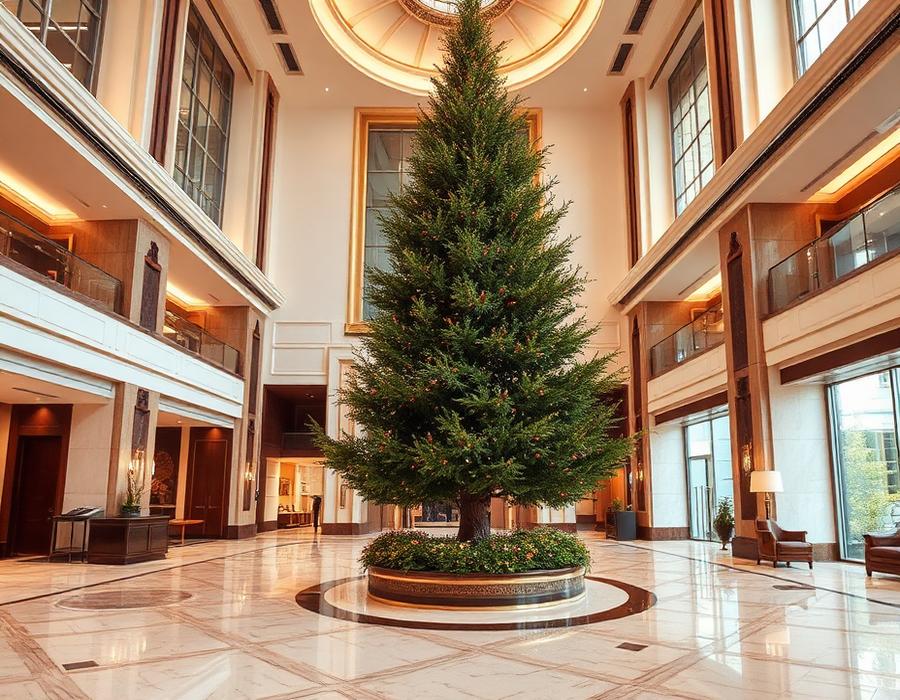
Our Christmas range is built for commercial installations: hotel lobbies, malls, restaurants and offices, in sizes from 3 ft up to 49 ft, including pre-lit, unlit, snow-flocked and rotating-stand builds. Those are quoted rather than sold off the shelf, because specification, delivery window and install access all change the price.
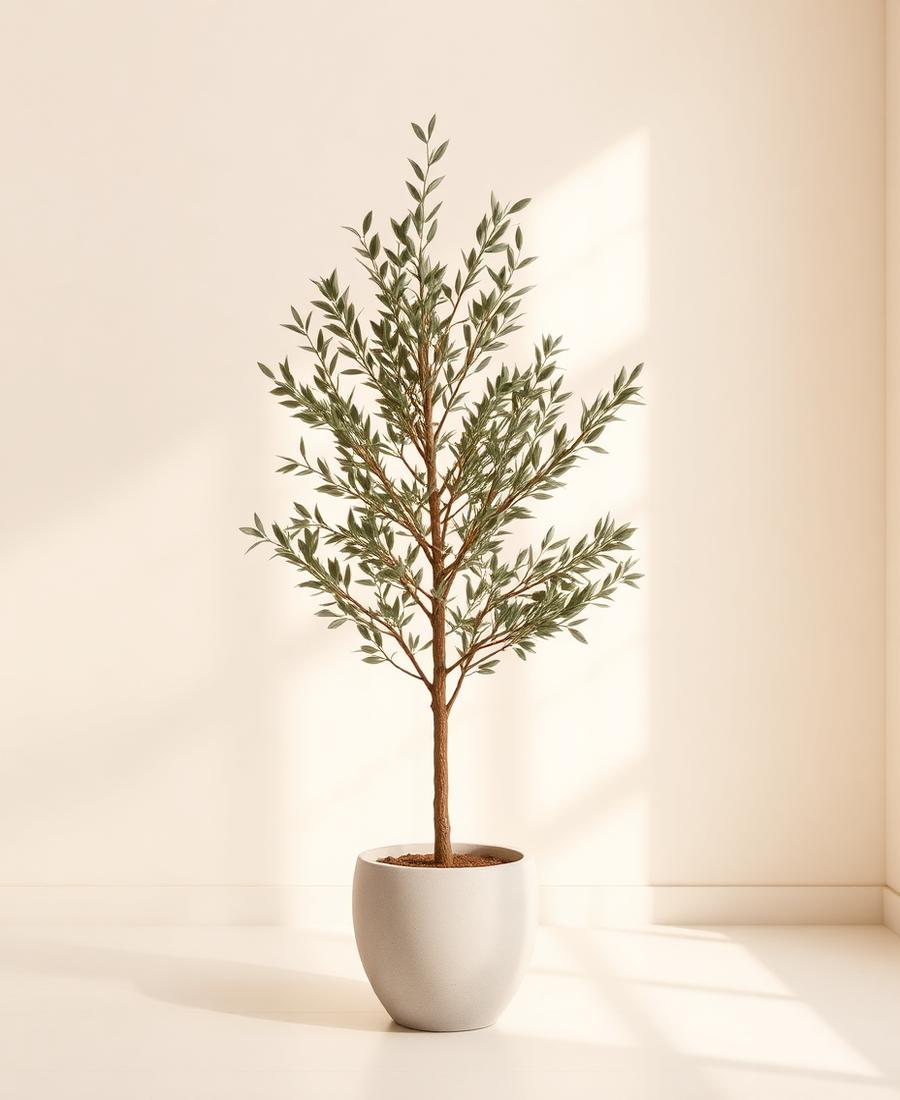
For a domestic piece that does the same job year-round, a Norfolk pine is the honest alternative: it reads as a conifer, it is not seasonal, and it does not need storing in January. Our 5 ft real-touch Norfolk pine is $389 CAD, and the 4 ft pair in a black or white planter is $304.99 to $309.99 CAD.
Frequently asked questions
Can you put an artificial Christmas tree outside?
Only with outdoor-rated lights on a protected circuit, a base that can be weighted or anchored, and PE rather than PVC foliage. The lights are the limiting factor: an indoor-rated string exposed to rain or snow is an electrical hazard, not merely a short-lived one.
Is PE or PVC better for an artificial Christmas tree?
PE, on any branch you can see. PE is moulded from a real branch so needles are three-dimensional, while PVC is cut from thin sheet and reads flat and uniform. Most trees use both, with PE on the outer tips and PVC filling the interior, so compare the PE proportion rather than treating it as one or the other.
What is a good tip count for a 7.5 ft tree?
Higher is denser, and the figure only compares between trees of the same height and profile. A low tip count shows the pole and wire through the middle of the tree, and shaping cannot fix it because the material is not there. A seller publishing a tip count at all is a reasonable signal, since sparse trees rarely advertise one.
Are pre-lit Christmas trees worth it?
They save setup time and cost more, and the lights usually carry a shorter warranty than the tree. If you buy pre-lit, look for independently wired bulbs and sections that plug into each other, so a single failure does not darken a third of the tree. Unlit plus your own lights is cheaper and far easier to repair.
How do you store an artificial Christmas tree so it lasts?
Fold the branches up toward the pole rather than flattening them, use a bag or box sized for the tree, and keep it somewhere cold and dry rather than in a hot attic. Coil pre-lit strings loosely, avoid sharp bends at connectors, label the sections, and photograph the assembled tree before taking it apart.
Eververda prices are CAD and current as of 12 October 2026.