
Are Artificial Plants Sustainable? An Honest Look at the Trade-offs
29 August 2026
Are artificial plants sustainable? The honest answer
Eververda sells artificial plants, so read what follows with that in mind. The honest answer: they are not an environmentally free choice, and not automatically greener than real plants either. They are made from fossil-derived plastics, they do nothing for a room while they sit in it, and at end of life almost all of them go to landfill. Whether owning one is defensible comes down to two things: how long you keep it, and what it replaces. A well-made tree kept a decade instead of several live plants bought and discarded over the same period displaces real, repeated inputs: watering, fertiliser, pesticide, peat-based media, heated greenhouse production, shipping. A cheap piece binned after two years because it looked tired does none of that; it is just plastic in the ground. There is no single correct answer here, only a more or less honest one.
What are artificial plants actually made from?
Foliage is usually polyethylene (PE) or a PE/PVC blend for leaves that need a soft drape, with polyester used for fabric leaves and flowers on cheaper lines. Stems and trunk armatures are typically steel wire wrapped in plastic or paper tape; pots and weighted bases are often PET, resin, or cement. All of that plastic content is fossil-derived and none of it is biodegradable. Eververda does not claim any of its products are recyclable, biodegradable, or eco-certified, because that would not be true of a mixed-material assembly like this.
Can artificial plants be recycled in Canadian curbside programmes?
In practice, no. We could not find a Canadian municipal programme that names artificial or silk plants specifically, so we are not claiming one exists. What we can verify is the general principle. Recycle BC's published materials list (checked 29 August 2026) accepts plastic bottles, tubs, and plant pots, but excludes items that are not packaging and mixed-material goods, its own example being a plastic bag with a cloth or rope handle, rejected unless removed first. Toronto's blue bin guidance (checked 29 August 2026) similarly excludes non-packaging plastics such as toys, hangers, and binders, and directs residents to its Waste Wizard tool rather than assuming a recycling symbol settles it. A steel-wire, PE-foliage assembly wired into a resin or cement base is exactly the mixed-material item these programmes are not built to sort. The realistic route is household garbage, then landfill, consistent with the wider picture: a 2019 Deloitte report for Environment and Climate Change Canada found Canada recycled just 9 percent of the plastic it generated in 2016, the rest landfilled, incinerated, or littered (checked 29 August 2026).
Do artificial plants do anything positive while they're in use?
No. An artificial plant does not sequester carbon, support pollinators, or measurably improve indoor air quality, because it is not a living organism carrying out photosynthesis or metabolic processes. Worth stating plainly.
Worth being honest, too, that the air-quality claim is weaker for real houseplants than most people assume. The widely cited 1989 NASA Clean Air Study measured VOC removal in small, sealed test chambers. A 2019 review by Bryan Cummings and Michael Waring at Drexel University, published in Nature's Journal of Exposure Science and Environmental Epidemiology (checked 29 August 2026), found that under normal room ventilation you would need roughly 100 to 1,000 houseplants per square metre to match what an open window or a building's air system already does. That does not make artificial better on this point, it makes the argument roughly a wash either way, and one we would rather drop than overstate.
Is there an honest case for artificial plants?
Yes, but a bounded one. A single artificial tree, kept, replaces a live plant that gets replaced repeatedly. Our worked cost comparison for olive trees lays out that cycle in dollar terms; our lifespan guide covers how long different constructions last by material, typically 8 to 15 years indoors out of direct sun for a decent PE or silk piece kept clean. Every time a live plant dies and is replaced, someone grows a new one: irrigation, fertiliser, pesticide where used, peat-based media, often a heated greenhouse and cold-chain shipping to reach the store. As one illustration of scale, not a Canadian figure, the UK's Wildlife Trusts reported (checked 29 August 2026) that peat dug for horticultural use in 2020 released up to 880,000 tonnes of CO2, disturbed peatland releasing carbon accumulated over centuries. We could not verify a comparable Canadian figure, so this is context for the general point, not a Canadian statistic.
None of this makes artificial greener overall. A live plant grown locally, in season, in soil rather than peat, kept alive for years, is genuinely low-impact. One flown in, grown under heat through a Canadian winter, and replaced annually because it did not survive a low-light room is not. An artificial plant kept a decade is a reasonable trade against the second scenario; one kept two years and binned because a trend passed is a trade against nothing, just added plastic waste.
| Consideration | Artificial plant, kept 10+ years | Live plant, replaced periodically |
|---|---|---|
| Material origin | Fossil-derived plastics (PE, PVC, PET, polyester), steel wire | Grown in soil or peat-based media, sometimes under heat |
| Ongoing inputs while owned | None: no water, fertiliser, or pesticide | Water, sometimes fertiliser and pesticide, over its life |
| Carbon sequestration or pollinator support | None | Present while alive; ends when the plant dies and is discarded |
| End of life, Canadian household stream | Not accepted curbside as a mixed-material item; landfill | Compostable through green bin or yard waste programmes where available |
| Repeat impact if replaced often | Low: one purchase can last a decade or more | Repeats fully each time: growing, shipping, disposal again |
If you do buy artificial, what actually lowers the impact?
The only lever that matters is how long the piece stays useful and out of landfill.
Buy once and buy well. Counted, layered foliage and a proper steel or wood-core armature hold shape and colour far longer than a thin, flat-moulded budget line, the difference between a decade of use and two years before it looks tired enough to bin.
Keep it, do not chase trends. The environmental cost is paid up front, at manufacture. A piece kept ten years amortises that cost across a decade; one replaced after eighteen months because the style moved on roughly doubles the plastic footprint for the same use, for nothing gained.
Clean rather than replace. Dust and fading kill usefulness before the materials fail. Our cleaning guide covers method by material; a plant dusted or rinsed on a normal schedule and kept out of direct sun outlasts one that is not, by years.
Choose repairable, reshapeable construction. Individually wired branches can be reshaped as a room changes, and a broken stem on a wired piece can sometimes be re-set; a glued or moulded piece generally cannot.
Pass it on rather than binning it. A plant that still looks presentable but no longer fits your space has value to someone else, a buy-nothing group, a secondhand marketplace, an office refresh, before it has any business in landfill. That does not make it recyclable, but it extends what matters: years of use per unit of plastic made.
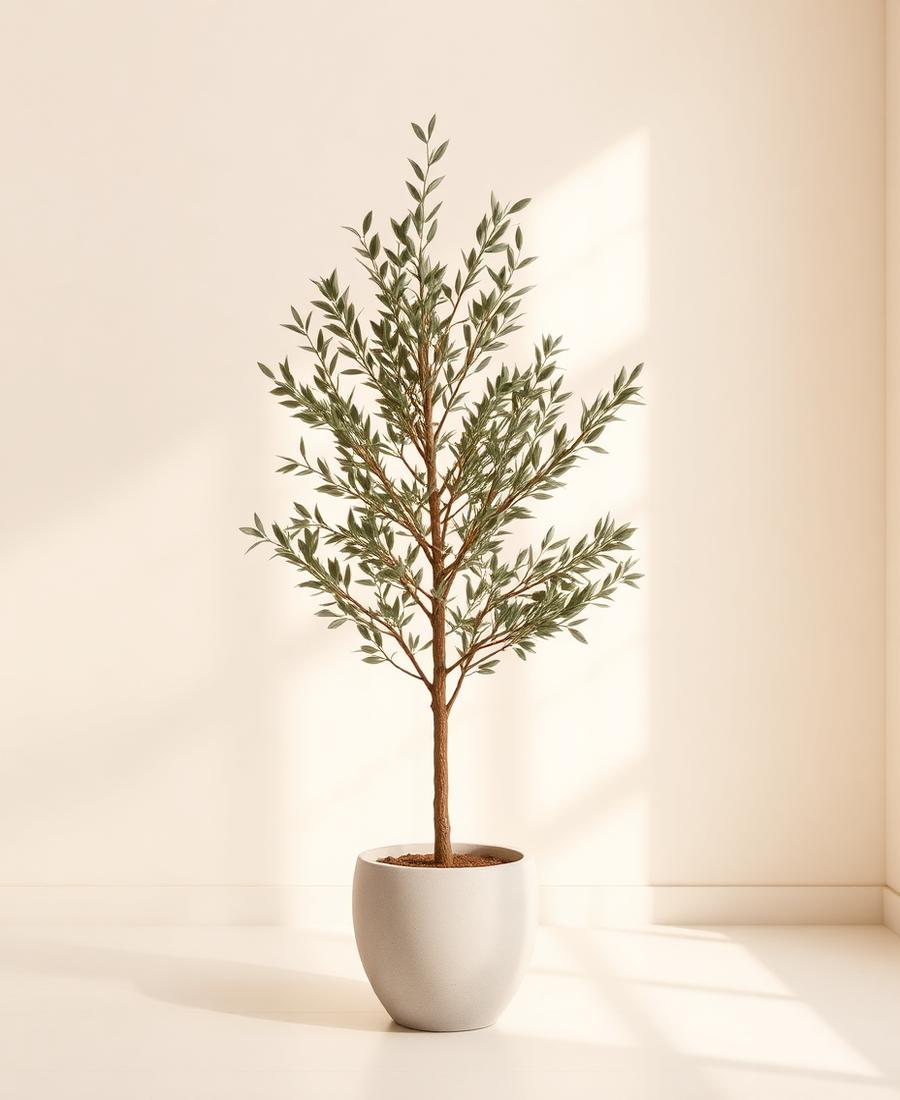
A 5.25 to 7 ft olive tree with a natural wood trunk, $249 to $419 CAD, or a 4 to 7 ft fiddle leaf fig with a weighted planter base, $219 to $399 CAD, are the kind of construction this points to: a real wood or steel core built to be reshaped and sit stable for years, not a light line built for one season. A taller golden cane palm, 4.5 to 9 ft, from $289 to $869 CAD, follows the same logic at larger scale. None are claimed as recyclable or eco-certified; the argument is durability, not a lifecycle number we cannot support.
When is a real plant the better answer?
Honestly, often. In a bright room with reasonable light, an easy species (pothos, snake plant, ZZ plant, spider plant) thrives with minimal input and gives you what artificial cannot: growth, air exchange, something that responds to care. If you enjoy the work of keeping a plant alive, that is a real reason to choose live, and no plastics argument should talk you out of it. Outdoors, in a garden or on a balcony, a living plant does something structurally impossible for an artificial one: it grows, seeds, supports insects, and returns organic matter to soil when it dies. If your space and habits suit a real plant, get a real plant. Artificial makes the most sense where light is poor, schedule makes reliable care unlikely, or a space needs to look consistent year-round, and where the piece will actually be kept for years, not replaced on a whim.
Frequently asked questions
Are artificial plants bad for the environment?
They carry a real cost: fossil-derived plastic, no recycling route in Canadian curbside programmes, and landfill disposal at end of life. Whether that cost outweighs the alternative depends on how long the piece is kept and what it replaces. A cheap piece replaced every year or two is a net negative; a well-made piece kept a decade against repeated live-plant replacement is a more defensible trade.
Can you put artificial plants in the recycling bin in Canada?
Generally no. We could not find a Canadian municipal programme naming artificial plants specifically, but Recycle BC and Toronto's blue bin guidance both exclude mixed-material, non-packaging goods, which is what an artificial plant is. The realistic disposal route is household garbage.
Do artificial plants improve air quality?
No. Nor do real plants, meaningfully: a 2019 Drexel University review found you would need roughly 100 to 1,000 houseplants per square metre to rival what open windows or a building's air system already achieve. An artificial plant removes no VOCs and produces no oxygen, since it is not a living organism.
Is a real plant more sustainable than an artificial one?
It depends how it is grown and kept. A real plant grown locally and kept alive for years is genuinely low-impact. One flown in, grown under heat through a Canadian winter, and replaced annually carries real impacts of its own: irrigation, fertiliser, peat-based media, greenhouse energy. Neither option is automatically greener.
How long does an artificial plant need to last to be worth it environmentally?
There is no verified break-even figure, and we are not inventing one. The longer a piece is kept and the more live-plant replacement cycles it displaces, the better the trade looks. Two to three years offsets very little; eight to fifteen years, realistic for a well-made piece kept clean, offsets considerably more.
What should I look for in an artificial plant that will actually last?
Individually wired, reshapeable branches rather than fused or moulded foliage; a steel or wood trunk core rather than a hollow plastic one; counted leaf and stem specifications rather than vague "lush and full" claims; and a weighted base built to stay upright. These are checkable on a listing, and they determine two years of use versus ten.
External facts in this article were checked 29 August 2026. Sources include Recycle BC's published accepted-materials list, the City of Toronto's blue bin guidance, a 2019 Deloitte report prepared for Environment and Climate Change Canada, a 2019 Drexel University review published in Nature's Journal of Exposure Science and Environmental Epidemiology, and Wildlife Trusts reporting on UK peat extraction. Eververda prices are CAD and current as of 28 August 2026.