
Tropical Style Without the Climate: Artificial Palms, Monstera and Bird of Paradise
29 August 2026
Tropical style reads as big, bold, layered foliage: a tall palm for verticality, a broad-leaf monstera or bird of paradise for drama at eye level, a banana plant for scale, all rising out of rattan or natural-fibre pots against warm wood tones. It is also the hardest look to keep alive as real plants in a Canadian home, because every species on that list evolved in humid, frost-free forest and Canadian winter indoor air, dried out by furnaces and forced-air heat, sits nowhere close to what they need. Health Canada's own guidance puts healthy indoor relative humidity at 30 to 50 percent, with practical winter targets sitting in the lower half of that band once the heat is running (guidance summarized by Homeowner.ca, checked 29 August 2026) - well under the 60 to 80 percent range that reference charts give for a plant like monstera (Houseplants Nook humidity chart, checked 29 August 2026). Artificial solves that gap outright: a golden cane palm from 4.5 to 9 ft, sold single or as a pair, runs $289 to $869 CAD, and a full three-piece tropical corner - tall palm, broad-leaf mid-height, floor plant - lands well under $1,000 CAD with no misting schedule and no leaf drop. What follows covers what actually defines the look, how to layer it so it reads as one composition, when to add colour, and how the same species read outdoors and at commercial scale.
What actually defines tropical style?
Four things, in order of how much visual weight they carry. Leaf size and boldness first: tropical foliage is large, glossy and simple in outline compared with the fine, fussy leaves of a Mediterranean olive or a temperate maple, and that scale is what reads as "tropical" from across a room. Height variety second: a real tropical planting is never one uniform canopy, it is palms punching up for verticality, broadleaf species filling the middle, and low foliage at the base. Species choice third - palms for height and movement, monstera deliciosa at 90 to 120 cm, sold single or as a pair, and bird of paradise for the broad, paddle-shaped leaf drama at mid-height, banana plants for sheer scale and the biggest leaf in the room. And container and finish last: rattan or natural-fibre pots, unglazed terracotta, and warm woods carry the look through in the base and the surrounding furniture, where a black lacquer pot or chrome trunk would read as a different, more architectural style entirely.
Dracaena earns a place in the mix too, though it reads less "jungle" and more "sculptural tropical" - narrow, upright, strappy leaves on a bare cane trunk, useful as a vertical accent where a full palm frond spread would not fit. Our palm buying guide covers frond quality and trunk realism in more depth if a palm is the centrepiece of your composition.
Why is tropical the hardest style to keep alive indoors in a Canadian winter?
Every plant on the tropical list - palm, monstera, bird of paradise, banana, dracaena - is native to a humid, frost-free forest floor or understorey, and none of them evolved for a Canadian furnace. Once outdoor winter air is pulled inside and heated, its relative humidity drops sharply even though no moisture was physically removed, which is exactly why Health Canada's 30 to 50 percent indoor target sits toward the low end through the heating season (checked 29 August 2026). Monstera alone wants 60 to 80 percent by the same reference charts used above - roughly double what a heated Canadian living room delivers without a humidifier running constantly. The result for real tropical plants is brown leaf edges, dropped leaflets on palms, and stalled growth from November through March, regardless of how much light the room gets. This is also why our own lifespan guide puts indoor artificial foliage life at a decade or more: the material never notices the humidity swing that stresses the real thing.
How do you layer heights so it reads as a composition, not scattered plants?
The formula real tropical interiors use, and the one worth copying with artificial pieces, is one tall palm, one broad-leaf plant at mid-height, and one lower floor plant, staggered rather than lined up. The palm carries the eye up and gives the corner its silhouette - an areca palm at 4 to 6 ft with 15 to 21 leaves counted by height works well here at $289 to $419 CAD. The mid-height broadleaf piece, a monstera or a dracaena, sits slightly forward and off to one side rather than directly behind the palm, so each plant's silhouette stays readable against the wall instead of merging into one green blob. A large dracaena marginata, from $686.99 CAD, fills that role with a narrower footprint than a monstera where floor space is tight. The floor piece anchors the base and should have the widest leaf in the group - this is where a banana plant does its job, since nothing else in the composition matches its scale. Three plants at three distinct heights, not touching, reads as an intentional planting; three plants at the same height in a row reads as furniture staging.
Should a tropical room stay all-green, or is a flowering accent worth adding?
Both work, and the choice is really about how much visual noise the rest of the room can take. An all-green tropical grouping - palm, monstera, banana, dracaena, nothing else - is the lower-maintenance choice visually: it recedes into a busy room, layers well against patterned textiles or rattan furniture, and never fights with wall colour. A single flowering accent, most often a bird of paradise's orange-and-blue bloom or a bougainvillea worked into the same corner, earns its place only when the rest of the room is calm enough to let one colour note stand out - a neutral wall, plain flooring, minimal competing pattern. The discipline that keeps this from looking busy is limiting the room to one flowering species; two or more competing bloom colours in a tropical grouping reads as a florist's display rather than a planted corner.
Tropical pieces worth knowing, by role in the composition
| Species | Role | Example (CAD) | Rated for direct sun? |
|---|---|---|---|
| Golden cane palm | Verticality, 4.5-9 ft, single or pair | $289-$869 | Not stated - keep indoors or shaded |
| Palm, UV-resistant fronds | Poolside/patio-safe height, 5-6 ft | $219-$289 | Yes, UV-resistant fronds |
| Areca palm | Layered mid-height texture, counted leaves | $289-$419 | Not stated - keep indoors or shaded |
| Monstera deliciosa | Broad-leaf drama, mid-height, 90-120 cm | $189-$449 | Not stated - keep indoors or shaded |
| Banana tree, UV-resistant | Scale at the base, 5-6 ft | $299-$449 | Yes, UV-resistant PE foliage |
| Dracaena, UV-resistant tapered planter | Sculptural vertical accent, 6 ft | $489 | Yes, UV-resistant |
| Dracaena marginata, large | Narrow-footprint floor accent | from $686.99 | Not stated - keep indoors or shaded |
| Coconut palm, commercial | Lobby/hospitality scale, 9 ft, glass fibre | $2,787.99-$6,291.99 | Not stated - request UV documentation via quote |
Full price ladders by height for palms specifically live in how much artificial palm trees cost, which breaks the range down size by size across the whole palm line.
Can you take the tropical look outdoors, poolside or on a patio?
Yes, but only with pieces the manufacturer states are UV-resistant - that is the honesty rule worth holding to, because standard PE and fabric foliage bleaches and turns brittle within a single season of direct sun. From the table above, the 5 to 6 ft palm with UV-resistant fronds at $219 to $289 CAD and the 5 to 6 ft banana tree with UV-resistant PE foliage at $299 to $449 CAD are both rated for that exposure, as is the 6 ft dracaena in a tapered, river-rock-ballasted planter at $489 CAD - useful for weighting a piece against wind on an open deck. Everything else in the tropical range, including the golden cane palm, the areca and the monstera, is built for indoor use and belongs in shade or indoors if it is going anywhere near direct sun for more than a season. The full method for poolside and patio specification - wind anchoring, chlorine and salt exposure, base protection, what changes over winter - is in artificial trees for pool areas and patios.
What changes for a hotel lobby or other commercial tropical installation?
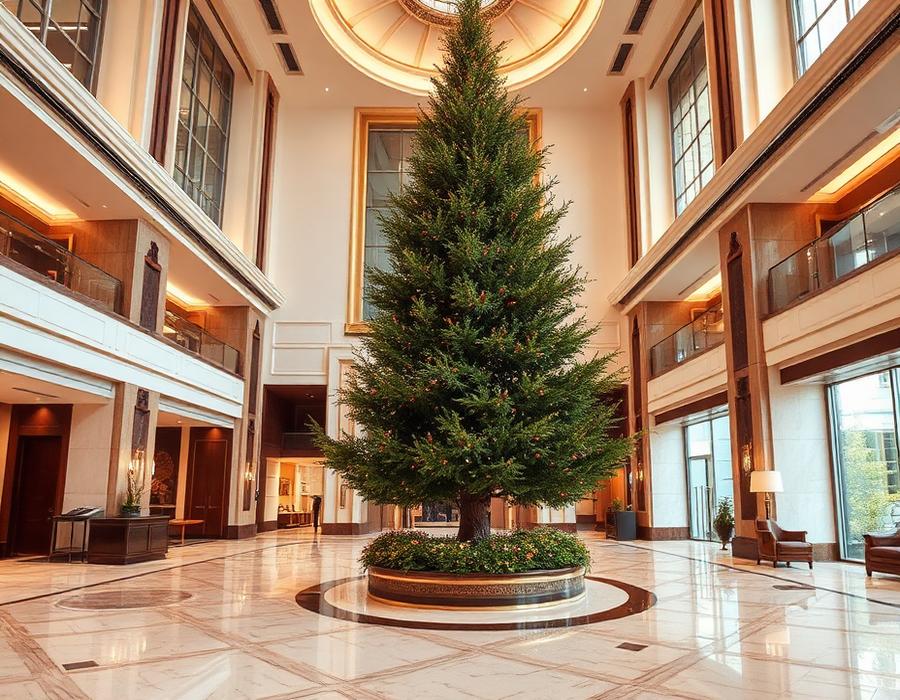
Scale and documentation, mainly. A residential tropical corner runs a handful of plants at 4 to 9 ft; a hotel lobby, resort atrium or restaurant feature typically specifies one or two trees at 9 ft or taller, in glass-fibre trunks built for the traffic and sightlines a public space demands - the 9 ft commercial coconut palm on a glass-fibre trunk runs $2,787.99 to $6,291.99 CAD. Fire and safety documentation also becomes a live question at that scale: request certification and compliance paperwork from every supplier, ours included, through the quote process, since the local fire authority having jurisdiction is who ultimately decides what a given space can install. Sizing method, planter proportions and cleaning schedules for lobby-scale trees are covered in artificial trees for hotel lobbies.
Frequently asked questions
Why do tropical plants look more obviously fake than other artificial styles?
Palm fronds and broad monstera leaves have simple, regular shapes with no irregular canopy to hide flaws in, unlike a fussy olive or ficus. Frond arc, leaflet spacing and leaf-vein detail show immediately if they are done cheaply. Judging trunk and frond realism before buying, covered in our palm buying guide, matters more for tropical species than for almost any other style.
Can real tropical plants survive a Canadian winter indoors without a humidifier?
Not comfortably. Health Canada's indoor guidance targets 30 to 50 percent relative humidity, sitting toward the low end once winter heating starts, while reference charts put a species like monstera at 60 to 80 percent. That gap is why real tropical foliage commonly drops leaves or browns at the edges from November through March in heated Canadian homes.
How many plants make a convincing tropical corner?
Three, staggered at three different heights, is the working formula: one tall palm for verticality, one broad-leaf plant such as monstera or dracaena at mid-height, and one wide floor piece such as a banana plant at the base. Lining plants up at the same height reads as furniture staging rather than a planted composition.
Is it safe to leave an artificial palm or monstera in direct sun on a patio?
Only if the listing states the piece is UV-resistant. Standard indoor tropical foliage, including most palms and all monstera in our range, bleaches and turns brittle within a season of direct sun. Only pieces stated as UV-resistant, such as our 5 to 6 ft palm and banana tree, are recommended for full poolside or patio sun.
Should I add a flowering plant to an all-green tropical grouping?
Only in a calm room. A single flowering accent, such as bird of paradise, works when the wall colour, flooring and other furnishings are neutral enough to let one bloom colour stand out. Adding two or more flowering species to the same grouping tends to read as a floral display rather than a planted tropical corner.
Checked 29 August 2026. Eververda prices are CAD and current as of that date; external figures are cited with their own source and date above.