

Artificial Plants for Senior Living and Healthcare Interiors
29 August 2026
Retirement residences, long-term care homes, clinics and hospital-adjacent spaces face a narrower set of choices for interior greenery than a hotel lobby or an office does. Many care areas restrict or avoid live plants outright, watering and soil upkeep is labour few care staff have spare time for, and corridors have to stay clear for wheelchairs, walkers and equipment. Artificial plants sidestep the infection-control, labour and mobility issues at once, provided the piece is specified correctly: a weighted or anchored base, wipeable PE foliage rather than fabric, no small parts that can detach, and a form that keeps sightlines and turning space open. A 4-6 ft fiddle leaf fig with a weighted base runs $319 to $449 CAD, and a 5-6 ft cherry blossom on a four-trunk cement pot is $469 to $529 CAD, both stable enough for a lounge or reception corner. This guide covers why live plants are limited in care settings, what a resident-safe specification looks like, and retail pieces versus quoted commercial fit-outs.
Why do care facilities restrict or avoid live plants indoors?
The clearest documented rule comes from the CDC's Guidelines for Environmental Infection Control in Health-Care Facilities, developed with the Healthcare Infection Control Practices Advisory Committee (HICPAC). Its section on flowers and plants in patient-care areas states that potted plants and flowers "need not be restricted" from areas serving immunocompetent patients, but for patient-care areas serving immunosuppressed patients the guidance is direct: "Do not allow fresh or dried flowers, or potted plants" (Category II recommendation; page last reviewed by CDC 11 January 2024, checked 29 August 2026). The same guidance recommends that any plant care in areas where it is allowed be handled by staff not directly involved in patient care, or with gloves and hand hygiene afterward if care staff must do it.
That rule is written for hospitals and other health-care facilities rather than for every retirement residence, and a facility's own infection-control policy — not this article — decides what applies to a given unit. Older infection-control literature has separately documented potted-plant soil and flower-vase water as reservoirs for mould and bacteria in clinical settings, including a 1973 Lancet study and a 1989 Mycopathologia study, both still cited in training material decades on though neither is current research. Soil and standing water are a long-documented concern in clinical areas; the applicable rule depends on the unit, and the operator's infection-control lead is the person to confirm it.
Labour is the other reason live plants lose out where they are permitted. Watering, repotting and pest checks are a standing task that has to sit on somebody's schedule, and in a staffing model built around resident care rather than horticulture, that task tends to slip until a plant visibly fails. Artificial foliage removes it rather than scheduling around it — no watering rota, no soil, no standing water.
What is the toxicity risk from live plants, and does it apply to artificial ones?
A number of common houseplants are toxic if ingested — a University of Connecticut Home & Garden Education Center factsheet on safe and toxic houseplants (revised 2016, checked 29 August 2026) names philodendron, dieffenbachia, oleander, English ivy and calla lily among them. That risk sits with the live species and its foliage, and it is a live consideration for units serving residents who may put objects in their mouths for reasons unrelated to the plant, which is a care-plan matter for clinical staff, not something this article assesses.
Swapping in plastic does not make ingestion a non-issue: PE and PVC leaves are not manufactured or tested as edible-safe, and a piece with beads, felt fruit or wired stems carries its own mouthing and choking risk regardless of plant toxicity. The specification response is one moulded or securely bonded unit, no loose decorative fruit or wired accents, and placement away from areas where a resident is unsupervised and prone to handling objects closely.
How much clearance does a corridor or lounge need around a floor plant?
Two figures set the floor. ADA accessibility standards call for a minimum clear width of 32 in for a single wheelchair at a point, 36 in continuously, and either a 60 in circular or T-shaped turning space to reverse direction (U.S. Access Board, checked 29 August 2026). Separately, the 2012 edition of NFPA 101, the Life Safety Code governing health-care occupancies, sets a minimum 8 ft corridor width and permits fixed furniture only if secured to the wall or floor on one side, leaving 6 ft clear, as summarized by a trade publication (Healthcare Facilities Today, checked 29 August 2026). The exact figures a building must meet depend on the code edition its authority has adopted, so treat these as the general pattern rather than a number to quote at an inspector.
CDC's STEADI home fall-prevention checklist states the underlying principle plainly: "Always keep objects off the floor" (2017). A floor plant that sits inside the required clearance rather than narrowing it is consistent with both the figures above and that principle — a furnishing-placement decision, not a claim that the plant itself changes anyone's fall risk. In practice, measure the corridor before ordering: a wide flared pot base eats into clear width differently than the same canopy on a narrow weighted base.
| Facility consideration | Live plants | Artificial plants, specified correctly |
|---|---|---|
| Watering and soil upkeep | Standing weekly task; soil and standing water require ongoing management | None — no soil, no water to manage |
| Restricted-area policy | May be disallowed in immunosuppressed patient-care areas per CDC/HICPAC guidance | No living tissue, soil or standing water for that guidance to apply to |
| Species toxicity if ingested | Varies by species; some common houseplants are toxic | No plant toxins; specify one-piece construction with no small detachable parts |
| Stability in a busy corridor | Pot weight varies by species and container | Weighted or anchored base sized to the piece, matched to expected traffic |
| Cleaning method | Dusting plus routine plant care | Wipe down with a damp cloth; no specialist care required |
What should a resident-safe specification require?
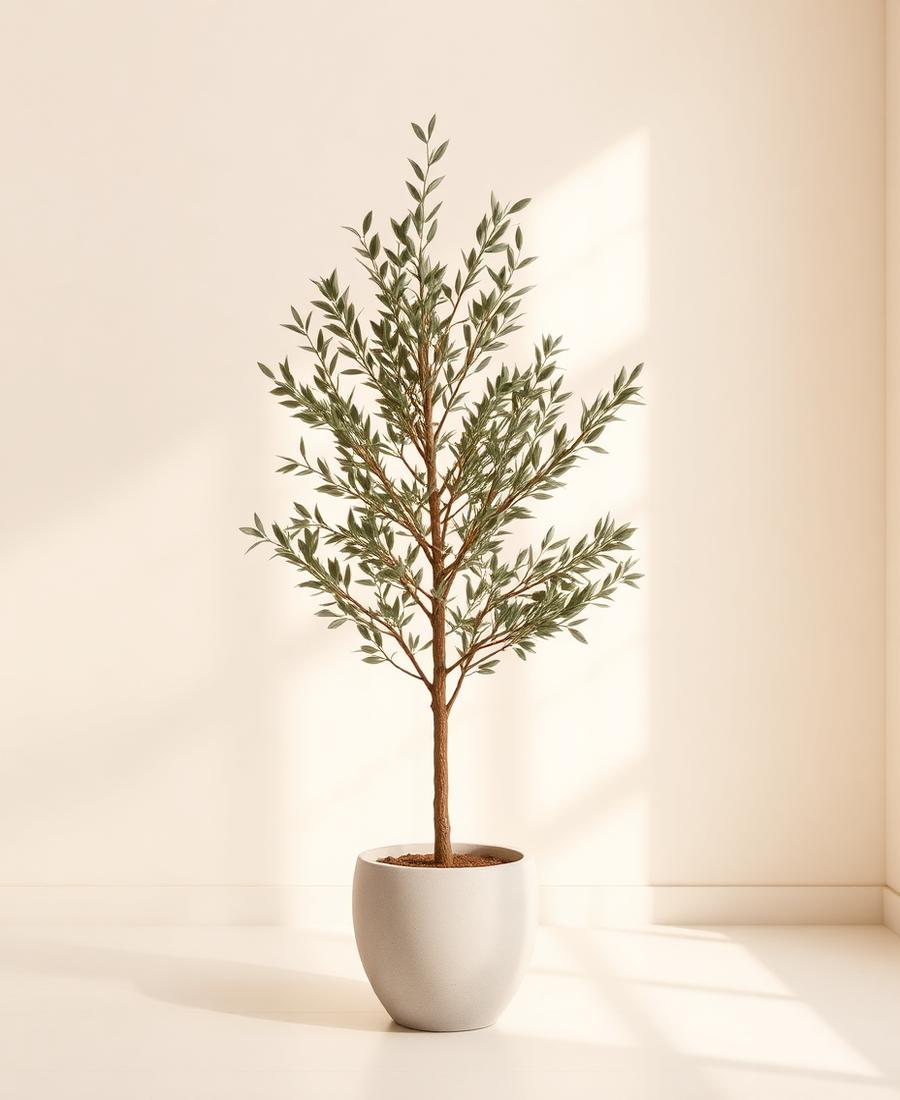
Four points cover most of it. A weighted or anchored base should be heavier, or more securely fixed to floor or wall, than the visible canopy suggests — cement-filled bases and anchor brackets are the two common approaches, mattering more in a corridor with mobility-aid traffic than a still corner; a 3.5 ft cedar topiary on a carbon-steel trunk and cement base, $519 CAD, shows the construction to look for. Wipeable PE foliage sheds a wipe-down the way silk fabric cannot — a 4-6 ft olive tree in PE foliage on stainless-steel branches is $199 to $329 CAD. No small detachable parts means skipping loose berries or wired accents a hand can pull free. And clear sightlines mean keeping foliage below sightline height in corridors, or well back from the walking line.
How does dementia-friendly design affect where plants go?
Design guidance for dementia care, rather than clinical research, is the right register here. brainXchange, a Canadian design-and-dementia community of practice, names plants among objects that "create continuity with home or past life experiences" in a care setting, alongside books and music, and recommends corridors that are "clutter-free, with few decision points" and "clearly visible endings" (brainXchange, 2013, checked 29 August 2026). These are design-practice statements, not claims about what plants do for health or cognition — the takeaway is to place foliage as a landmark at a junction rather than scattered along a walking route, and out of the sightline down a corridor.
What fire documentation should a care facility request?
Fire performance matters more in a care setting than in most commercial interiors, because evacuation is slower and often needs staff assistance. Eververda does not claim any product is fire-certified or code-compliant — the local authority having jurisdiction (AHJ) decides that, against whichever code edition it has adopted. In Canada, the reference standard for decorative fabrics and films is CAN/ULC-S109, and provincial fire codes set which occupancy classes it applies to; in the US, NFPA 701 is the equivalent. Request written fire-performance documentation for the specific product from every supplier, ours included, through the quote process, and confirm applicability with your fire code consultant and the AHJ before installation. The full breakdown of what these standards test is in our guide to fire ratings and commercial artificial greenery.
Retail pieces or a quoted commercial fit-out — which fits a care facility?
A single piece for a reception desk or a resident lounge corner is an ordinary retail order: the fiddle leaf fig, cherry blossom and olive tree above carry plain CAD prices and ship without a quote step. Furnishing every corridor junction, dining room and common area across a multi-floor residence is commercial-scale work, and Eververda's commercial catalogue covers it: a 6-8.5 ft UV-resistant dracaena starts from $1,246.99 CAD for a dayroom, a large ficus-banyan floor tree starts from $2,787.99 CAD for an atrium, and a fiberglass-trunk clusia tree for hospitality-scale interiors is quote-priced. Orders above $3,000 CAD go through Eververda's quote process, so freight, crating and room-by-room delivery scheduling are planned per project rather than per order.
Frequently asked questions
Can a retirement residence or long-term care home have live plants at all?
It depends on the unit and the facility's own infection-control policy. CDC/HICPAC guidance says potted plants and flowers need not be restricted in areas for immunocompetent patients but should not be allowed in patient-care areas for immunosuppressed patients. Whether a specific retirement residence or care unit applies that rule, or a stricter one, is a decision for the operator's infection-control lead, not a general rule this article can state for every building.
Do artificial plants need any watering or plant-specific maintenance?
No. There is no soil, no watering schedule and no standing water to manage. Maintenance is limited to an occasional damp-cloth wipe-down, which is the main reason artificial foliage removes a task that live plants add to an already busy care-staff schedule.
Is any part of an artificial plant a safety risk for residents?
Artificial foliage is not manufactured or tested as edible-safe, and pieces with loose beads, felt fruit or wired accents carry a mouthing and choking risk regardless of plant toxicity. Specify one-piece moulded or securely bonded construction, skip loose decorative trim, and keep placement away from areas where a resident is unsupervised and prone to handling objects closely.
How much clear floor space should be left around a floor plant near a corridor?
ADA standards call for at least 32 in of clear width at a point (36 in continuously) for a single wheelchair, and a 60 in circular or T-shaped turning space to reverse direction. Health-care corridors under the 2012 edition of NFPA 101 are set at a minimum 8 ft clear width, with fixed furniture required to leave 6 ft clear — measure the specific corridor and code your building follows before ordering.
What kind of base keeps a tall artificial tree from tipping in a busy hallway?
Look for a base that is weighted — typically cement-filled — or anchored to the floor or wall with brackets, heavier or more secured than the canopy size suggests it needs. That matters more in corridors carrying wheelchair, walker and cart traffic than it does in a still corner, where a bump is far more likely to reach the piece.
External facts in this article were checked 29 August 2026. Eververda prices are CAD and current as of 29 August 2026.