
Artificial Trees and Greenery for Churches and Worship Spaces
29 August 2026
Churches, mosques, synagogues, temples and community halls share a set of building constraints that a hotel lobby or a retail store does not: maintenance is done by volunteers between other commitments, not by paid staff on a schedule; the building is often used hard for a few hours on a few days a week and stands empty and unheated the rest of the time; sanctuaries and prayer halls are frequently double-height, built at a scale that dwarfs a normal 6 to 7 ft floor plant; budgets are tight and furnishings are often donated rather than purchased new; and many of these buildings are heritage-listed, which usually means nothing can be screwed, nailed or anchored into the original walls or floor. Artificial greenery suits this combination well: it needs no watering rota and tolerates a cold, empty building between services without wilting, provided the piece is sized to the room, kept clear of sightlines and aisles, and stored properly between seasons. This guide covers sizing for tall interiors, sightlines and egress, seasonal storage and rotation, fire documentation for assembly-occupancy buildings, and specific pieces for entrances and platforms.
Our position on fire documentation. Eververda publishes a fire figure only where documentation exists for that specific piece, and describes nothing as "fire rated". On a commercial quote we establish the occupancy, the adopted code edition and what your authority having jurisdiction (AHJ) will accept as documentation, in writing, before the order. Where no documented route exists for a piece, we say so and set out the alternatives. We do not claim a certificate for any product.
Why does greenery in a worship space need different specs than an office or hotel lobby?
The building pattern is different from almost anywhere else artificial greenery gets specified. A church, mosque, synagogue or temple is typically staffed by volunteers rather than a facilities team, so anything needing a watering rota, a feeding schedule or a repotting cycle is a task nobody has claimed. The building itself runs on an intermittent schedule: full for a service or festival, then empty with the heating often turned down between, a swing live plants tolerate poorly but artificial foliage does not notice. Furnishings are frequently donated in mixed batches rather than bought as a coordinated set, and the budget rarely has a line item for decor, so a piece needs to do its job for years, not one season. A meaningful share of these buildings also carry a heritage designation, which typically means no permanent fixings into original walls, floors or ceiling fabric: greenery has to work as a freestanding or weighted-base piece, not something wall-mounted or bolted down.
How do you size greenery for a sanctuary that is two or three storeys tall?
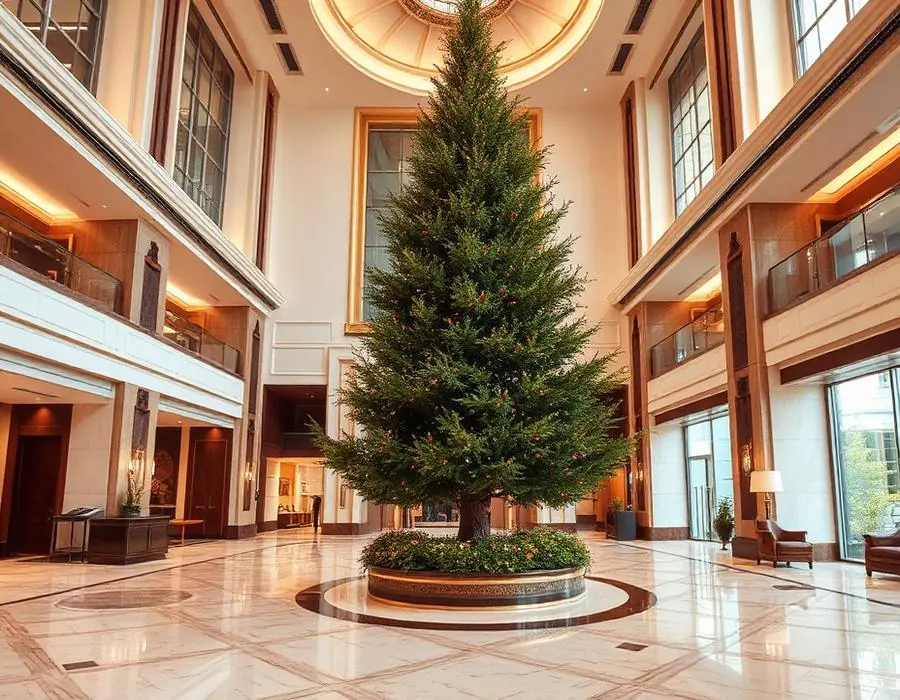
A tree sized for a living room or a standard 8 to 9 ft office ceiling reads as small and lost against a sanctuary, nave or prayer hall built with a double-height or vaulted ceiling: the same piece that anchors a corner at home disappears against 20 or 30 ft of open space. Flanking an entrance, altar rail, bimah, minbar or platform edge calls for a genuinely large specimen or a matched pair scaled to the architecture, not a residential-size tree pushed to do a commercial job. For entrance thresholds and platform edges at a moderate scale, options include a 6.56 ft cedar pine bonsai on a natural-look trunk at $1,246.99 CAD, or the same silk pine bonsai form built up through landscape-feature sizing from $547.99 to $4,889.99 CAD, which lets a committee choose entrance scale or platform scale from one product line rather than mixing suppliers. Where the space genuinely needs a tree that reads at 12 to 15 ft or more, a true double-height sanctuary or a cathedral-scale nave, that is the specification covered in Eververda's guide to large-scale artificial trees, including what changes in trunk construction, base weight and shipping once a piece passes about 8 ft.
How do you keep large pieces clear of sightlines and exits?
The first sightline test is simple: stand in the back row and confirm nothing (tree canopy, planter, or a pair of flanking pieces) cuts across the view to the front, the reading stand, the ark, the minbar or wherever attention is meant to go. Do that check from several seats, not just the centre aisle, since a piece that clears the middle can still block a side pew or a wheelchair-accessible row. The second test is aisles and exits: nothing goes in a path of egress, and exit clearance width is not a number this article can state for a given building. It is set by the local Authority Having Jurisdiction (AHJ) under the applicable provincial or state fire and building code, and it varies by occupant load, aisle configuration and the building's own approved layout. Confirm clearance with whoever holds the building's occupancy permit or fire inspection file before placing anything permanently.
How do you handle greenery that only comes out for Christmas, a harvest festival, or a specific season?
Congregations and community halls tend to reuse the same seasonal pieces for years rather than buying fresh decor annually, which makes storage and rotation discipline worth more than the purchase price. Foliage stores best packed loosely rather than crushed flat, kept out of damp basements and unheated attics where humidity cycles fade colour and stiffen leaves faster than the material's design life, and labelled by piece so the same volunteer team is not re-learning the assembly sequence every year. A garland or wreath flattened in a bin for eleven months looks noticeably worse by its third season than one stored loosely. For the fuller timeline (when to start planning, order, install and pack away a seasonal display around a fixed date like Christmas), Eververda's business Christmas installation timeline lays out the schedule a volunteer committee can work from months ahead rather than the week before. The same rotation logic behind commercial seasonal decor generally, covered in Eververda's guide to seasonal decor for hospitality spaces, applies just as directly to a fellowship hall or community room reusing the same pieces every year.
What should be checked on documentation for greenery in an assembly-occupancy building?
A church, mosque, synagogue or temple is typically treated as an assembly occupancy, the same classification applied to theatres and banquet halls, and your AHJ confirms how your own building is classified. That classification is why decorative greenery in a place of worship gets more fire-code attention than the same piece would in a private home: inspectors and insurers treat assembly occupancies as higher-scrutiny spaces by design. Ontario's Fire Code (O. Reg. 213/07, Division B, Article 2.3.2.1) requires drapes, curtains, netting and other similar or decorative materials, including textiles and films, to meet CAN/ULC-S109 in listed locations, a lobby or exit among them. The Code does not mention artificial trees or vegetation by name, so applying it to a tree rests on a broad reading of “other similar or decorative materials”. Outside Ontario, confirm the code in force with your AHJ. In the United States, the International Fire Code accepts either NFPA 701 (Test Method 1 or 2) or NFPA 289 (20 kW ignition source, 100 kW maximum heat release rate) for artificial vegetation, at Section 807.4.1 from the 2018 edition onward; it was Section 806.2 in the 2015 edition, which some jurisdictions still run. No product is unconditionally safe in a fire, and no supplier, Eververda included, should be taken at their word on a compliance claim. Ask any supplier what documentation actually exists (for our listings, ask through the quote process and we will tell you what, if anything, the manufacturer can provide), confirm which standard and edition it was tested to, and check with the building's fire inspector or AHJ on what that specific building requires, since requirements vary by jurisdiction. Eververda's guide to fire documentation for commercial artificial greenery covers what these standards actually test and how to read a supplier's documentation.
Which pieces work well for entrances, platforms and fellowship halls?
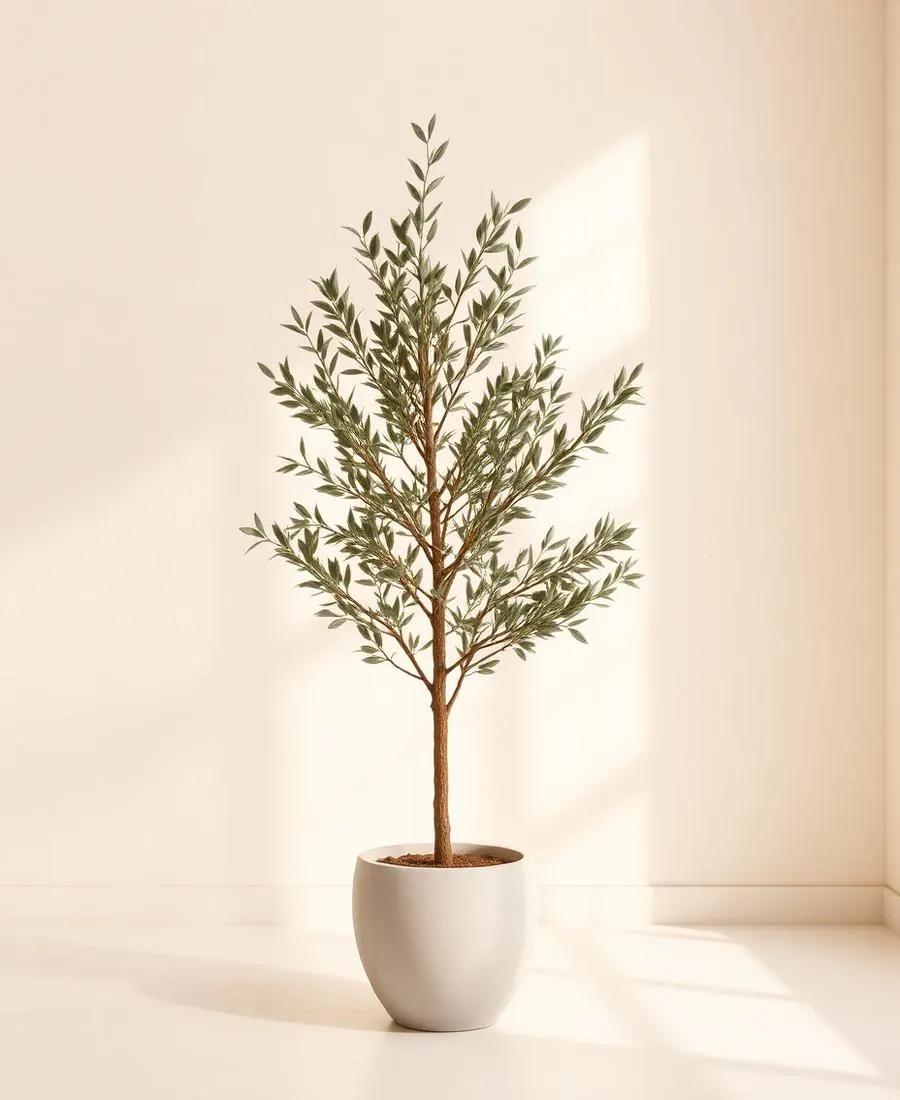
For flanking a main entrance or a platform edge with a matched pair, a set of two cedar topiary balls, 17 to 23 in is priced from $249 CAD and reads as a formal, symmetrical accent without towering over a doorway. A step up in height, an artificial cedar topiary tree, 3 to 5 ft, on a carbon-steel trunk and cement base is priced from $329 CAD, and the cement base matters specifically for a heritage building since it stands freestanding rather than needing anything fixed to the floor. For softening a plain wall or backing a table or lectern without touching the building fabric, a boxwood-style panel, anti-UV runs from $127.99 CAD and can be framed or leaned rather than mounted. For a foyer or narthex, an olive tree, 5.25 to 8 ft, with counted silk foliage is $249 to $449 CAD, sized for a normal-height doorway rather than a full sanctuary. For platform or altar-area scale where the ceiling calls for something larger, three commercial pieces are quote-priced rather than listed at a fixed number, since size, trunk finish and base all vary by installation: an artificial cedar tree with a natural wood trunk, a 14 ft indoor pine built for tall interiors, and a 4.5 m cypress tower on a natural wood trunk for an outdoor entrance or courtyard. All three are quote-priced; get a number through Eververda's quote process rather than assuming a list price applies.
| Placement | Typical piece | Price | Fixing needed |
|---|---|---|---|
| Entrance, flanking a doorway | Cedar topiary balls, set of 2 | From $249 CAD | None, freestanding pair |
| Entrance or platform edge | Cedar topiary tree, 3 to 5 ft, cement base | From $329 CAD | None, weighted base |
| Foyer or narthex, moderate scale | Olive or fiddle-leaf-fig tree | $199 to $1,019 CAD | None: potted, some weighted |
| Wall or backdrop, heritage-safe | Boxwood-style panel | From $127.99 CAD | None: leaned or framed, not mounted |
| Platform, altar area, tall sanctuary | Commercial cedar, pine or cypress, 3 to 4+ m | Quote-priced | Confirmed at quote stage |
Frequently asked questions
Who decides how much aisle and exit clearance a worship space needs?
The local Authority Having Jurisdiction, applying the province's or state's fire and building code to that specific building's occupant load and layout. This article cannot state a clearance number that applies everywhere; confirm placement with whoever holds the building's fire inspection or occupancy file before any large or paired piece goes in permanently.
Can artificial greenery be fixed to a heritage-listed building's walls or floor?
Usually not without separate heritage permission, and often not at all. Most heritage designations restrict permanent fixings into original wall, floor or ceiling fabric, which is why freestanding pieces with a weighted or cement base, rather than anything wall-mounted or bolted down, are the safer default in a listed building.
Does a volunteer-run building need any ongoing care for artificial greenery?
Very little. There is no watering, feeding or repotting cycle to schedule. Maintenance is an occasional damp-cloth wipe and, for seasonal pieces, careful packing when they come down, which protects the piece for reuse far more than any care it needs while on display.
Is any artificial greenery certified for fire safety in a church or similar building?
No product, from Eververda or any other supplier, should be described as certified in the abstract. The Ontario Fire Code cites CAN/ULC-S109 for decorative materials in listed locations, and the International Fire Code accepts NFPA 701 or NFPA 289 for artificial vegetation; ask any supplier what documentation actually exists and confirm with the building's fire inspector what that particular building requires.
What size tree actually reads as full-scale in a double-height sanctuary?
It depends on the ceiling height and viewing distance, but a piece under about 6 to 7 ft generally disappears in a genuinely double-height space. For sanctuaries with 12 ft-plus ceilings, a large-format tree specified for that scale, covered in Eververda's guide to large-scale artificial trees, is usually the better fit than a residential-size piece.
Do quote-priced commercial trees cost more than the listed retail line?
Not necessarily more per foot, but the final number depends on height, trunk finish, base construction and delivery, which is why these pieces are quoted rather than listed at one fixed price. A quote also lets a committee confirm the piece against the specific ceiling height and placement before committing budget.
External facts in this article were checked 29 August 2026. Eververda prices are CAD and current as of 29 August 2026. Fire code text was verified against the publishers' own published text on 24 October 2026.
Products in this article
- Tall Artificial Cedar Pine Bonsai Tree Green 2 m (6.56 ft)$1,246.99 CAD, quoted
- Silk Pine Bonsai Tree for Landscape Feature Displays$547.99 CAD to $4,889.99 CAD
- Artificial Cedar or Eucalyptus Topiary Balls, 17 to 25 in, Set of 2$249 CAD to $769 CAD, quoted
- Artificial Cedar Topiary Trees, Set of 2, 3 to 5 ft, Carbon Steel Trunk with Cement Base$329 CAD to $769 CAD, quoted
- Boxwood Fence Artificial Plant Panel Anti UV$127.99 CAD, quoted
- Artificial Olive Tree, 5.25 to 8 ft, Silk Leaves with Fruit, Black Pot$249 CAD to $449 CAD, quoted
- Artificial Cedar Tree, 13 to 20 ft (4 to 6 m)$4,738.99 CAD to $7,551.99 CAD
- Artificial Pine Tree, 14 ft (4.3 m), Natural Look$6,990.99 CAD, quoted
- 15 ft Cypress Tower Tree Natural Wood Trunk Outdoor$6,291.99 CAD