
Artificial Greenery for Condo Amenity Floors and Coworking Spaces
29 August 2026
A condo party room, a rooftop terrace, a coworking floor and a residential lobby share one thing a private office or a single apartment does not: nobody who uses the space owns it, and nobody in it was hired to water plants. That drives almost every decision below: who authorizes the purchase, why live planting fails, the durability spec unsupervised space needs, how a rooftop changes the UV and wind calculation, what a coworking floor needs that a private office does not, and how often the result gets cleaned. For single-office fit-outs, see specifying artificial plants for an office fit-out and the best artificial plants for windowless offices; for hotels, see artificial trees for hotel lobbies. This piece covers the space in between: party rooms, gyms and lounges inside a residential building, rooftop terraces, coworking floors, and shared lobbies.
Our position on fire documentation. Eververda publishes a fire figure only where documentation exists for that specific piece, and describes nothing as "fire rated". On a commercial quote we establish the occupancy, the adopted code edition and what your authority having jurisdiction (AHJ) will accept as documentation, in writing, before the order. Where no documented route exists for a piece, we say so and set out the alternatives. We do not claim a certificate for any product.
Short version: shared amenity space needs weighted, anchored, wipeable pieces bought through a documented process, because the people who benefit from the greenery are never the people responsible for keeping it alive, watered or upright.
Who actually pays for greenery on a condo amenity floor or in a coworking space?
In a condominium corporation, the decision runs through the board, and the money comes from one of two pots. Ontario's Condominium Act restricts reserve fund money to "major repair and replacement of the common elements and assets of the corporation" (s.93(2), summarized by CCI-National, checked 29 August 2026), and reserve monies cannot be borrowed for operating costs (Shibley Righton Condo Law, 12 May 2023, checked 29 August 2026). A one-time greenery purchase is ordinarily an operating-budget or special-project line, not a reserve-fund draw, since it is furnishing rather than repair of an existing asset: confirm the classification with your property manager and accountant, since other provinces run their own condo legislation with broadly similar but not identical splits. A short mid-year budget resolves the same way regardless: raise common-element fees or levy a special assessment (CCI-National, checked 29 August 2026). None of that argues against the purchase. It argues for one clean quote at one board meeting rather than piecemeal buying.
A coworking operator has a simpler structure: no board, one operations manager who owns the decision, and the spend sits in operating expenses beside coffee and cleaning. The trade-off is margin, not governance: member seats are revenue per square foot, so greenery has to justify itself as part of the space people pay to sit in, not as an amenity nobody prices.
Why does live planting fail in shared amenity space?
Three reasons repeat everywhere. Nobody owns the watering: a resident waters their own apartment because it is theirs, but nobody feels responsible for the ficus in the party room, and the responsible property manager is not on-site daily. Contract cleaners are hired to vacuum and wipe surfaces, not to diagnose an underwatered fig or catch spider mites early. That is a horticultural skill outside a cleaning contract's scope. And a maintenance contract to plug that gap is a recurring line item to defend every budget cycle, on top of replacing the plant when it declines anyway. Artificial greenery removes all three at once: it needs cleaning, not care, and cleaning is already inside the janitorial contract.
What durability spec does unsupervised shared space actually need?
A plant in a party room or lounge gets knocked, leaned on, and occasionally climbed on by a child at a birthday party, with nobody supervising it the way a receptionist watches an office lobby. The spec that survives is narrower than a private room's:
- Weighted or cement bases, not loose pots. A 4 to 6 ft fiddle leaf fig with a black planter and weighted base runs $319 to $449 CAD and stays upright through a bump that would tip a light nursery pot: the physics and further anchoring is in stopping a tall artificial tree from tipping over.
- Wipeable PE foliage over silk. Shared space collects grease and dust faster than a private office, and moulded polyethylene wipes clean where fabric "silk" leaves absorb stains and fray.
- Nothing detachable. Loose branches or snap-in leaf clusters do not belong in an unsupervised room; fixed, moulded foliage on a solid trunk is the safer spec.
- No loose pebbles or stone top-dressing. Loose fill gets kicked and tracked into hallways: a slip and choking hazard a supervised office room does not have to weigh the same way.
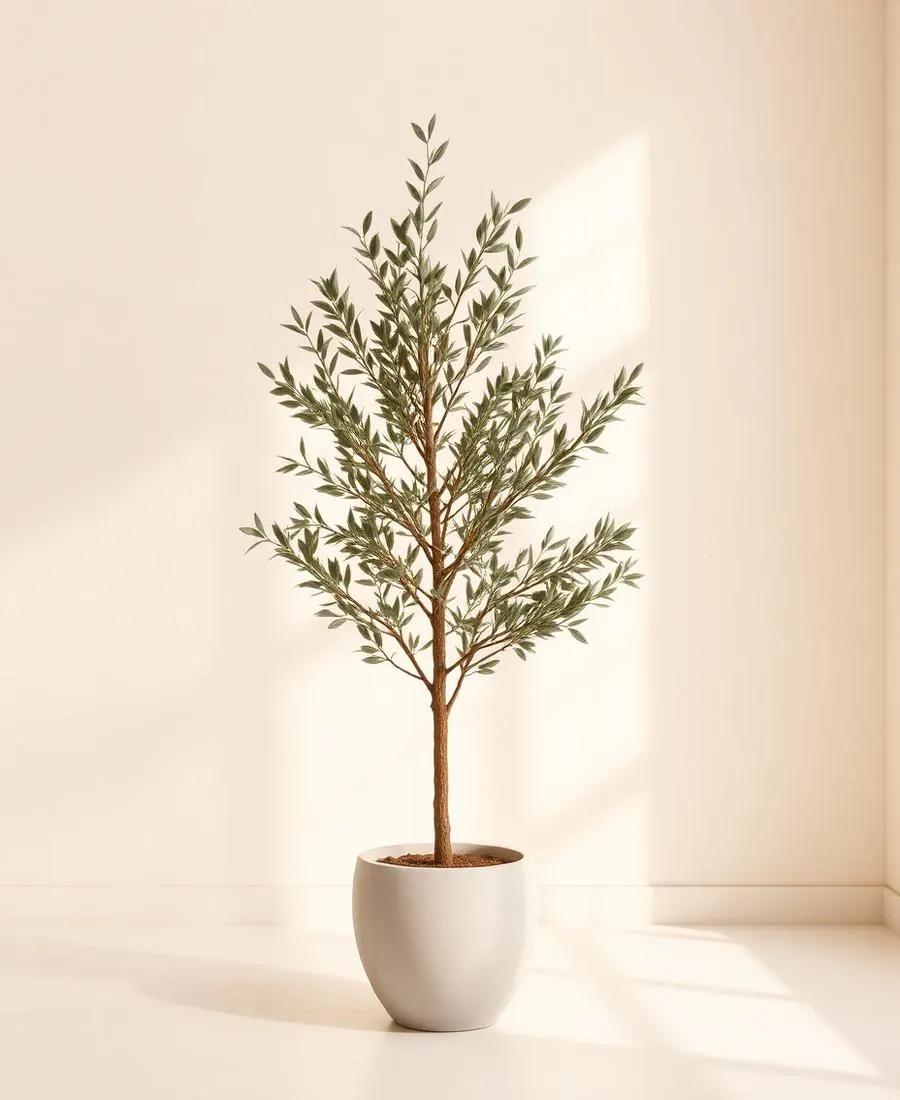
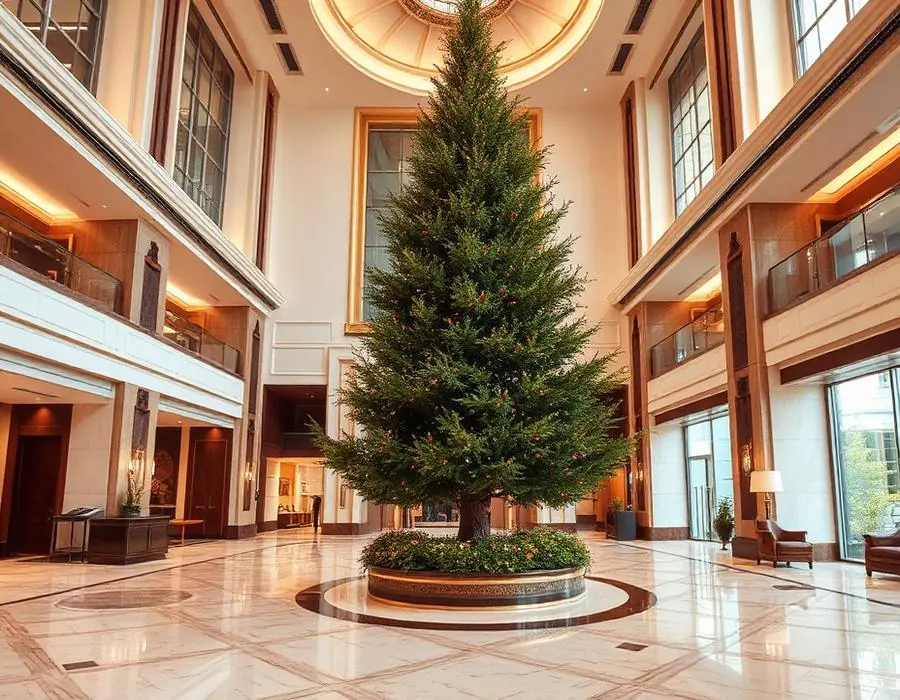
An olive tree, 5.25 to 8 ft, with counted leaves and fruit in a black pot, at $249 to $449 CAD, works as an anchor for a party room or lounge corner because it reads as a finished, styled object rather than a plant someone has to tend. A residential tower lobby wants the same logic scaled up: one weighted anchor sized to the ceiling rather than a cluster of small pots underfoot, and an 8.2 ft olive tree in bonsai form, at $1,807.99 CAD, carries its canopy above head height and out of the way of foot traffic.
What changes on a rooftop terrace or pool deck?
Two things change, and both are honesty questions, not styling ones. First, UV: only products the manufacturer publishes as UV-resistant belong on an exposed deck. A 5 to 6 ft palm with UV-resistant fronds is $293.99 to $374.99 CAD; a boxwood fence panel with anti-UV treatment is $127.99 CAD for railing screening. Standard indoor foliage fades and turns brittle under sustained sun and freeze-thaw cycling: the material science is in artificial plants outdoors through a Canadian winter, and the same logic holds for summer-only rooftop use. Do not put a piece listed for indoor use outside because the room looks bare; check the UV statement first.
Second, wind. A rooftop is a windier microclimate than ground level, and a full canopy on a tall trunk catches wind the way a sail does. That is a genuine anchoring question: taller, broader pieces need a heavier base at minimum, and on a high or exposed site the anchor may need to tie into the roof structure itself, a decision for the building's structural or property-management team, not a spec sheet. The same principles cover indoor tipping risk in our tipping-over guide; a rooftop just raises the stakes. For a large pool deck anchor at commercial scale, a 9 ft coconut palm in glass fibre, listed for commercial indoor/outdoor use, runs $2,787.99 to $6,291.99 CAD; an outdoor-use Washingtonia palm for larger decks is quote-priced through our commercial quote service.
What does a coworking floor need that a private office does not?
A single-tenant fit-out (covered in our fit-out guide) is specified once for one company's brand. A coworking floor has to work for whoever books the desk that day, which changes two things. It needs to read as a video-call backdrop for members on camera constantly: a fixed backdrop that does not depend on natural light or a tidy desk. A six-piece greenery wall panel set is $249 CAD for a backdrop wall behind a bank of desks; coverage math for larger walls is in our green wall panels guide. It also needs to zone an open floor without adding walls a lease usually cannot alter: tall pieces at intervals do the job glass partitions do elsewhere. A pair of golden cane palms, 4.5 to 9 ft, at $289 to $869 CAD, or an areca palm with a published leaf count, 4 to 6 ft, at $289 to $419 CAD, work as a repeatable zoning form.
What it does not do is anything measurable for sound. Decorative foliage is not an acoustic product, and we could not verify a manufacturer claim of measurable noise reduction from artificial plants. A real acoustic problem needs dedicated panelling or baffles; budget greenery as a visual and zoning tool only.
How often does shared-space greenery need cleaning, and who does it?
Shared space collects dust and grease faster than a private room, so a light wipe-down on the same schedule as the room's other high-touch surfaces is realistic (weekly in a heavily used lounge or coworking floor, monthly in a lower-traffic corridor), folded into the existing janitorial contract rather than a separate line item. PE foliage wipes down with a damp cloth; fabric "silk" foliage needs a lower-moisture approach and shows wear faster at this frequency, another reason PE is the better call for a shared room. Full method by material and scale is in our cleaning guide.
What fire documentation should a board or coworking operator ask for?
Greenery going into a residential building's common areas, or into an assembly-type room (a party room booked for events, a large lounge, a banquet-capable amenity space) sits in the category that gets fire-code scrutiny precisely because it is shared and unsupervised. That does not mean every piece needs paperwork; it means asking a supplier the right question before ordering. Ontario's Fire Code (O. Reg. 213/07, Division B, Article 2.3.2.1) requires drapes, curtains, netting and other similar or decorative materials, including textiles and films, to meet CAN/ULC-S109 in listed locations, a lobby or exit among them. The Code does not mention artificial trees or vegetation by name, so applying it to a tree rests on a broad reading of “other similar or decorative materials”. Outside Ontario, confirm the code in force with your AHJ. In the United States, the International Fire Code accepts either NFPA 701 (Test Method 1 or 2) or NFPA 289 (20 kW ignition source, 100 kW maximum heat release rate) for artificial vegetation, at Section 807.4.1 from the 2018 edition onward; it was Section 806.2 in the 2015 edition, which some jurisdictions still run. Ask every supplier what documentation exists for the specific product, and for our listings, ask through the quote process and we will tell you what, if anything, the manufacturer can provide: no supplier's word settles the question, since the building's local authority having jurisdiction (AHJ) decides what a specific room requires. What the standards actually test is explained in our guide to fire documentation for commercial artificial greenery.
| Amenity space | Who typically authorizes the buy | Durability priority | Example price tier |
|---|---|---|---|
| Party room / lounge | Condo board, operating budget | Weighted base, no detachable parts or loose top-dressing | $249 to $449 CAD |
| Rooftop terrace / pool deck | Condo board, often with a capital-project vote | UV resistance as published; anchored or heavy base against wind | $127.99 to $374.99 CAD; $2,787.99 CAD+ or quote-priced commercial |
| Building gym or fitness room | Condo board, operating budget | Wipeable PE against sweat and humidity: see our gyms and fitness studios guide | See linked guide |
| Coworking floor / hot-desk zone | Facilities manager, operating expense | Zoning form and a fixed video-call backdrop, not acoustic performance | $249 CAD panel set; $289 to $869 CAD floor pieces |
| Residential tower lobby | Condo board, operating or capital budget | Single anchor piece scaled to ceiling height, weighted base | $1,807.99 to $2,787.99+ CAD |
Frequently asked questions
Does a condo board need a special resolution to buy greenery for a party room?
Not usually: a routine furnishing purchase is ordinarily approved the same way as any operating-budget line item at a board meeting. That differs from a reserve-fund draw, which under Ontario's Condominium Act is restricted to major repair and replacement of common elements, not new furnishings. Confirm the classification with your property manager and accountant, since practice and provincial rules vary.
Can artificial plants stay on an exposed rooftop terrace year-round in Canada?
Only pieces the manufacturer publishes as UV-resistant, and even those age faster outdoors than indoors. Wind is a separate question from UV: a full canopy on an exposed deck needs a heavy or anchored base regardless of any UV claim. See artificial plants outdoors through a Canadian winter for the material detail.
Do artificial plants reduce noise in an open coworking floor?
We could not verify any manufacturer claim of measurable sound absorption from decorative artificial foliage, and it is not sold or specified as an acoustic product. Use it for zoning and visual backdrop; use dedicated acoustic panelling for an actual noise problem.
Do party rooms and amenity lounges need fire documentation for their greenery?
Ask the question rather than assume either way. Assembly-type rooms in residential buildings get fire-code scrutiny, and the local authority having jurisdiction decides what a specific room requires. Ask any supplier what documentation exists before ordering for these rooms: see our full guide to fire documentation for commercial artificial greenery.
Checked 29 August 2026. Governance facts cite CCI-National and Shibley Righton Condo Law on Ontario's Condominium Act; other provinces run their own condominium legislation with broadly similar but not identical rules. Eververda prices are CAD, current as of 27 September 2026. Fire code text was verified against the publishers' own published text on 24 October 2026.
Products in this article
- Artificial Fiddle Leaf Fig Tree, 4 to 6 ft, Black Planter with Weighted Base$319 CAD to $449 CAD, quoted
- Artificial Olive Tree, 5.25 to 8 ft, Silk Leaves with Fruit, Black Pot$249 CAD to $449 CAD, quoted
- 8.2 ft Faux Olive Tree Indoor$2,475.99 CAD
- Artificial Palm Tree, 5 to 6 ft, UV-Resistant Fronds, Black or White Pot$293.99 CAD to $374.99 CAD, quoted
- Boxwood Fence Artificial Plant Panel Anti UV$127.99 CAD, quoted
- Army Green Artificial Coconut Palm Tree 9.8 ft Glass Fiber$2,787.99 CAD to $6,291.99 CAD
- Artificial Washingtonia Palm Tree for Outdoor Use$3,209.99 CAD to $9,794.99 CAD
- Artificial Greenery Wall Panels, 6-Piece Set, 1.4 m² Coverage$249 CAD, quoted
- Artificial Golden Cane Palm, 4.5 to 9 ft, Single or Pair$289 CAD to $869 CAD, quoted
- Artificial Areca Palm Tree, 4 to 6 ft, 15 to 21 Leaves by Height$289 CAD to $419 CAD, quoted