
Where to Buy Realistic Artificial Plants in Canada
22 August 2026
This is a real question in Google's People Also Ask box, phrased almost exactly like that, and the reason it gets asked is that the Canadian market for artificial plants is genuinely harder to shop than the American one. Fewer specialists, higher prices, and a set of cross-border costs that are easy to trip over. Here is what is actually going on.
Where can I find real-looking fake plants in Canada?
Realistic artificial plants in Canada come from three places: specialist online sellers who focus only on artificial greenery, a small number of physical showrooms concentrated in the Toronto, Vancouver and Montreal areas, and the big-box and marketplace listings. The specialists are where the realistic product is; the big-box aisles are where the price is.
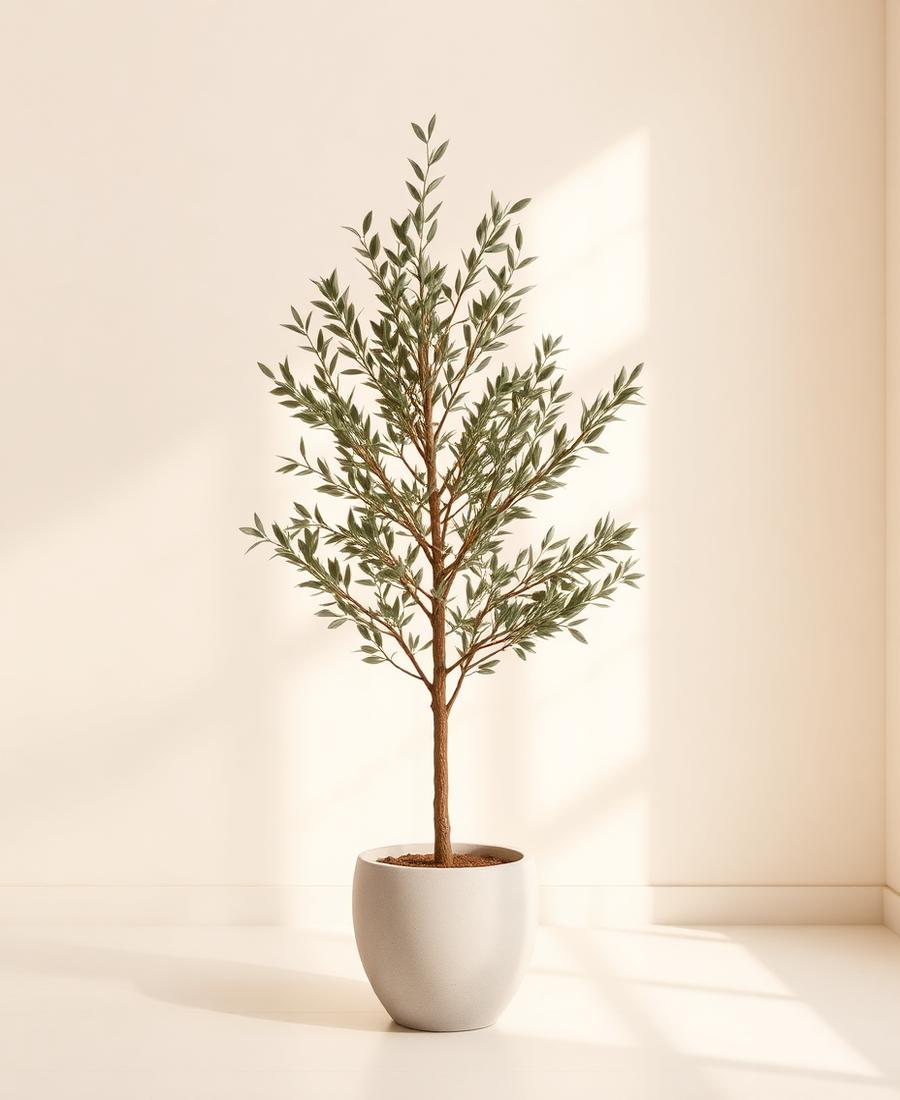
The practical shortcut is to sort by trunk construction rather than by retailer. If a seller publishes what the trunk is made of and what the canopy spread is, they are probably a specialist. If those specifications are absent everywhere on the site, you are looking at generic sourced stock, and realism will be a lottery. It is the standard we hold our own listings to: a 5.25 to 7 ft olive on a natural wood trunk runs $249 to $419 CAD, and the listing gives you the trunk material and the spread rather than a height and a photograph.
Why are fake plants more expensive in Canada?
Canadian prices for large artificial trees generally run well above American prices for comparable pieces, and it is not simply retailer margin. Three things drive it: the exchange rate on goods almost all imported and invoiced in US dollars, a smaller domestic market that means smaller order volumes and worse per-unit landed cost, and domestic freight over a very large country with a thin population.
That last one is the biggest and least visible. Which brings us to the thing that surprises most first-time buyers.
Why does shipping cost so much on a large tree?
Because large artificial trees are charged on dimensional weight, not actual weight. Carriers bill oversized parcels on the volume they occupy in a truck, and a 10 ft tree is a very long, very light box - the worst possible combination for freight pricing.
Once a box exceeds the standard parcel limits, usually somewhere around 108 inches in length or in length-plus-girth, it stops being a parcel and becomes an oversize or LTL freight shipment. The price step at that boundary is not gradual. This is why an 8 ft tree may ship at a normal-looking rate and a 12 ft tree of the same design costs several times more to deliver.
What to do with that information:
- Get the shipping cost before you commit, not at checkout on the final screen. On anything over 8 ft, ask directly.
- Check whether the quote is curbside or to-the-door. Freight carriers deliver curbside by default, which on a 12 ft box in a Toronto condo is a genuine problem.
- Ask whether a residential surcharge or a lift-gate fee applies. Both are common on freight and both are often added after the initial quote.
- Remote and northern postal codes attract significant surcharges. If you are outside a major metro, confirm rather than assume.
What happens if I buy from a US site?
You become the importer, and three separate costs can land on you after the order: duty, GST or HST, and a brokerage fee. The brokerage fee is the one that catches people, because it is charged by the courier rather than the government and it does not appear anywhere in the US checkout.
On duty, there is a widespread misconception worth clearing up. Buying from an American company does not make a shipment duty-free under CUSMA. CUSMA preference depends on where the goods were manufactured, not where the website is. The overwhelming majority of artificial plants sold in North America are made in China, so a US retailer shipping you a Chinese-made tree is shipping a non-originating good, and it is dutiable at the applicable rate.
On tax, GST or HST applies on import at your province's rate, calculated on the value of the goods plus duty plus freight - so you pay tax on the shipping too.
On brokerage, courier services charge a customs clearance fee on ground shipments, and on a large item it can be substantial. Canada Post charges a comparatively small flat handling fee; the private couriers charge on a sliding scale tied to shipment value. Rates and the low-value thresholds change, so check the current figures with the carrier and CBSA rather than trusting a number in a blog post, including this one.
The practical upshot: a US price that looks 30 percent better than a Canadian one frequently is not, once freight, duty, tax and brokerage land. Work out the delivered cost before comparing. And if something goes wrong, returning an oversized tree across the border is expensive enough that it is often not worth doing, which makes buying domestically worth a real premium on large items.
How the buying routes compare
| Route | Where it wins | The catch |
|---|---|---|
| Big-box and marketplace listings | Price - this is the cheapest route | Specifications are absent, so you are looking at generic sourced stock and realism is a lottery |
| Canadian specialists - online sellers, plus a small number of showrooms concentrated in Toronto, Vancouver and Montreal | The realistic product, with trunk material and canopy spread published; no duty or brokerage, and some list local pickup on large items | Higher sticker prices - the exchange rate, smaller order volumes and domestic freight are built in; get a freight quote before committing on anything over 8 ft |
| US retailers shipping to Canada | Sticker prices that can look 30 percent better | Duty on Chinese-made goods (CUSMA does not help), GST or HST on goods plus duty plus freight, a courier brokerage fee that never shows in the US checkout, and cross-border returns often not worth making on an oversize tree |
What to check before ordering a large artificial tree
Six things, and the first three are the ones people skip:
- Canopy spread, not just height. A broadleaf tree wants a spread of roughly half its height. A 10 ft tree with a 3 ft spread is narrow because narrow is cheaper to build.
- Trunk construction. Natural wood or cast fibreglass reads as real up close. Moulded plastic does not. If the listing does not say, assume moulded.
- Access route. Building entrance width, lift dimensions, stairwell turns. Large trees ship in long boxes and a tight landing can make delivery impossible.
- Pot diameter. Needed before you buy a decorative planter, so the tree actually drops into it.
- Lead time. Made-to-order large trees are commonly quoted in weeks. If a date matters, confirm it in writing.
- Return policy on oversize items. Many sellers exclude oversize freight from free returns. Read this clause specifically before ordering anything over 8 ft.
Buying in Toronto, Vancouver and Montreal
The three metros have the most options, and it is worth knowing that some Canadian sellers list local pickup or nearby delivery on large items. On a 12 ft tree, collecting it yourself can save more than the difference between two sellers' prices - if you have a vehicle that will take a box that long, which most people do not.
In Quebec, search terms behave differently and it is worth searching in French as well as English. Bare French terms pull a lot of European and North African results, so qualify with Quebec or Montreal, or use "haut de gamme" for the premium end. The Quebec-specific results are a genuinely different and largely local set.
How to spot a seller worth trusting
A few signals that cost nothing to check. Does the site publish real specifications - trunk material, canopy spread, pot diameter, weight - or only a height and a price? Does it state lead times honestly, including the long ones? Is there a Canadian address and a Canadian phone number, or only a contact form?
And be sceptical of scale claims. This category has a persistent problem with new websites claiming tens of thousands of installations, decades of heritage, or review scores with no verifiable source behind them. A young company saying so plainly is telling you more than an old-sounding story that cannot be checked.
Frequently asked questions
Do I have to pay duty on artificial plants ordered from a US website?
Usually, yes. CUSMA duty-free treatment depends on where the goods were manufactured, not where the website is, and the overwhelming majority of artificial plants sold in North America are made in China - so a US retailer shipping you a Chinese-made tree is shipping a dutiable good. On top of duty you pay GST or HST, calculated on the goods plus duty plus freight, and the courier usually adds a brokerage fee that never appeared at checkout.
Is it cheaper to buy an artificial tree from the US?
Frequently not, once the delivered cost lands. A US sticker price that looks 30 percent better than a Canadian one can be eaten by freight, duty, GST or HST and the courier's brokerage fee. And returning an oversized tree across the border is expensive enough that it is often not worth doing, which makes buying domestically worth a real premium on large items. Compare delivered cost, not list price.
What size of tree tips an order into freight shipping?
Somewhere around 108 inches in length or in length-plus-girth, a box stops being a parcel and becomes an oversize or LTL freight shipment, and the price step at that boundary is not gradual. That is why an 8 ft tree can ship at a normal-looking rate while a 12 ft tree of the same design costs several times more to deliver. On anything over 8 ft, ask for the shipping cost directly before you commit.
Can a large artificial tree be delivered to a condo?
Yes, but check the details first. Freight carriers deliver curbside by default, which on a 12 ft box in a Toronto condo is a genuine problem - confirm whether the quote is curbside or to-the-door, and whether a residential surcharge or lift-gate fee applies. Then measure the access route: building entrance width, lift dimensions and stairwell turns, because a tight landing can make delivery impossible.
How long do large artificial trees take to arrive?
Made-to-order large trees are commonly quoted in weeks rather than days, so if a date matters, confirm the lead time in writing before ordering. It is one of the checks people skip, along with the return policy on oversize items - many sellers exclude oversize freight from free returns, and that clause matters most on exactly the trees with the longest lead times.
We ship across Canada from a Canadian storefront, so there is no cross-border duty or brokerage on our orders. If you want to start with the range, artificial trees Canada is the full catalogue, artificial olive trees Canada is the most-asked-for species, and artificial plants Toronto and GTA covers the local selection. For a sense of where the residential pricing sits, a 4 to 7 ft fiddle leaf fig in a white planter with a weighted base is $219 to $399 CAD, and a golden cane palm from 4.5 to 9 ft, sold single or as a pair runs $289 to $869 CAD. Ask us about freight on anything over 8 ft before you order - we would rather quote it up front than surprise you.
Details on duty, brokerage and freight reflect the rules as commonly applied when this article was checked in August 2026. Eververda prices are CAD and current as of 28 August 2026.