
Are Artificial Plants Bad Feng Shui? An Even-Handed Answer
29 August 2026
Eververda sells artificial trees and plants, so read our answer knowing that. Feng shui practitioners do not agree with each other here, and we are not going to pretend they do or say which camp is correct — feng shui is a design and placement tradition, not something we can verify or endorse. One camp holds that living plants carry a growing, wood-element chi an artificial plant cannot supply. A second camp, practitioners working in actual client homes, holds that a healthy-looking artificial plant in a dark corner is better feng shui than a real plant dying there, and that intention and upkeep matter more than whether the leaf is silk or living. Both views come from named sources, checked 29 August 2026, represented below with no verdict of our own attached. Where we do have an opinion is the practical one: if a room genuinely cannot keep a plant alive — no window, a high shelf, a cold entryway, a house empty for weeks at a stretch — an artificial plant still looks healthy six months on, and every source below agrees that healthy-looking is the part that actually matters.
What does the traditional feng shui view say about artificial plants?
The traditional position ties plants to the wood element, one of five elements in classical feng shui, and specifically to growth. Lee Classical Feng Shui Online, checked 29 August 2026, states that live plants are "much preferred" because they actively "enhance chi" through air purification and vitality, and that the wood element carries "life, renewal, and softness" an artificial version does not generate. Anjie Cho, a feng shui teacher at the Mindful Design School, put it more narrowly to Livingetc (Amiya Baratan, 5 February 2025): "fake plants aren't bad feng shui," but a fake plant "will simply fail to impart the same qi as a living one" when plants are being used specifically to enhance a space's energy. Dee Oujiri, a feng shui strategist and biophilic designer, told the same publication that fake plants work well in bedrooms, bathrooms, and outdoor areas, but advised against the main door or entrance, wanting living "plant qi" at the threshold. None of these sources call artificial plants bad luck outright — they describe a lesser substitute in the rooms where a practitioner is actively cultivating energy.
What do practitioners who work with real homes actually recommend?
A second group of practitioners, writing from consulting practice rather than classical theory, reach a more permissive conclusion by starting from a different question: not "is it fake," but "is it dying." Amanda Gibby Peters, a feng shui consultant at Simple Shui, checked 29 August 2026, agrees that "living greens and fresh flowers have the most powerful chi because of their ability to grow," but argues that where a space cannot support a living plant, a well-kept artificial one is preferable to a struggling real one there. She treats personal reaction as a genuine factor too: if you love how a fake plant looks, "that beauty generates YOUR personal energy which is a good vibe multiplier." Her rules are to dust artificial plants regularly and replace one once it stops looking vibrant — she applies the same logic to dried flowers, which she calls dead and says give "zero nourishing energy," recommending against keeping them long-term.
Rachel of peace.love.feng shui, a practitioner of the School of Intention lineage, checked 29 August 2026, goes further on the comparison: a dying real plant is the worse outcome, because "they can die, which can bring negative energy into the space," while an artificial plant carries no such risk. She frames belief itself as load-bearing, writing that a person convinced fake plants are bad luck will experience them that way, "but if you love fake plants and keep them clean and in good condition, they won't bring you bad luck." She is specific about cleaning, warning that dust on artificial foliage "can trap stagnant Chi energy and stop it from circulating" — an artificial plant left dusty is treated as a lapse in the practice, not a neutral object.
Where do these sources agree, and where do they genuinely disagree?
They agree on more than the framing suggests: a dead or dying real plant is worse than a clean, healthy artificial one; dust and clutter interfere with the intent of placing any plant; and quality matters, since a convincing artificial plant is taken more seriously than an obviously synthetic one. They disagree sharply on one location: the entryway. Dee Oujiri advises against fake plants at the main door, wanting living qi concentrated there. Rachel recommends artificial plants at entryways for the opposite reason, calling the front door "the mouth of Chi" and treating a consistently healthy plant there as more useful than a real one struggling in a cold, low-light hallway. Neither source is wrong on its own terms; they apply different priorities to the same spot, a genuine, unresolved disagreement rather than a settled rule.
| Location | Traditional / wood-energy view | Practical / condition-first view |
|---|---|---|
| Main entryway | Avoid fake plants; keep living qi at the threshold (Dee Oujiri) | Good spot for artificial, called the "mouth of Chi," often too cold or dim for a real plant (Rachel) |
| Bedroom, bathroom, outdoors | Acceptable, secondary to entry and main living spaces (Dee Oujiri) | Acceptable; same cleaning and condition rules apply (Simple Shui) |
| Windowless room or office | Acceptable where live care isn't realistic (Nathalie Khouri) | Preferred over a real plant that will decline without light (Simple Shui; Rachel) |
| Dried or wilting flowers | Not addressed by the classical sources reviewed | Treated as dead energy; replace rather than keep past their prime (Simple Shui) |
| Sharp interior corners | Not addressed by the classical sources reviewed | A plant, real or fake, is a common softening tool; condition still applies (Rachel) |
When does an artificial plant make more practical sense than a real one?
This is the part we can speak to directly, because it is a plant-care claim, not a feng shui one. If a corner gets no natural light, sits under a heat vent or a cold draft, is above head height where watering means a stepladder, or is in a house or office empty for stretches at a time, a real plant there is fighting a losing battle regardless of tradition. An artificial plant does not solve for chi — we make no claim either way on that — but it solves the one thing every source above agrees matters: staying healthy-looking, indefinitely, where a living plant would not.
The gap between a convincing artificial plant and an obviously fake one is real, and it is the difference between a piece that reads as intentional and one that reads as a compromise. We cover the specific styling moves — trimming factory-straight stems, fluffing packed foliage, mixing leaf sizes so a canopy doesn't look uniform — in how to make artificial plants look real. Dust, fade, and the insect question that comes up before almost every purchase are covered honestly in do artificial plants get dusty, fade, or attract insects. Both matter here because the practitioner sources above tie a plant's condition, not its material, to whether it functions as intended.
How should an artificial plant be placed, based on what these sources say?
Strip out the entryway disagreement and the placement advice above converges on a short list. Keep foliage clean and free of visible dust, since more than one source treats dust as something that interferes with the point of having the plant there. Replace a piece once it stops looking full or healthy rather than leaving it out of habit — the same rule Simple Shui applies to living plants. Use a plant, real or artificial, to soften a sharp interior corner rather than leaving it bare. And in a room with no natural light or inconsistent care, that is the spot where an artificial plant does exactly the job the practical-camp sources describe: staying presentable where a real plant would not. For a quieter, more sculptural alternative to a full leafy plant, our guide to Japanese-style artificial trees for a zen corner covers a related but distinct tradition built around restraint rather than fullness.
Which artificial plants hold up best for this kind of placement?
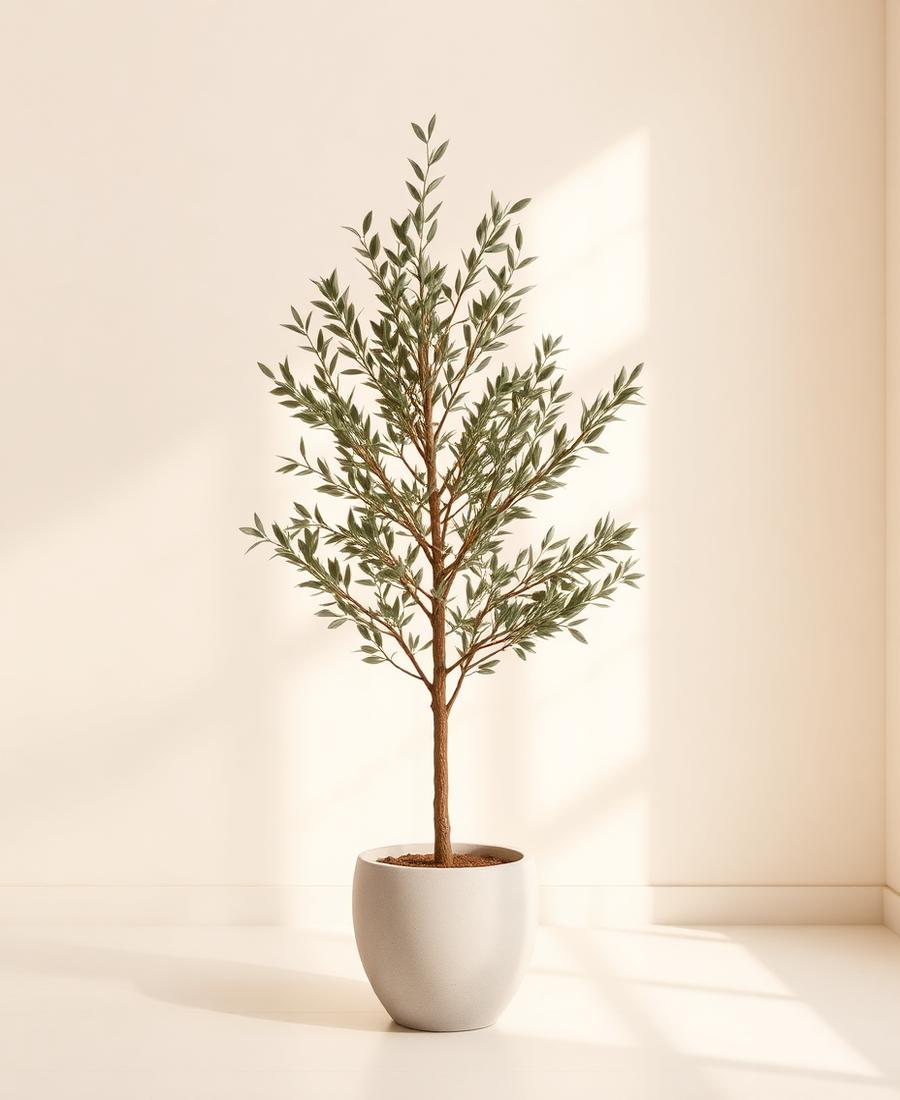
Every source above ties condition to whether an artificial plant reads as intentional, so the pieces worth buying are the ones that look genuinely full rather than sparse. A 4 to 6 ft fiddle leaf fig with a black planter and weighted base runs $319 to $449 CAD, with the broad, glossy-leafed presence of a well-tended plant. An olive tree from 5.25 to 8 ft with silk foliage and counted leaves, $249 to $449 CAD, has an open, mature branch structure that suits an entryway or corner without crowding it. For a rounder, denser leaf, a tall faux monstera floor plant is priced from $419.99 CAD, and a 5 ft rubber tree with full, glossy foliage from $547.99 CAD — both shapes have broad, unbroken leaves, which is exactly what shows thinning first on a lower-quality piece. A lifelike bamboo tree, from $547.99 CAD, suits the tighter, upright spots this kind of placement usually calls for. For a larger corner or a commercial entryway, a 7.2 ft podocarpus bonsai with a UV-resistant, lifelike trunk is $1,246.99 CAD and holds its shape without the seasonal upkeep a live bonsai that size would need. All prices are CAD, current as of 29 August 2026.
Frequently asked questions
Is it bad feng shui to have fake plants in the house?
Sources disagree. Lee Classical Feng Shui Online says living plants are preferred because they actively generate chi through growth; Simple Shui and peace.love.feng shui say a clean, healthy artificial plant is not bad feng shui and can be better than a real plant that's struggling. Neither camp calls fake plants bad luck outright.
Is a dying real plant worse feng shui than a healthy fake one?
According to practitioner Rachel of peace.love.feng shui, yes — a dying plant "can bring negative energy into the space," a risk an artificial plant doesn't carry. Simple Shui's Amanda Gibby Peters reaches a similar conclusion: where a space can't keep a plant alive, a well-kept artificial one beats a struggling real one there.
Where should I avoid putting fake plants, according to feng shui?
This is the one real disagreement among the sources checked. Strategist Dee Oujiri advises against fake plants at the main entrance, wanting living "plant qi" there. Practitioner Rachel takes the opposite view for that same spot, recommending artificial plants at entryways precisely because they're often too dim or cold for a real plant to thrive.
Do dried flowers count as good feng shui the way fresh or fake plants do?
No, according to Simple Shui's Amanda Gibby Peters, who describes dried flowers as dead and says they give "zero nourishing energy." She treats this differently from artificial plants, considered acceptable when clean and in good condition; her advice is to replace dried flowers rather than keep them long-term.
Does an artificial plant need regular cleaning for feng shui purposes?
Multiple sources say yes. Rachel of peace.love.feng shui warns that dust on artificial foliage "can trap stagnant Chi energy and stop it from circulating," and Simple Shui recommends regular dusting to keep an artificial plant's condition, and its function in the space, intact.
Feng shui sources checked 29 August 2026. Eververda prices are CAD and current as of 29 August 2026.